School of Mathematics and Statistics, The University of Melbourne, Parkville, Victoria, Australia.
MRC Centre for Global Infectious Disease Analysis, Department of Infectious Disease Epidemiology, School of Public Health, Imperial College London, London, United Kingdom.
PLoS Comput Biol. 2019 Jan 17;15(1):e1006568. doi: 10.1371/journal.pcbi.1006568. eCollection 2019 Jan.
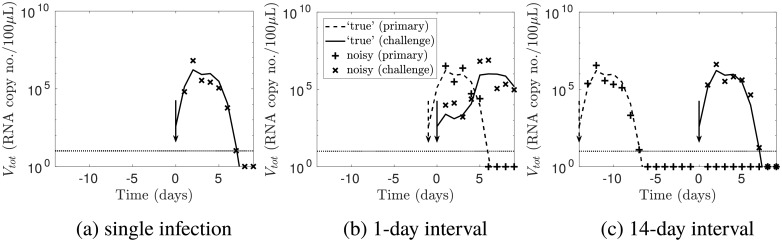
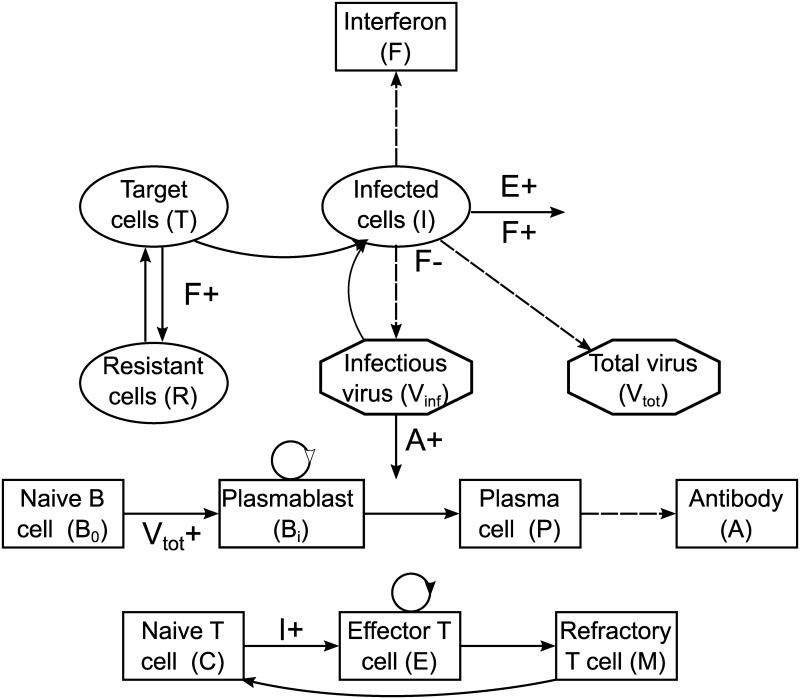
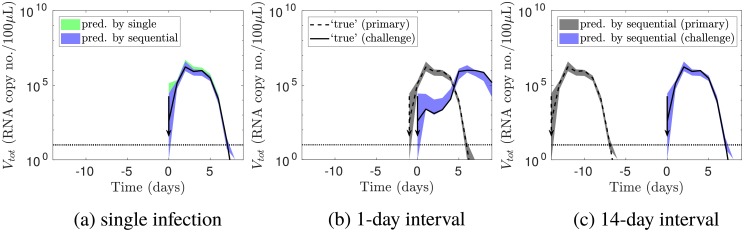
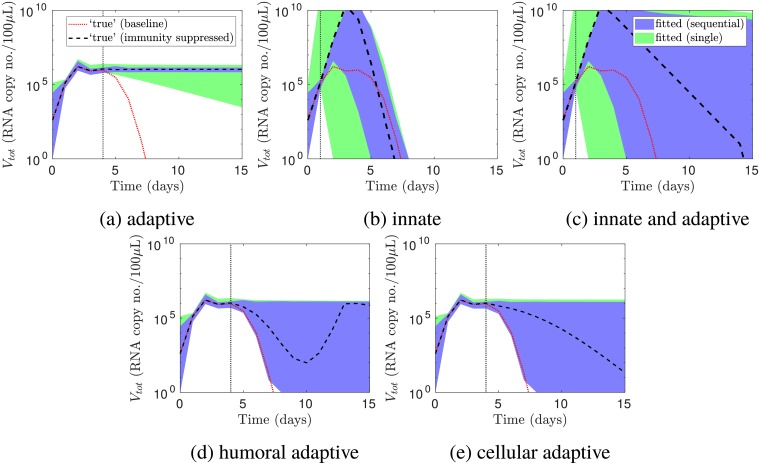
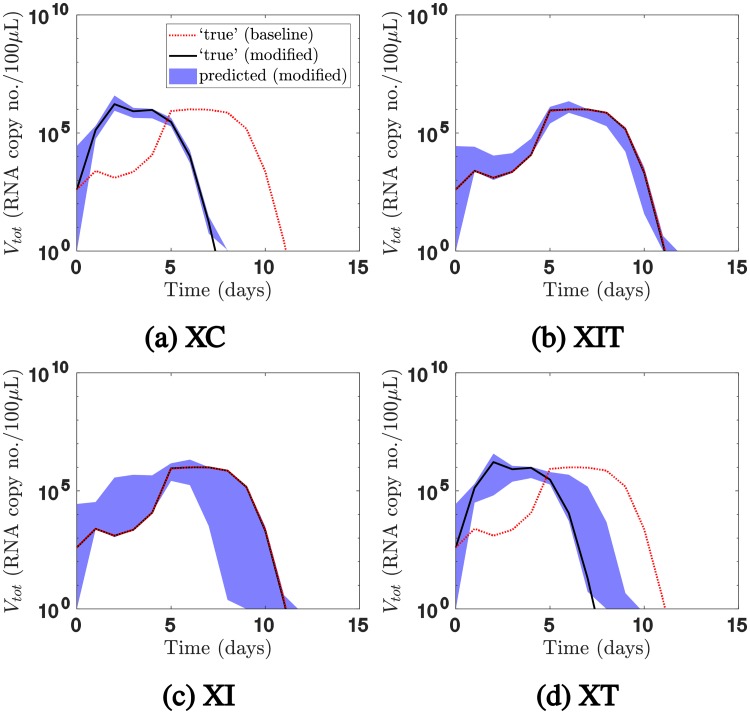
Laboratory models are often used to understand the interaction of related pathogens via host immunity. For example, recent experiments where ferrets were exposed to two influenza strains within a short period of time have shown how the effects of cross-immunity vary with the time between exposures and the specific strains used. On the other hand, studies of the workings of different arms of the immune response, and their relative importance, typically use experiments involving a single infection. However, inferring the relative importance of different immune components from this type of data is challenging. Using simulations and mathematical modelling, here we investigate whether the sequential infection experiment design can be used not only to determine immune components contributing to cross-protection, but also to gain insight into the immune response during a single infection. We show that virological data from sequential infection experiments can be used to accurately extract the timing and extent of cross-protection. Moreover, the broad immune components responsible for such cross-protection can be determined. Such data can also be used to infer the timing and strength of some immune components in controlling a primary infection, even in the absence of serological data. By contrast, single infection data cannot be used to reliably recover this information. Hence, sequential infection data enhances our understanding of the mechanisms underlying the control and resolution of infection, and generates new insight into how previous exposure influences the time course of a subsequent infection.
实验室模型常用于通过宿主免疫来理解相关病原体的相互作用。例如,最近的实验中,雪貂在短时间内接触两种流感株,这表明交叉免疫的效果如何随暴露时间和使用的特定株而变化。另一方面,对不同免疫分支的工作及其相对重要性的研究,通常使用单次感染实验。然而,从这类数据中推断不同免疫成分的相对重要性具有挑战性。在这里,我们通过模拟和数学建模研究了顺序感染实验设计是否不仅可以用于确定对交叉保护有贡献的免疫成分,还可以深入了解单次感染期间的免疫反应。我们表明,来自顺序感染实验的病毒学数据可用于准确提取交叉保护的时间和程度。此外,可以确定负责这种交叉保护的广泛免疫成分。此类数据还可用于推断控制原发性感染的某些免疫成分的时间和强度,即使在没有血清学数据的情况下也是如此。相比之下,单次感染数据无法可靠地恢复此信息。因此,顺序感染数据增强了我们对感染控制和解决机制的理解,并深入了解先前暴露如何影响后续感染的时间进程。