Department of Mathematical Sciences, University of Bath, Bath, UK.
Milner Centre for Evolution, University of Bath, Bath, UK.
Proc Biol Sci. 2023 Jan 25;290(1991):20222000. doi: 10.1098/rspb.2022.2000.
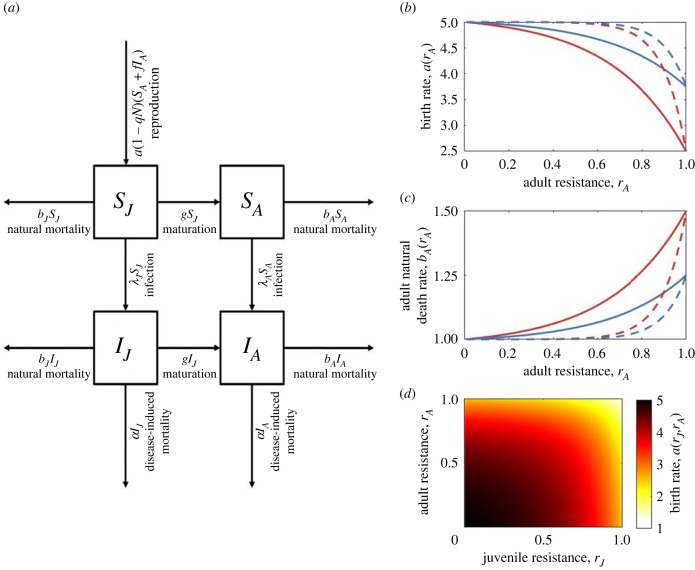
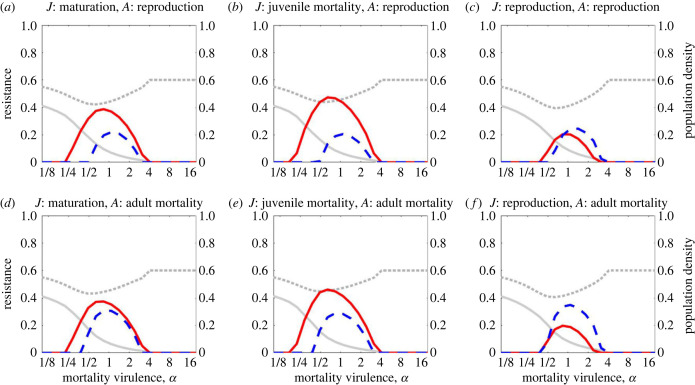
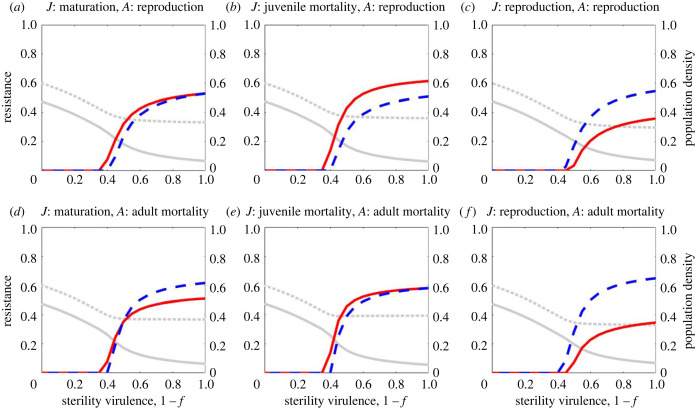
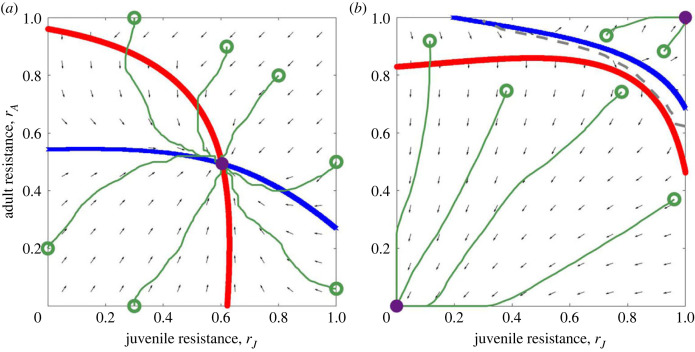
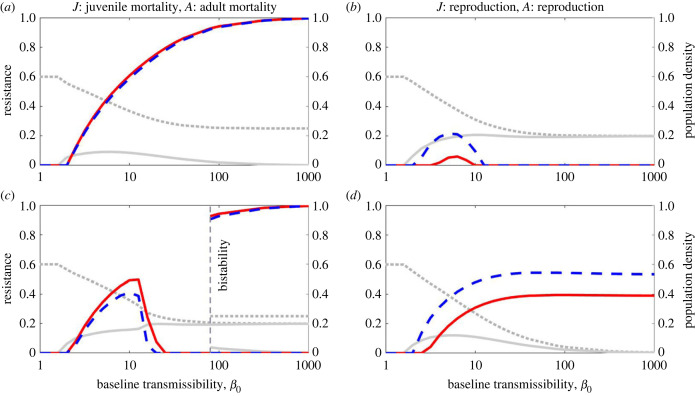
Innate, infection-preventing resistance often varies between host life stages. Juveniles are more resistant than adults in some species, whereas the opposite pattern is true in others. This variation cannot always be explained by prior exposure or physiological constraints and so it has been hypothesized that trade-offs with other life-history traits may be involved. However, little is known about how trade-offs between various life-history traits and resistance at different life stages affect the evolution of age-specific resistance. Here, we use a mathematical model to explore how trade-offs with natural mortality, reproduction and maturation combine to affect the evolution of resistance at different life stages. Our results show that certain combinations of trade-offs have substantial effects on whether adults or juveniles are more resistant, with trade-offs between juvenile resistance and adult reproduction inherently more costly than trade-offs involving maturation or mortality (all else being equal), resulting in consistent evolution of lower resistance at the juvenile stage even when infection causes a lifelong fecundity reduction. Our model demonstrates how the differences between patterns of age-structured resistance seen in nature may be explained by variation in the trade-offs involved and our results suggest conditions under which trade-offs tend to select for lower resistance in juveniles than adults.
先天抗感染能力在宿主的不同生命阶段通常存在差异。在某些物种中,幼体比成体更具抗性,而在其他物种中则相反。这种变化不能总是用先前的暴露或生理限制来解释,因此有人假设与其他生活史特征的权衡可能与之相关。然而,对于不同生命阶段的各种生活史特征与抗性之间的权衡如何影响特定年龄抗性的进化,人们知之甚少。在这里,我们使用一个数学模型来探讨自然死亡率、繁殖和成熟之间的权衡如何结合起来影响不同生命阶段的抗性进化。我们的结果表明,某些权衡组合对成体或幼体更具抗性有实质性影响,幼体抗性和成体繁殖之间的权衡比涉及成熟或死亡率的权衡内在地更具成本(在其他条件相同的情况下),即使感染导致终生繁殖力降低,也会导致幼体阶段的抗性持续进化降低。我们的模型展示了自然界中年龄结构抗性模式的差异如何可以通过所涉及的权衡变化来解释,并且我们的结果表明,在哪些条件下,权衡往往会选择幼体比成体具有更低的抗性。