Institute of Experimental Medicine, Czech Academy of Sciences, Videnska 1083, 142 20, Prague, Czech Republic.
New York Medical College, Valhalla, NY, 10595, USA.
J Neuroinflammation. 2019 Jan 17;16(1):12. doi: 10.1186/s12974-019-1394-7.
Traumatic spinal cord injury (SCI) triggers a chain of events that is accompanied by an inflammatory reaction leading to necrotic cell death at the core of the injury site, which is restricted by astrogliosis and apoptotic cell death in the surrounding areas. Activation of nuclear factor-κB (NF-κB) signaling pathway has been shown to be associated with inflammatory response induced by SCI. Here, we elucidate the pattern of activation of NF-κB in the pathology of SCI in rats and investigate the effect of transplantation of spinal neural precursors (SPC-01) on its activity and related astrogliosis.
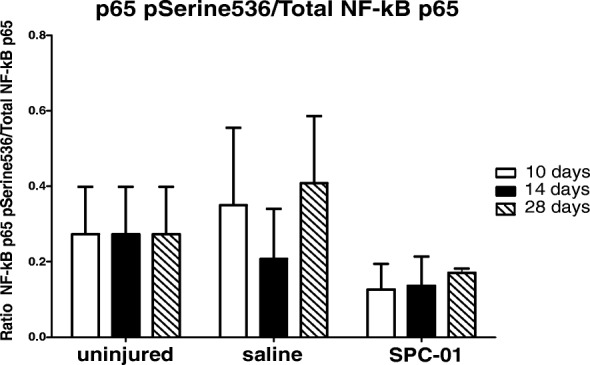
Using a rat compression model of SCI, we transplanted SPC-01 cells or injected saline into the lesion 7 days after SCI induction. Paraffin-embedded sections were used to assess p65 NF-κB nuclear translocation at days 1, 3, 7, 10, 14, and 28 and to determine levels of glial scaring, white and gray matter preservation, and cavity size at day 28 after SCI. Additionally, levels of p65 phosphorylated at Serine536 were determined 10, 14, and 28 days after SCI as well as levels of locally secreted TNF-α.
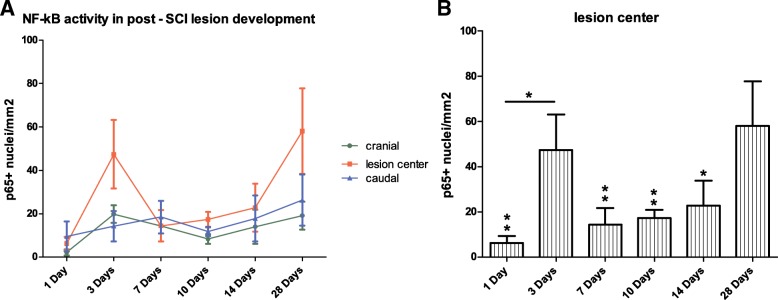
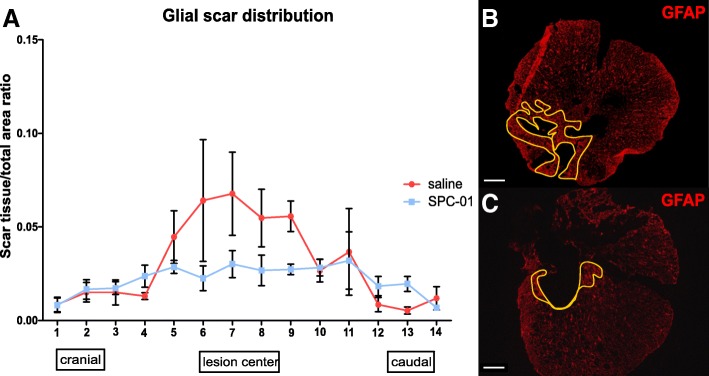
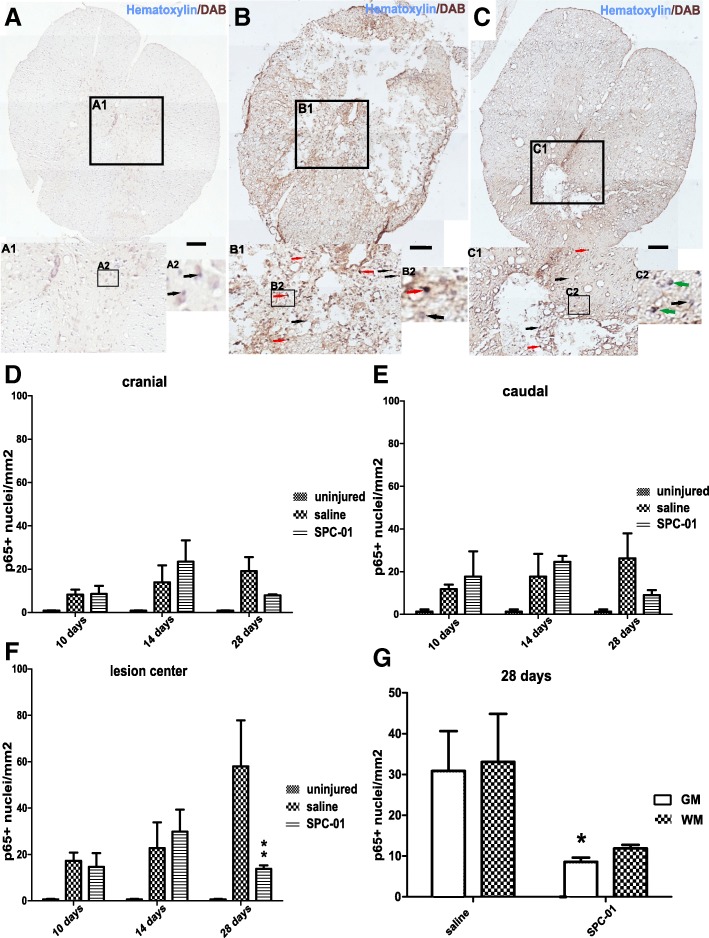
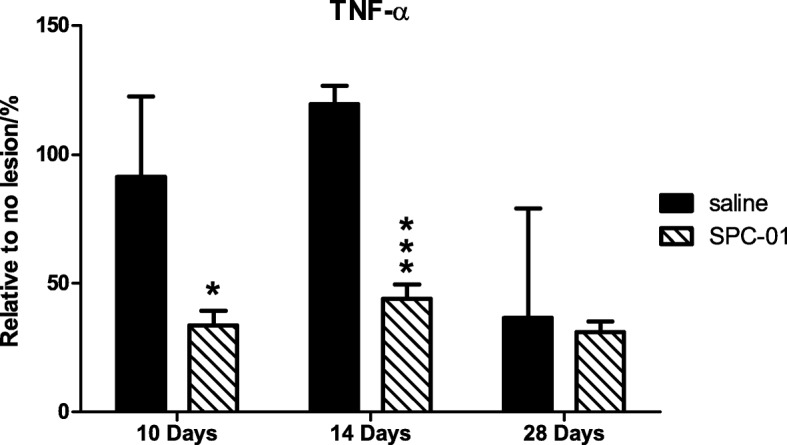
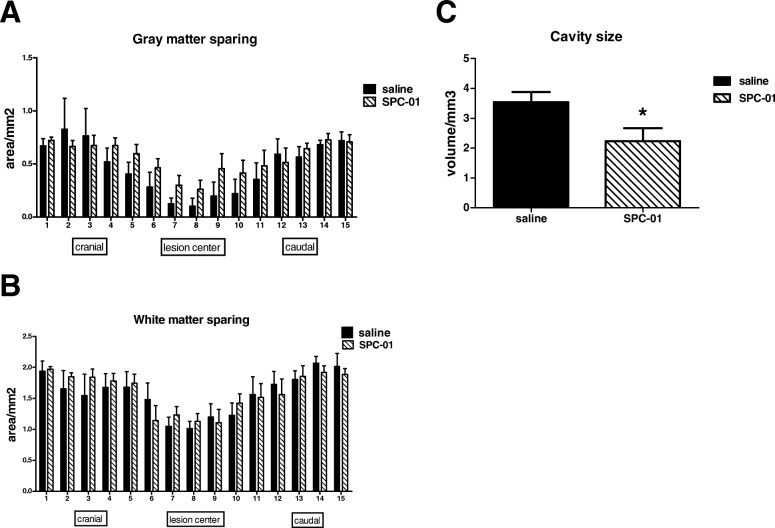
We determined a bimodal activation pattern of canonical p65 NF-κB signaling pathway in the pathology of SCI with peaks at 3 and 28 days after injury induction. Transplantation of SCI-01 cells resulted in significant downregulation of TNF-α production at 10 and 14 days after SCI and in strong inhibition of p65 NF-κB activity at 28 days after SCI, mainly in the gray matter. Moreover, reduced formation of glial scar was found in SPC-01-transplanted rats along with enhanced gray matter preservation and reduced cavity size.
The results of this study demonstrate strong immunomodulatory properties of SPC-01 cells based on inhibition of a major signaling pathway. Canonical NF-κB pathway activation underlines much of the immune response after SCI including cytokine, chemokine, and apoptosis-related factor production as well as immune cell activation and infiltration. Reduced inflammation may have led to observed tissue sparing. Additionally, such immune response modulation could have impacted astrocyte activation resulting in a reduced glial scar.
外伤性脊髓损伤(SCI)引发一系列事件,伴随着炎症反应,导致损伤部位核心的坏死细胞死亡,星形胶质细胞增生和周围区域的细胞凋亡将其限制。核因子-κB(NF-κB)信号通路的激活已被证明与 SCI 引起的炎症反应有关。在这里,我们阐明了 NF-κB 在大鼠 SCI 病理中的激活模式,并研究了脊髓神经前体细胞(SPC-01)移植对其活性和相关星形胶质细胞增生的影响。
使用大鼠 SCI 压迫模型,我们在 SCI 诱导后 7 天将 SPC-01 细胞移植或注射到损伤部位。使用石蜡包埋切片在第 1、3、7、10、14 和 28 天评估 p65 NF-κB 核易位,并在 SCI 后第 28 天评估神经胶质瘢痕、白质和灰质保存以及腔大小。此外,还在 SCI 后 10、14 和 28 天测定 p65 Serine536 磷酸化水平以及局部分泌的 TNF-α水平。
我们确定了 SCI 病理中经典 p65 NF-κB 信号通路的双峰激活模式,损伤诱导后 3 和 28 天达到峰值。SPC-01 细胞移植导致 SCI 后 10 和 14 天 TNF-α产生显著下调,SCI 后 28 天 p65 NF-κB 活性受到强烈抑制,主要在灰质中。此外,在 SPC-01 移植大鼠中发现神经胶质瘢痕形成减少,同时灰质保存增强,腔体积减小。
这项研究的结果表明,SPC-01 细胞具有强大的免疫调节特性,基于对主要信号通路的抑制。经典 NF-κB 通路的激活强调了 SCI 后包括细胞因子、趋化因子和凋亡相关因子产生以及免疫细胞激活和浸润在内的大部分免疫反应。炎症的减少可能导致了观察到的组织保存。此外,这种免疫反应的调节可能影响星形胶质细胞的激活,导致神经胶质瘢痕减少。