Department of Clinical Neuroscience, Institute of Neuroscience and Physiology, Sahlgrenska Academy, University of Gothenburg, Gothenburg, Sweden.
Acta Neurol Scand. 2019 Apr;139(4):382-388. doi: 10.1111/ane.13067. Epub 2019 Feb 6.
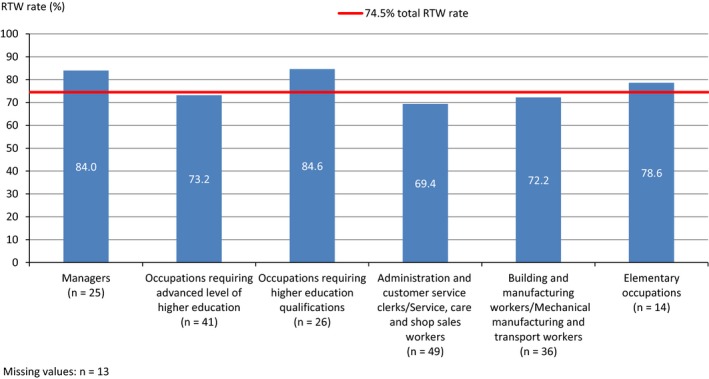
Disability due to stroke imposes a large burden on individuals, and on society, in terms of impaired work ability and sick leave. The reported return to work (RTW) rate after stroke varies globally and is influenced by a range of different aspects. The aim of this study was to investigate the influence of work-related factors on time to RTW after stroke, and possible differences between the sexes.
MATERIALS & METHODS: Data from 204 persons with first-time stroke in the years 2009-2010 in Gothenburg, Sweden, who were of working age and had worked prior to their stroke, were analysed. Disease-related characteristics were retrieved from medical records, and work-related- and socio-economic data were collected up to 6 years post-stroke from Statistics Sweden and the Swedish Social Insurance Agency. Cox regression was used to analyse predictors for time to RTW.
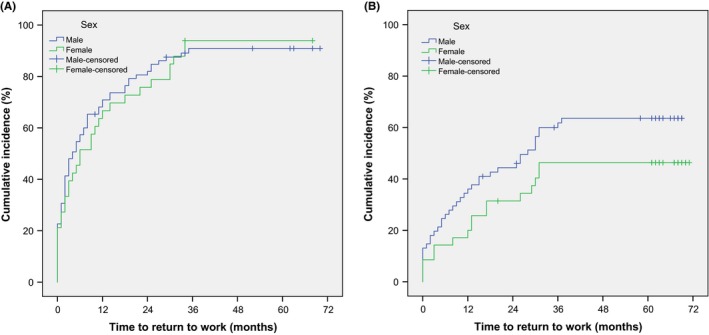
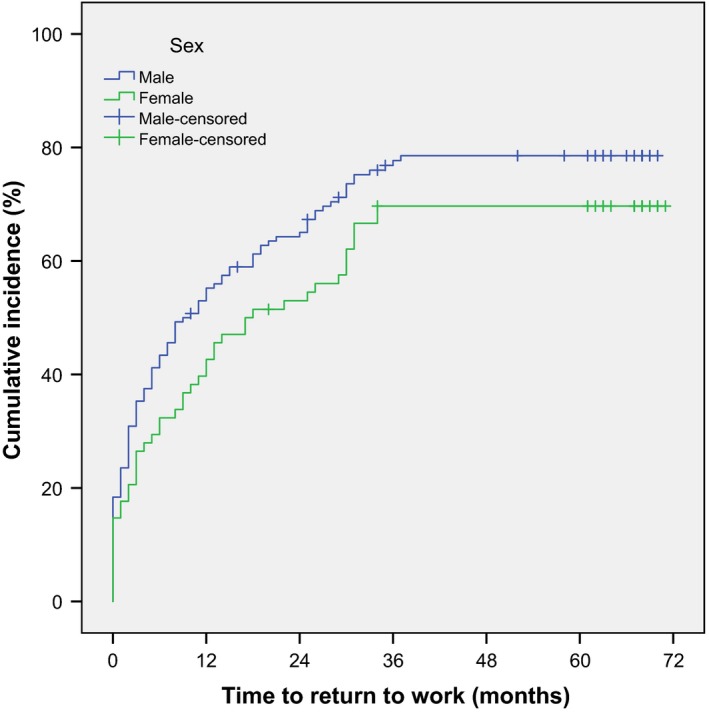
We identified qualified occupation and large organizational size as work-related predictors for shorter time to RTW after stroke. Being male predicted a faster and higher frequency of RTW. Qualified occupation predicted shorter time to RTW in men but not in women. For women, the only predictor for RTW was physical dependency at discharge.
Type of work and organizational size are work-related factors of importance for RTW after stroke. Work-related factors were important for RTW in men, but not in women. Reasons for differences between men and women in work-related factors that influence RTW need to be further investigated to better understand how to support women in the RTW process.
由于中风导致的残疾给个人和社会带来了巨大的负担,表现在工作能力受损和病假上。全球范围内报告的中风后重返工作岗位(RTW)率各不相同,受到多种不同因素的影响。本研究旨在调查工作相关因素对中风后 RTW 时间的影响,以及性别之间可能存在的差异。
对 2009-2010 年在瑞典哥德堡首次中风的 204 名处于工作年龄且中风前有工作的人员进行了数据分析。从病历中获取疾病相关特征,从瑞典统计局和瑞典社会保险局收集中风后长达 6 年的工作相关和社会经济数据。使用 Cox 回归分析 RTW 的预测因素。
我们发现,具有专业资格和大型组织规模的工作是中风后 RTW 时间较短的工作相关预测因素。男性是 RTW 速度更快、频率更高的预测因素。专业资格是男性 RTW 时间较短的预测因素,但不是女性的预测因素。对于女性,唯一的 RTW 预测因素是出院时的身体依赖性。
工作类型和组织规模是中风后 RTW 的重要工作相关因素。工作相关因素对男性的 RTW 很重要,但对女性则不然。需要进一步研究男性和女性在影响 RTW 的工作相关因素方面的差异的原因,以更好地了解如何在 RTW 过程中支持女性。