Pan Xi, Wang Zhi, Yao Lin, Xu Lan
Department of Neurology, The First Affiliated Hospital of Soochow University, Suzhou, Jiangsu, China.
Nursing Department, The First Affiliated Hospital of Soochow University, Suzhou, Jiangsu, China.
Front Neurol. 2023 Feb 23;14:1078251. doi: 10.3389/fneur.2023.1078251. eCollection 2023.
This study aimed to explore the reasons and influencing factors for non-return to work (non-RTW) within 1 year among young and middle-aged patients with stroke and to assess their health-related quality of life (HRQoL) at 1 year across different reasons.
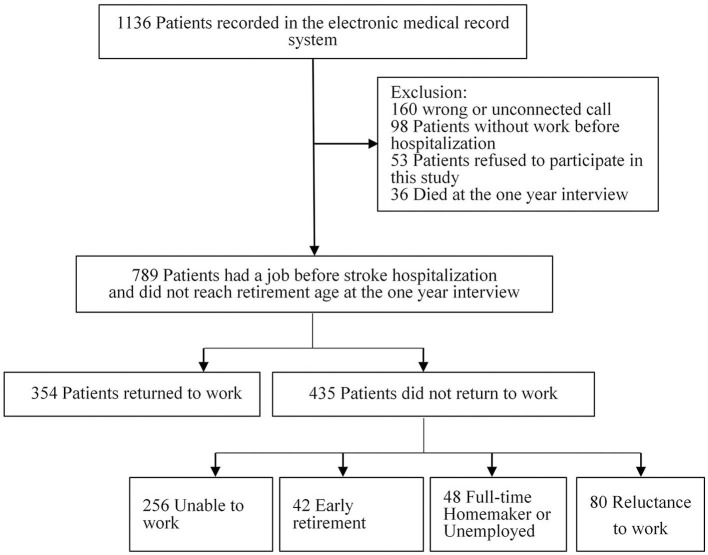
The study was conducted as a telephone-based cross-sectional survey. Seven hundred eighty-nine young and middle-aged patients with stroke aged between 18 and 54 years for men and 18 and 49 years for women in the electronic medical system were included. Data collection included demographic characteristics, socioeconomic status, behavioral habits, history of chronic diseases, work status, reasons for non-RTW, and HRQoL.
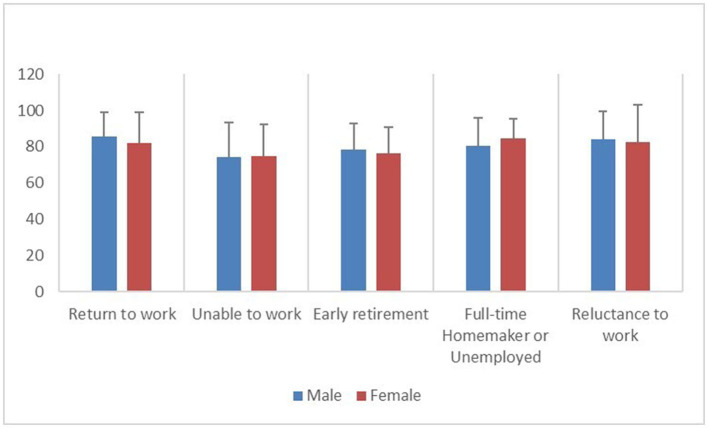
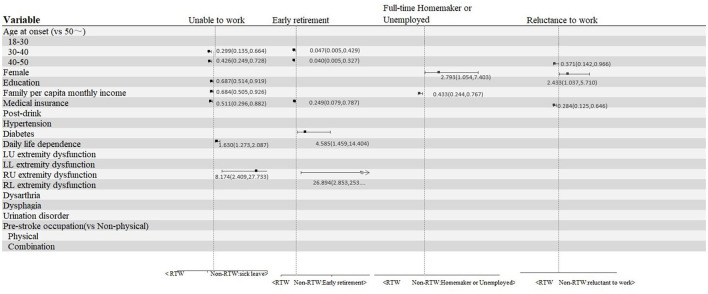
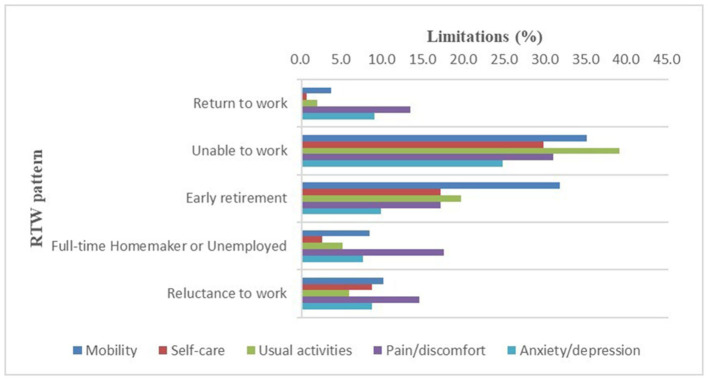
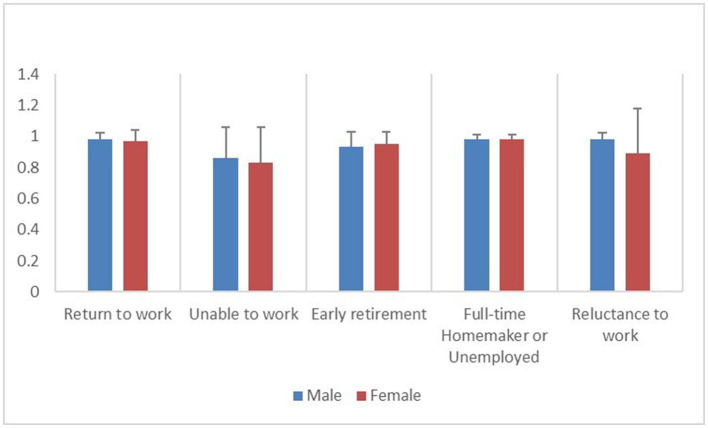
Of 789 patients, 435 (55.1%) (mean [SD] age, 47.7 [7.8] years) did not return to work within 1 year after stroke. Among the patients who did not RTW, 58.9% were unable to work, 9.7% retired early, 11.03% became full-time homemakers or were unemployed, and 20.5% were reluctant to work. The disordered multiclass logistic regression model showed that the factors influencing the reasons for non-RTW included age, gender, education, income, health insurance, diabetes comorbidity, ability to perform activities of daily living, and mobility of the right upper extremity. Furthermore, patients who were unable to work had significantly lower HRQoL compared to those who had RTW, followed by those who retired early.
More than half did not RTW within 1 year in our study. The results will help inform future research to identify interventions to promote RTW and improve HRQoL for young and middle-aged patients with stroke.
本研究旨在探讨中青年脑卒中患者1年内未恢复工作(未复工)的原因及影响因素,并评估不同原因导致的患者1年时的健康相关生活质量(HRQoL)。
本研究采用电话横断面调查。纳入电子医疗系统中年龄在18至54岁(男性)和18至49岁(女性)的789例中青年脑卒中患者。数据收集包括人口统计学特征、社会经济状况、行为习惯、慢性病病史、工作状况、未复工原因及HRQoL。
789例患者中,435例(55.1%)(平均[标准差]年龄,47.7[7.8]岁)在脑卒中后1年内未恢复工作。在未复工的患者中,58.9%无法工作,9.7%提前退休,11.03%成为全职家庭主妇或失业,20.5%不愿工作。无序多分类逻辑回归模型显示,影响未复工原因的因素包括年龄、性别、教育程度、收入、医疗保险、糖尿病合并症、日常生活活动能力及右上肢体活动度。此外,与已复工的患者相比,无法工作的患者HRQoL显著较低,其次是提前退休的患者。
在我们的研究中,超过一半的患者在1年内未复工。研究结果将有助于为未来研究提供信息,以确定促进复工及改善中青年脑卒中患者HRQoL的干预措施。