Environment-Omics-Disease Research Center, China Medical University Hospital, Taichung, Taiwan.
Graduate Institute of Biomedical Science, China Medical University, Taichung, Taiwan.
PLoS One. 2019 Jan 18;14(1):e0210901. doi: 10.1371/journal.pone.0210901. eCollection 2019.
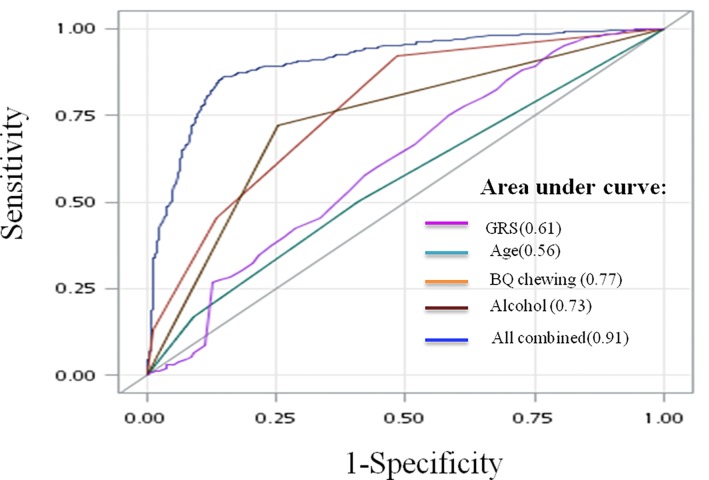
A number of genetic variants were suggested to be associated with oral malignancy, few variants can be replicated. The aim of this study was to identify significant variants that enhanced personal risk prediction for oral malignancy. A total of 360 patients diagnosed with oral squamous cell carcinoma, 486 controls and 17 newly diagnosed patients with OPMD including leukoplakia or oral submucous fibrosis were recruited. Fifteen tagSNPs which were derived from somatic mutations were genotyped and examined in associations with the occurrence of oral malignancy. Environmental variables along with the SNPs data were used to developed risk predictive models for oral malignancy occurrence. The stepwise model analysis was conducted to fit the best model in an economically efficient way. Two tagSNPs, rs28647489 in FAT1 gene and rs550675 in COL9A1 gene, were significantly associated with the risk of oral malignancy. The sensitivity and specificity were 85.7% and 85.5%, respectively (area under the receiver operating characteristic curve (AUC) was 0.91) for predicting oral squamous cell carcinoma occurrence with the combined genetic variants, betel-quid, alcohol and age. The AUC for OPMD was only 0.69. The predictive probability of squamous cell carcinoma occurrence for genetic risk score without substance use increased from 10% up to 43%; with substance use increased from 73% up to 92%. Genetic variants with or without substance use may enhance risk prediction for oral malignancy occurrence in male population. The prediction model may be useful as a clinical index for oral malignancy occurrence and its risk assessments.
一些遗传变异被认为与口腔恶性肿瘤有关,但很少有变异可以被复制。本研究旨在确定能增强个体对口腔恶性肿瘤发生风险预测的显著变异。共招募了 360 名确诊为口腔鳞状细胞癌患者、486 名对照者和 17 名新诊断的 OPMD 患者(包括白斑或口腔黏膜下纤维性变)。对来自体细胞突变的 15 个标签 SNP 进行了基因分型,并对其与口腔恶性肿瘤发生的关联进行了研究。环境变量与 SNP 数据一起用于开发口腔恶性肿瘤发生风险预测模型。采用逐步模型分析,以经济有效的方式拟合最佳模型。FAT1 基因中的 rs28647489 和 COL9A1 基因中的 rs550675 这两个标签 SNP 与口腔恶性肿瘤的风险显著相关。用联合遗传变异、咀嚼槟榔、饮酒和年龄预测口腔鳞状细胞癌发生的敏感性和特异性分别为 85.7%和 85.5%(接受者操作特征曲线下的面积(AUC)为 0.91)。用于预测 OPMD 的 AUC 仅为 0.69。在没有物质使用的情况下,遗传风险评分对鳞状细胞癌发生的预测概率从 10%增加到 43%;在有物质使用的情况下,从 73%增加到 92%。无论是否使用物质,遗传变异都可能增强男性口腔恶性肿瘤发生风险的预测。该预测模型可作为口腔恶性肿瘤发生及其风险评估的临床指标。