Department of Paediatric Cardiac Surgery, Birmingham Children's Hospital, Birmingham, UK.
Institute of Clinical Sciences, University of Birmingham, Birmingham, UK.
Eur J Cardiothorac Surg. 2019 Jul 1;56(1):101-109. doi: 10.1093/ejcts/ezy474.
Tetralogy of Fallot is characterized by anterocephalad deviation of the outlet septum, along with abnormal septoparietal trabeculations, which lead to subpulmonary infundibular stenosis. Archives of retained hearts are an important resource for improving our understanding of congenital heart defects and their morphological variability. This study aims to define variations in aortic override, coronary arterial patterns and ventricular septal defects in tetralogy of Fallot as observed in a morphological archive, highlighting implications for surgical management.
The Birmingham Children's Hospital archive contains 211 hearts with tetralogy of Fallot, of which 164 were analysed [69 (42.1%) unrepaired and 95 (57.9%) operated specimens]. A detailed morphological and geometric analysis was performed using a rigorous 5-layer review process.
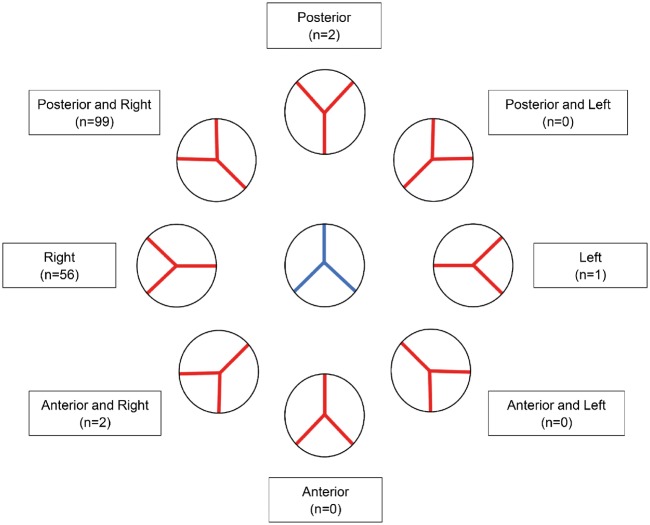
Anomalies were observed in the orifices, origins and course of the coronary arteries: 20 hearts (13.0%) had more than 2 orifices and 3 hearts (1.9%) had a single orifice. In 7 hearts (4.3%), a coronary artery crossed the right ventricular outflow tract. The extent of aortic override ranged from 31.0% to 100% (median of 59.5%). The ventricular septal defect was most often perimembranous (139, 84.8%), but we also found muscular (14, 8.5%), atrioventricular (7, 4.3%) and doubly committed juxta-arterial (2, 1.2%) variants.
Anatomical variations are common and can impact surgical management. Anomalous coronary arteries may require a conduit rather than a transannular patch. Variability in aortic override determines the size of patch used to baffle blood to the aorta. The type of ventricular septal defect affects patch closure and the risk of postoperative conduction defects.
法洛四联症的特征为流出道间隔向前上移位,同时伴有异常的室间隔小梁化,导致肺动脉瓣下漏斗部狭窄。保留心脏的档案是提高我们对先天性心脏缺陷及其形态变异性理解的重要资源。本研究旨在通过形态学档案定义法洛四联症中主动脉瓣上覆盖、冠状动脉模式和室间隔缺损的变异,突出其对手术管理的影响。
伯明翰儿童医院档案包含 211 例法洛四联症心脏,其中 164 例进行了分析[69 例(42.1%)未修复和 95 例(57.9%)手术标本]。使用严格的 5 层审查程序进行详细的形态和几何分析。
观察到冠状动脉口、起源和走行异常:20 例(13.0%)有超过 2 个口,3 例(1.9%)有 1 个口。7 例(4.3%)中,冠状动脉穿过右心室流出道。主动脉瓣上覆盖范围从 31.0%到 100%(中位数为 59.5%)。室间隔缺损最常见于膜周(139 例,84.8%),但我们也发现肌部(14 例,8.5%)、房室(7 例,4.3%)和双重连接的动脉下型(2 例,1.2%)。
解剖变异很常见,可能影响手术管理。异常的冠状动脉可能需要使用移植物而不是跨瓣环补片。主动脉瓣上覆盖的变异性决定了用于将血液引流至主动脉的补片大小。室间隔缺损的类型影响补片关闭和术后传导缺陷的风险。