School of Nutrition and Translational Research in Metabolism, Faculty of Health Medicine and Life Sciences, Maastricht University, Maastricht, The Netherlands.
Department of Health Sciences, College of Natural Health Sciences, Zayed University, Dubai, United Arab Emirates.
J Nephrol. 2019 Aug;32(4):549-566. doi: 10.1007/s40620-018-00565-z. Epub 2019 Jan 18.
Intradialytic exercise (IDE) is not yet a routine practice for hemodialysis patients, the lack of guidelines supporting it being a major reason. This systematic review and meta-analysis of aerobic IDE interventions examined the efficacy of IDE regarding quality of life (QOL), serum phosphorus, dialysis efficiency, inflammatory status, vitamin D3, parathyroid hormone, intake of phosphate binders, mortality and hospitalization rate.
Pubmed, Medline (Ovid), Embase (Ovid), Cochrane, and Cinahl (EBSCO) databases were searched to retrieve studies up to June 12, 2018. A manual reference search was also performed. Studies were included if they evaluated (a) aerobic IDE effect on at least one of our study parameters, (b) adult hemodialysis patients, (c) patients for > 1 month.
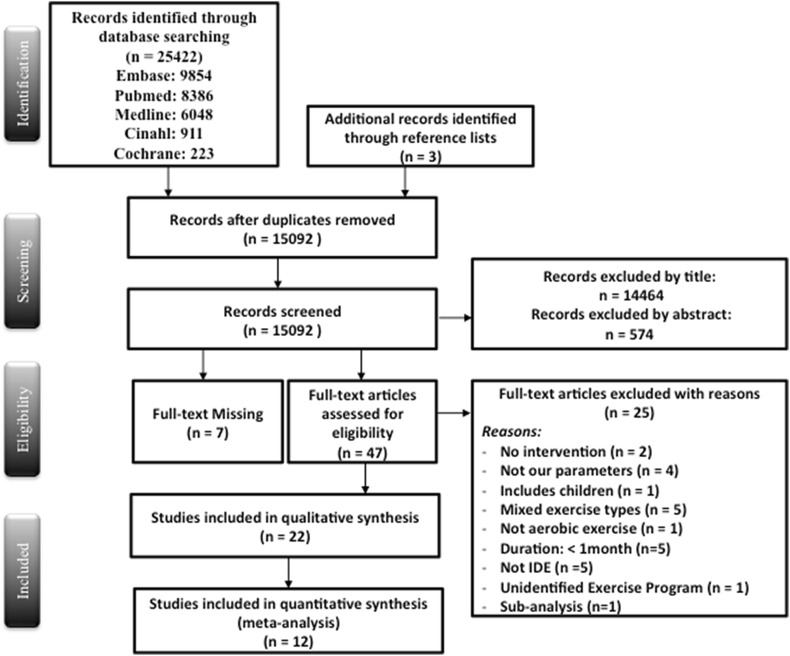
Twenty-two studies were retrieved (706 participants), of which 12 were eligible for meta-analysis. Aerobic IDE had a significant positive effect on the QOL physical component score (QOL-PSC) and on mental component score (QOL-MCS) of SF36, but not on serum phosphorus or Kt/V.
IDE incorporation into clinical practice has a significant positive effect on QOL-PSC and QOL-MCS. In the reviewed studies, IDE did not result in any health hazard in hemodialysis patients. Nevertheless, future research should assess the long-term effectiveness and safety of IDE. The limitations of this review include the lack of quality analysis of the studies, the limited number of studies that could be included in the meta-analysis, the diversity in the exercise intensity, duration and modality, and the limited data for several outcomes.
CRD42016052062.
透析时运动(IDE)并非血液透析患者的常规治疗方法,缺乏相关指导是主要原因。本系统评价和荟萃分析对 IDE 的有氧运动干预进行了研究,评估 IDE 对生活质量(QOL)、血清磷、透析效率、炎症状态、维生素 D3、甲状旁腺激素、磷酸盐结合剂摄入、死亡率和住院率的影响。
检索 Pubmed、Medline(Ovid)、Embase(Ovid)、Cochrane 和 Cinahl(EBSCO)数据库,以获取截至 2018 年 6 月 12 日的研究。还进行了手动参考文献检索。如果研究评估了(a)有氧运动 IDE 对我们研究参数中的至少一个参数的影响,(b)成年血液透析患者,(c)患者透析时间>1 个月,则纳入研究。
共检索到 22 项研究(706 名参与者),其中 12 项符合荟萃分析条件。有氧运动 IDE 对 SF36 的 QOL 生理成分评分(QOL-PSC)和心理成分评分(QOL-MCS)有显著的积极影响,但对血清磷或 Kt/V 没有影响。
将 IDE 纳入临床实践对 QOL-PSC 和 QOL-MCS 有显著的积极影响。在回顾的研究中,IDE 并未对血液透析患者造成任何健康危害。然而,未来的研究应该评估 IDE 的长期有效性和安全性。本综述的局限性包括研究质量分析的缺乏、可纳入荟萃分析的研究数量有限、运动强度、持续时间和方式的多样性,以及几个结果的数据有限。
PROSPERO 注册号:CRD42016052062。