Department of Otorhinolaryngology-Head and Neck Surgery, Eulji University Medical Center, Eulji University School of Medicine, Daejeon, Korea.
J Korean Med Sci. 2019 Jan 4;34(3):e19. doi: 10.3346/jkms.2019.34.e19. eCollection 2019 Jan 21.
This study assessed the therapeutic effect of adjunctive bifrontal transcranial direct current stimulation (tDCS) in patients with tinnitus.
Forty-four patients who visited our university hospital with a complaint of non-pulsatile subjective tinnitus in January through December 2016 were enrolled. All patients received directive counseling and sound therapy, such as a sound generator or hearing aids, and/or oral clonazepam. Patients who agreed to undergo additional bifrontal tDCS were classified as the study group (n = 26). For tDCS, 1.5 mA of direct current was applied to the prefrontal cortex with a 10-20 EEG system for 20 minutes per session.
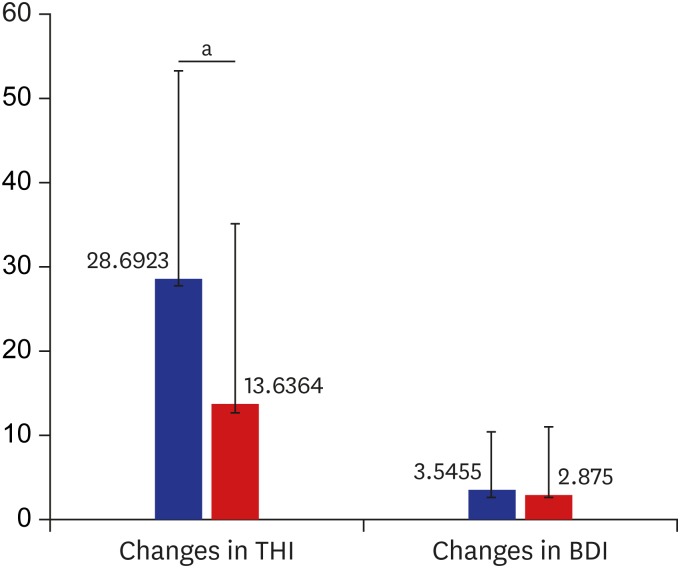
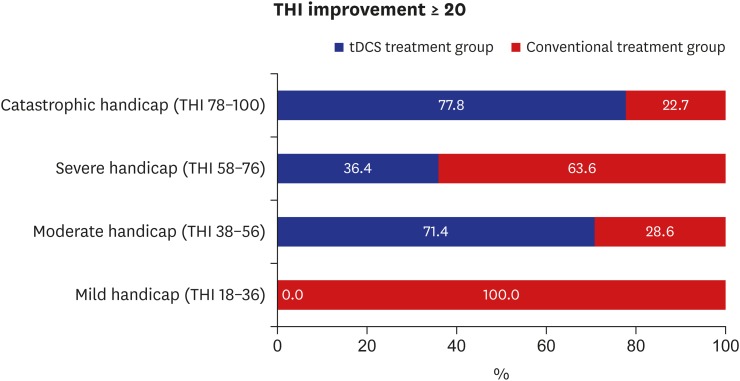
The Tinnitus Handicap Inventory (THI), Beck Depression Inventory, and Visual Analog Scale (VAS) scores decreased significantly after treatment ( < 0.001). Patients who had a moderate or catastrophic handicap were significantly more likely to respond favorably to bifrontal tDCS ( = 0.026). There was no correlation of number of tDCS sessions with change in the THI or VAS score ( > 0.05). Logistic regression analysis revealed that the initial THI score was independently associated with improvement in the THI. However, tDCS was not a significant determinant of recovery.
tDCS can be used as an adjunctive treatment in patients with severe tinnitus. Although tDCS did not decrease the loudness of tinnitus, it could alleviate the distress associated with the condition in some patients with a moderate or catastrophic handicap.
本研究评估了附加双侧额颅直流电刺激(tDCS)治疗耳鸣患者的疗效。
2016 年 1 月至 12 月期间,共有 44 名因非搏动性主观性耳鸣就诊于我院的患者入选。所有患者均接受了指导咨询和声音治疗,如声音发生器或助听器,和/或口服氯硝西泮。同意接受附加双侧额 tDCS 的患者被分为研究组(n = 26)。对于 tDCS,使用 10-20 EEG 系统以 1.5 mA 的直流电施加于前额皮质,每次治疗 20 分钟。
治疗后耳鸣残疾量表(THI)、贝克抑郁量表和视觉模拟量表(VAS)评分显著降低(<0.001)。中重度残疾的患者更有可能对双侧额 tDCS 治疗有良好的反应(=0.026)。tDCS 治疗次数与 THI 或 VAS 评分的变化无相关性(>0.05)。逻辑回归分析显示,初始 THI 评分与 THI 的改善独立相关。然而,tDCS 并不是恢复的显著决定因素。
tDCS 可作为严重耳鸣患者的辅助治疗方法。尽管 tDCS 并未降低耳鸣的响度,但它可以减轻一些中重度残疾患者的耳鸣相关痛苦。