Rajamanickam Karthic, Yang Jian, Sakharkar Meena Kishore
Drug Discovery and Development Research Group, College of Pharmacy and Nutrition, University of Saskatchewan, Saskatoon, SK, Canada.
Front Pharmacol. 2019 Jan 4;9:1486. doi: 10.3389/fphar.2018.01486. eCollection 2018.
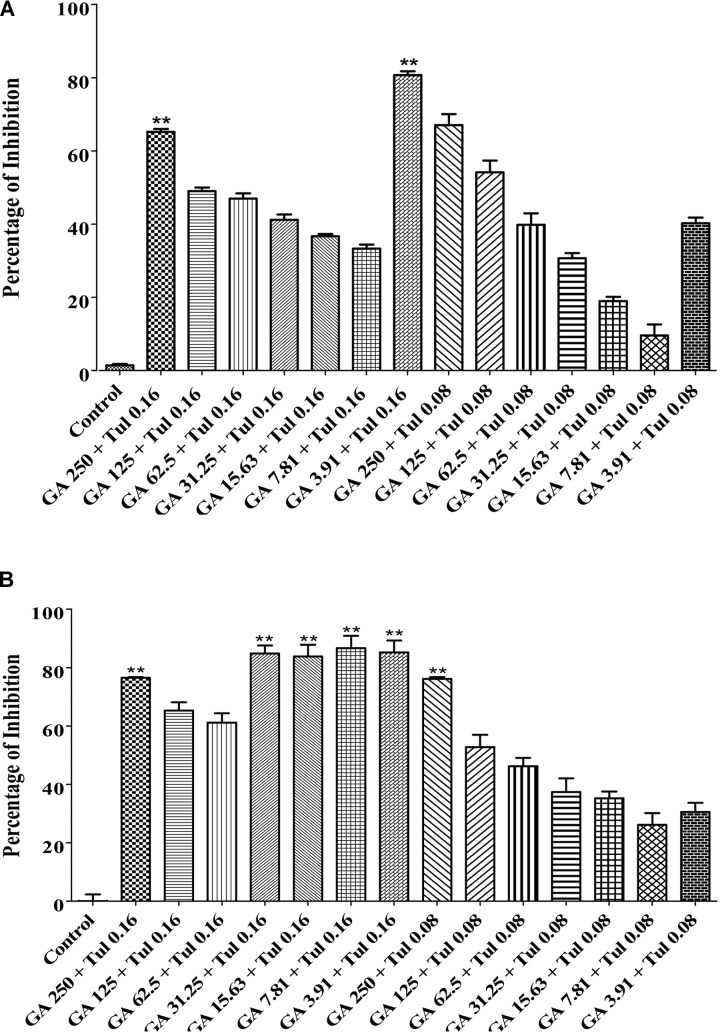
Bovine respiratory disease (BRD) is the most common infectious disease in dairy and beef cattle. It is associated with significant morbidity and mortality and causes a huge economic loss each year. In western Canada, a one-time injection of tulathromycin is commonly used as a metaphylactic procedure to reduce BRD incidence and eliminate potential BRD outbreak. With increased global concern on antimicrobial usage in dairy and beef products and bacterial resistance to antimicrobials, it is important to develop a novel strategy to eliminate the usage or decrease the dosage of antimicrobials. In this study, we showed that gallic acid was active against both and , two key BRD associated-pathogens, with the minimum inhibitory concentration (MIC) measured at 250 and 500 μg/mL, respectively. Co-administration of tulathromycin and gallic acid exhibited a strong additive or weak synergistic effect toward both and . Tulathromycin, gallic acid and their combination were also effective against the mixed culture of and . Furthermore, we showed that pre-exposure to tulathromycin generated bacterial resistance to the antimicrobial in but not in .
牛呼吸道疾病(BRD)是奶牛和肉牛中最常见的传染病。它与高发病率和死亡率相关,每年造成巨大的经济损失。在加拿大西部,一次性注射泰拉霉素通常用作一种群体预防措施,以降低BRD的发病率并消除潜在的BRD疫情爆发。随着全球对乳制品和牛肉产品中抗菌药物使用以及细菌对抗菌药物耐药性的关注度不断提高,制定一种消除抗菌药物使用或降低其剂量的新策略非常重要。在本研究中,我们表明没食子酸对两种与BRD相关的关键病原体均有活性,其最低抑菌浓度(MIC)分别测定为250和500μg/mL。泰拉霉素和没食子酸联合给药对这两种病原体均表现出强烈的相加或弱协同作用。泰拉霉素、没食子酸及其组合对这两种病原体的混合培养物也有效。此外,我们表明预先接触泰拉霉素会使细菌对该抗菌药物产生耐药性,但对另一种病原体则不会。