Department of Dermatology, Drug Hypersensitivity Clinical and Research Center, Chang Gung Memorial Hospital, Linkou, Taipei and Keelung, Taiwan.
Chang Gung Immunology Consortium, Chang Gung Memorial Hospital and Chang Gung University, Taiwan.
J Immunol Res. 2018 Dec 19;2018:4325874. doi: 10.1155/2018/4325874. eCollection 2018.
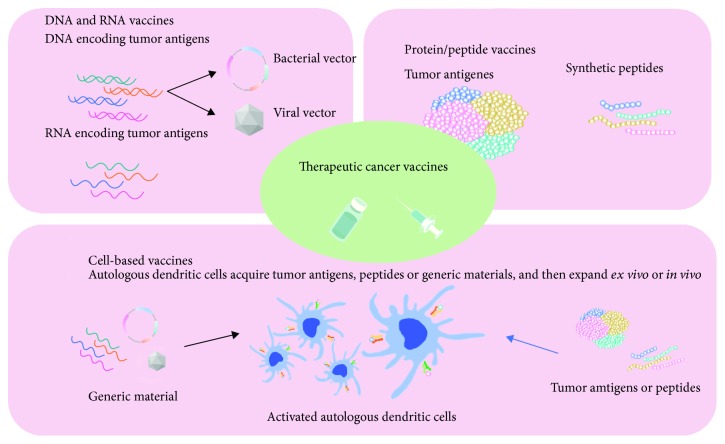
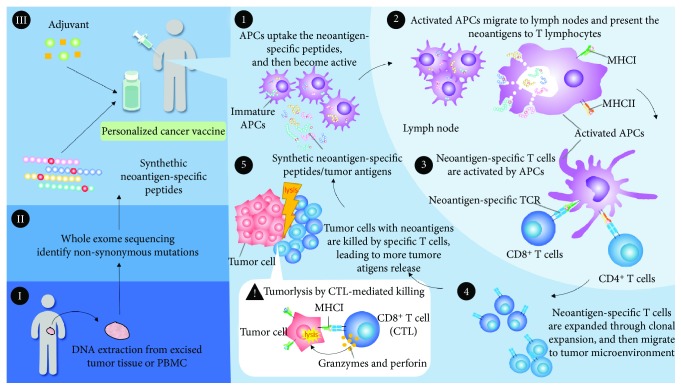
Recently, increasing data show that immunotherapy could be a powerful weapon against cancers. Comparing to the traditional surgery, chemotherapy or radiotherapy, immunotherapy more specifically targets cancer cells, giving rise to the opportunities to the patients to have higher response rates and better quality of life and even to cure the disease. Cancer vaccines could be designed to target tumor-associated antigens (TAAs), cancer germline antigens, virus-associated antigens, or tumor-specific antigens (TSAs), which are also called neoantigens. The cancer vaccines could be cell-based (e.g., dendritic cell vaccine provenge (sipuleucel-T) targeting prostatic acid phosphatase for metastatic prostate cancer), peptide/protein-based, or gene- (DNA/RNA) based, with the different kinds of adjuvants. Neoantigens are tumor-specific and could be presented by MHC molecules and recognized by T lymphocytes, serving the ideal immune targets to increase the therapeutic specificity and decrease the risk of nonspecific autoimmunity. By targeting the shared antigens and private epitopes, the cancer vaccine has potential to treat the disease. Accordingly, personalized neoantigen-based immunotherapies are emerging. In this article, we review the literature and evidence of the advantage and application of cancer vaccine. We summarize the recent clinical trials of neoantigen cancer vaccines which were designed according to the patients' personal mutanome. With the rapid development of personalized immunotherapy, it is believed that tumors could be efficiently controlled and become curable in the new era of precision medicine.
最近,越来越多的数据表明免疫疗法可能是对抗癌症的有力武器。与传统的手术、化疗或放疗相比,免疫疗法更能针对癌细胞,为患者提供更高的反应率、更好的生活质量,甚至有治愈疾病的机会。癌症疫苗可以针对肿瘤相关抗原(TAA)、癌症种系抗原、病毒相关抗原或肿瘤特异性抗原(TSA)设计,也称为新抗原。癌症疫苗可以是细胞为基础的(例如,针对转移性前列腺癌的前列腺酸性磷酸酶的树突细胞疫苗 provenge(sipuleucel-T))、肽/蛋白为基础的或基因为基础的(DNA/RNA),具有不同种类的佐剂。新抗原是肿瘤特异性的,可以由 MHC 分子呈递并被 T 淋巴细胞识别,是提高治疗特异性和降低非特异性自身免疫风险的理想免疫靶点。通过针对共享抗原和个体表位,癌症疫苗具有治疗疾病的潜力。因此,个性化的基于新抗原的免疫疗法正在出现。本文综述了癌症疫苗的优势和应用的文献证据。我们总结了最近根据患者个人突变组设计的新抗原癌症疫苗的临床试验。随着个性化免疫疗法的快速发展,人们相信在精准医学的新时代,肿瘤可以得到有效控制并变得可治愈。