Division of Gastroenterology, University of Pennsylvania Perelman School of Medicine, Penn Presbyterian Medical Center, Philadelphia, Pennsylvania.
Takeda Pharmaceuticals International Inc, Cambridge, Massachusetts.
Aliment Pharmacol Ther. 2019 Feb;49(4):408-418. doi: 10.1111/apt.15113. Epub 2019 Jan 20.
Prospectively designed studies assessing the exposure-response profile of vedolizumab are lacking. Observational exposure-response data for vedolizumab are limited and have not been adjusted for potential confounding factors, particularly those that may affect vedolizumab clearance.
To (a) investigate the vedolizumab exposure-response relationship after adjusting for potential confounding variables; (b) propose potential target serum vedolizumab concentrations for future study; (c) ascertain whether early vedolizumab serum concentrations were associated with short- and long-term clinical outcomes in adults with ulcerative colitis in GEMINI 1.
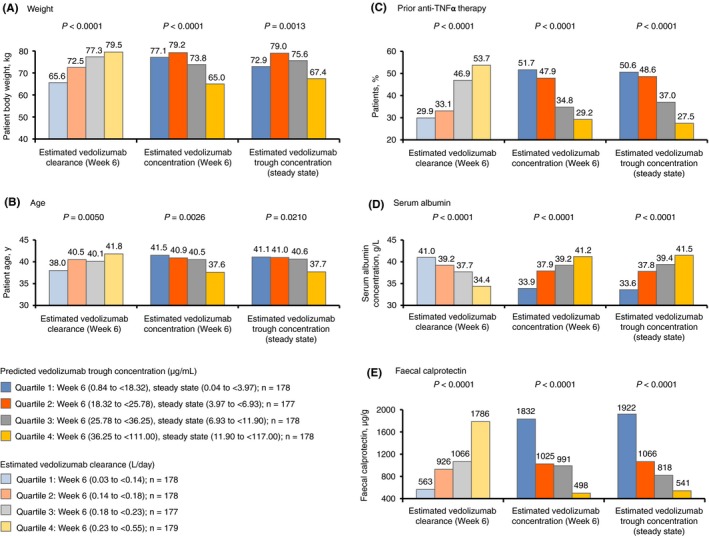
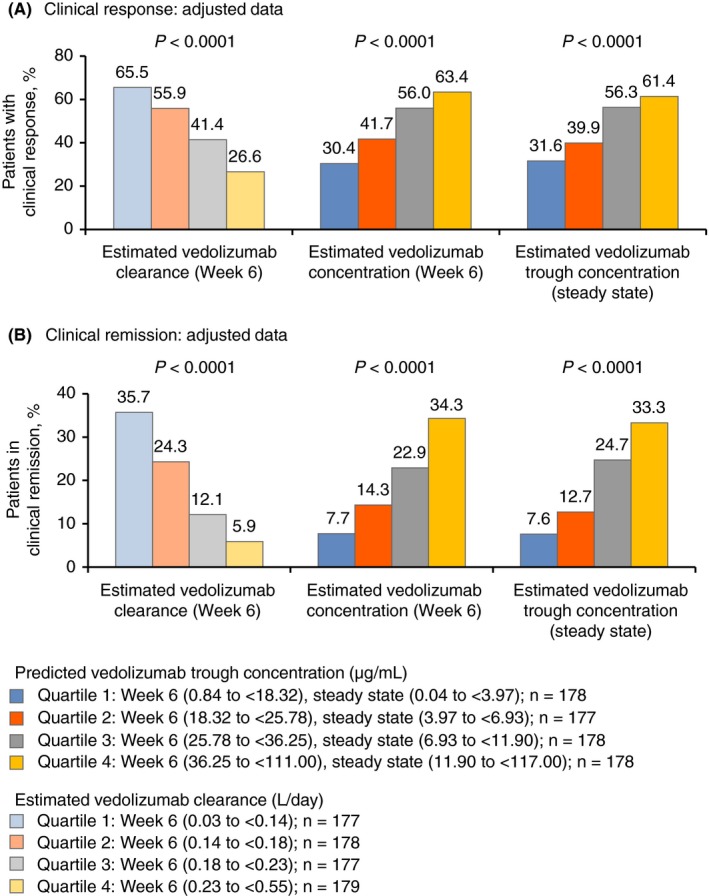
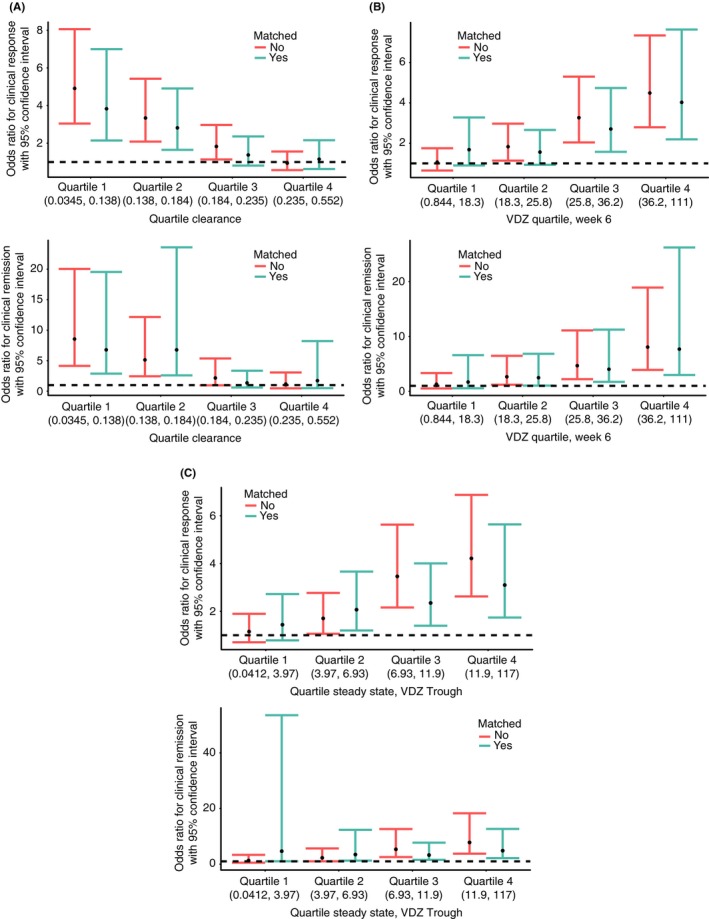
Propensity-score-based case-matching analysis was performed using data from GEMINI 1 and an earlier large population pharmacokinetic study, with vedolizumab clearance or concentration as predictors of clinical remission and response, adjusted for age, weight, anti-tumour necrosis factor alpha therapy history, serum albumin and faecal calprotectin concentrations. Potential vedolizumab concentration targets at weeks 6, 14 and steady state were proposed. Association between early vedolizumab concentrations at weeks 2, 4 and 6 and clinical remission at weeks 14 and 52 was evaluated.
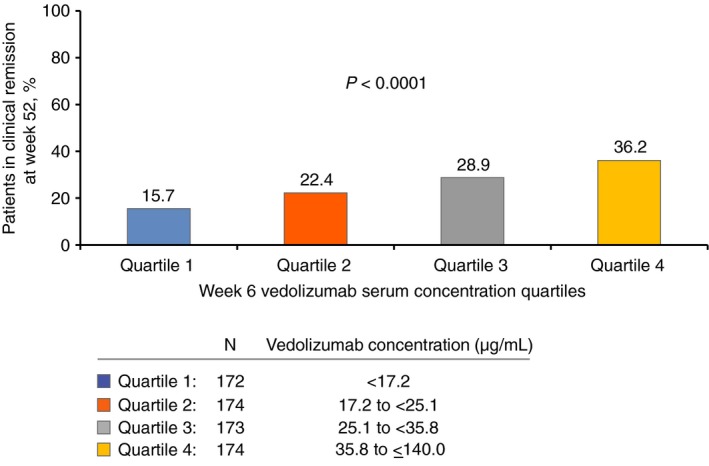
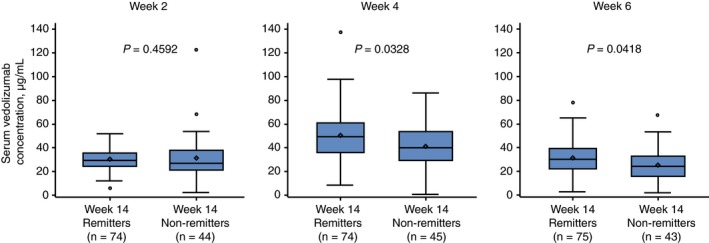
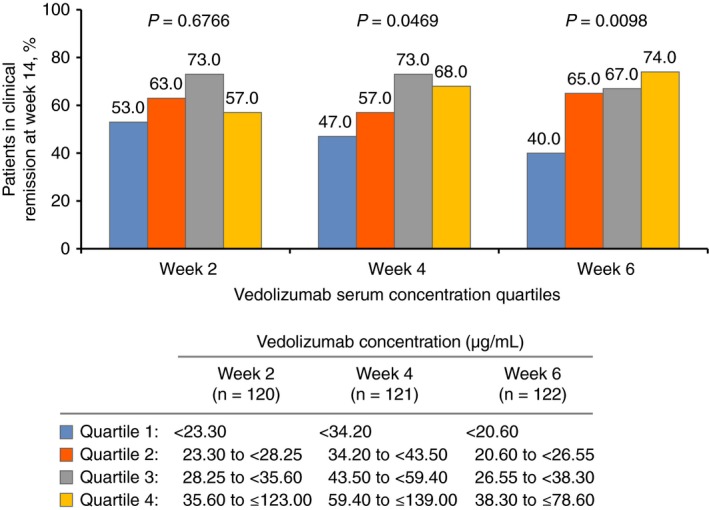
Among 693 patients with pharmacokinetic data at week 6, potential target vedolizumab concentrations at weeks 6, 14 and steady state were 37.1, 18.4 and 12.7 µg/mL respectively. Week 6 was identified as the earliest time at which vedolizumab concentrations were consistently associated with clinical remission at weeks 14 and 52.
In this comprehensively adjusted analysis, vedolizumab concentrations at week 6 were associated with short- and long-term remission. Potential induction and maintenance target concentrations were proposed for further study.
缺乏前瞻性设计研究评估 vedolizumab 的暴露-反应特征。观察性暴露-反应数据有限,且未调整潜在混杂因素,尤其是可能影响 vedolizumab 清除率的因素。
(a)在调整潜在混杂变量后,研究 vedolizumab 的暴露-反应关系;(b)提出潜在的 vedolizumab 血清浓度目标值,用于未来的研究;(c)确定在 GEMINI 1 中,溃疡性结肠炎成人患者早期 vedolizumab 血清浓度是否与短期和长期临床结局相关。
采用 GEMINI 1 和先前大型药代动力学研究的数据,进行倾向评分匹配病例对照分析,以 vedolizumab 清除率或浓度作为临床缓解和应答的预测因子,调整年龄、体重、抗肿瘤坏死因子-α治疗史、血清白蛋白和粪便钙卫蛋白浓度。提出了第 6、14 周和稳态时潜在的 vedolizumab 浓度目标值。评估了第 2、4 和 6 周时早期 vedolizumab 浓度与第 14 周和第 52 周时临床缓解的关系。
在 693 例具有第 6 周药代动力学数据的患者中,第 6、14 周和稳态时的潜在 vedolizumab 浓度目标值分别为 37.1、18.4 和 12.7µg/ml。第 6 周是最早能够一致预测第 14 周和第 52 周临床缓解的时间点。
在这项全面调整分析中,第 6 周 vedolizumab 浓度与短期和长期缓解相关。提出了潜在的诱导和维持目标浓度,以进一步研究。