Celume Macarena-Paz, Besançon Maud, Zenasni Franck
Laboratoire Adaptations Travail-Individu, Ecole Cognition, Comportements et Conduites Humaines, Université Sorbonne Paris Cité, Université Paris Descartes, Boulogne-Billancourt, France.
Center for Interdisciplinary Research, Département Frontiéres du Vivant et de l'Apprendre, IIFR, Université Sorbonne Paris Cité, Université Paris Descartes, Paris, France.
Front Psychol. 2019 Jan 7;9:2611. doi: 10.3389/fpsyg.2018.02611. eCollection 2018.
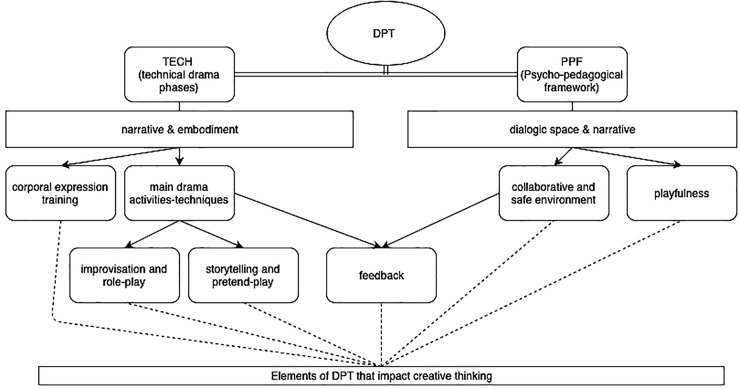
Drama Pedagogy Training (DPT), as other drama-based pedagogies, has been related to several outcomes, including creativity enhancement. This enhancement is commonly proven through the measurement of different creative processes. In our review we systematize characteristics, activities and techniques of DPT that are assumed to be related to creativity in order to have a more comprehensive framework to identify the specific DPT elements that are involved in the enhancement of some of the creative processes of children and adolescents. To this end, we identified five creative processes in experimental studies using DPT: divergent thinking, fantasy and imagination, associative thinking, symbolization, and problem solving. These processes were cross referenced with DPT characteristics, activities, and techniques that were argued to be related to creativity enhancement. Our review will propose a model with two main categories and six elements as follows: (1) which emphasizes the role of narrative and embodiment through (a) corporal and vocal training and (b) main drama techniques (e.g., storytelling and improvisation and role-play), and (2) which emphasizes the role of a dialogic space through (c) playfulness and a (d) collaborative, safe space. We also identified (e) feedback as an important element of DPT which belongs to both drama technical phases and psycho-pedagogical framework categories. Along with the model, we explain the creative outcomes associated to each of these elements as a means to attire the attention to drama-based pedagogies for the development of creativity in the educational setting.
戏剧教学法培训(DPT)与其他基于戏剧的教学法一样,与多种成果相关,包括创造力的提升。这种提升通常通过对不同创作过程的测量来证明。在我们的综述中,我们将DPT中被认为与创造力相关的特征、活动和技巧进行了系统化整理,以便有一个更全面的框架来识别参与提升儿童和青少年某些创作过程的DPT具体元素。为此,我们在使用DPT的实验研究中确定了五个创作过程:发散性思维、幻想与想象、联想思维、符号化和问题解决。这些过程与被认为与创造力提升相关的DPT特征、活动和技巧进行了交叉参照。我们的综述将提出一个包含两个主要类别和六个元素的模型,如下所示:(1)通过(a)身体和声音训练以及(b)主要戏剧技巧(如讲故事、即兴表演和角色扮演)强调叙事和体现的作用;(2)通过(c)趣味性和(d)协作性、安全的空间强调对话空间的作用。我们还确定(e)反馈是DPT的一个重要元素,它既属于戏剧技术阶段,也属于心理教育框架类别。连同该模型,我们解释了与这些元素中的每一个相关的创作成果,以此作为一种手段,吸引人们关注基于戏剧的教学法在教育环境中对创造力发展的作用。