Sorbonne Université, Muséum National d'Histoire Naturelle, UMR CNRS 7590, IRD, Institut de Minéralogie, de Physique des Matériaux et de Cosmochimie, IMPMC, Paris, France.
National Center for Biotechnology Information, National Library of Medicine, National Institutes of Health, Bethesda, MD.
Genome Biol Evol. 2019 Feb 1;11(2):572-585. doi: 10.1093/gbe/evz010.
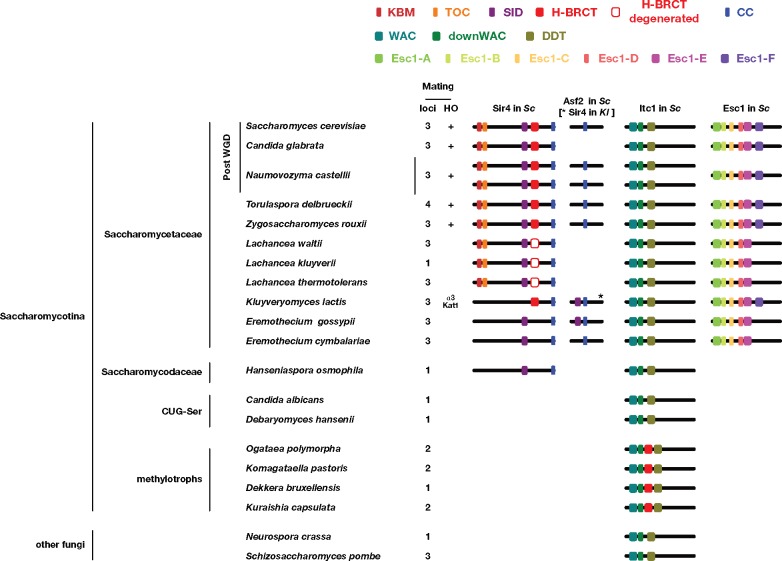
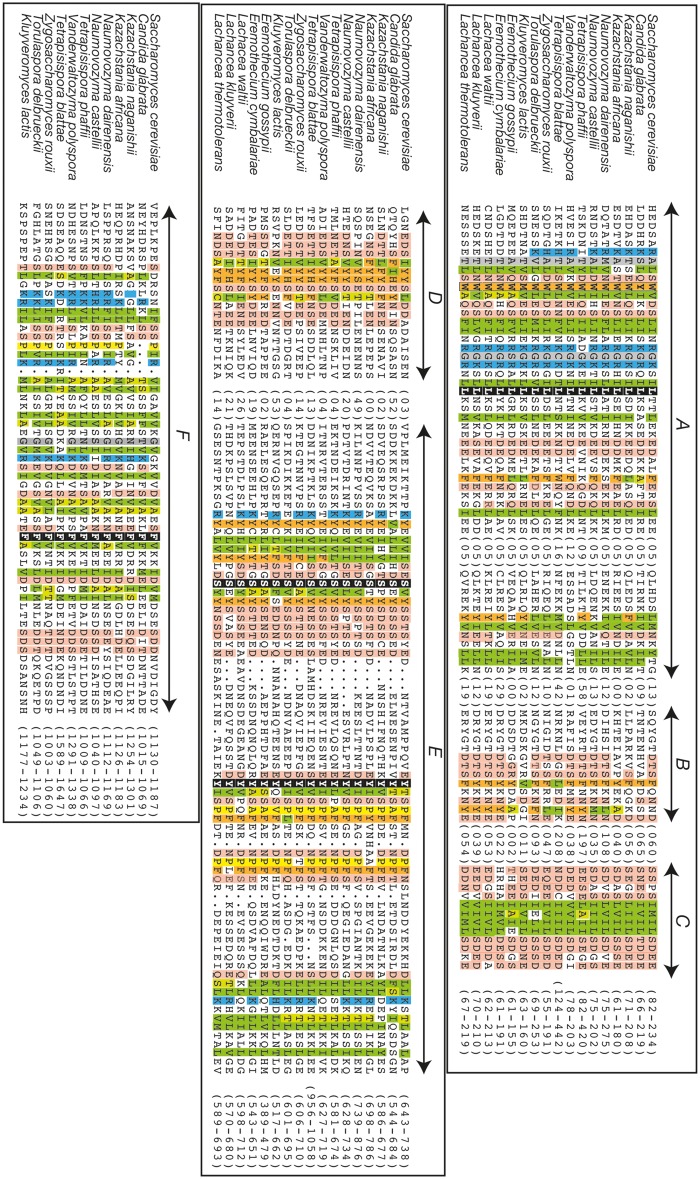
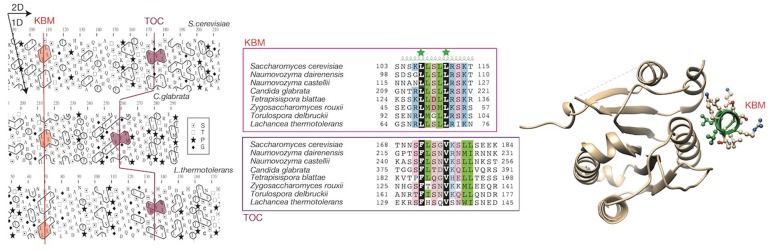
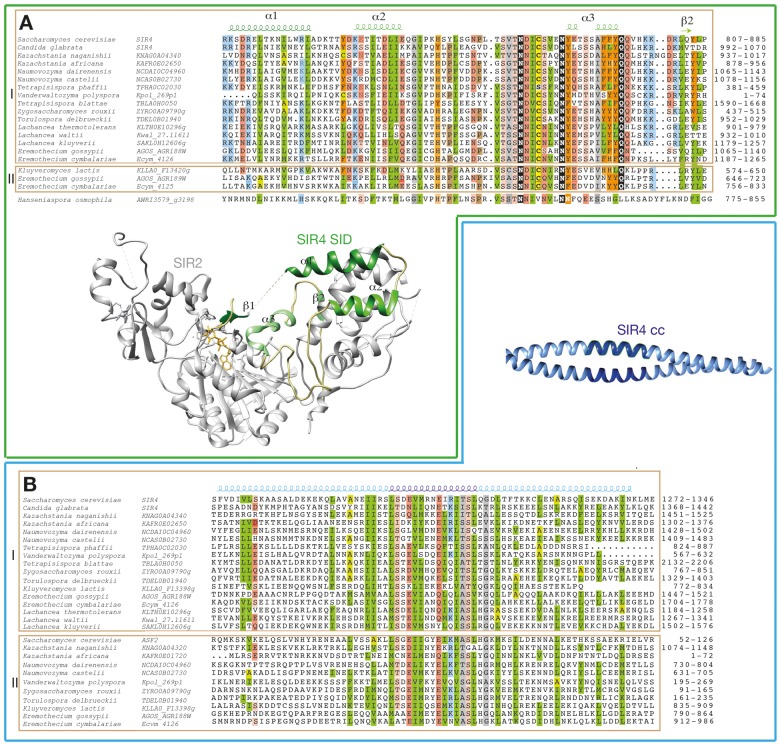
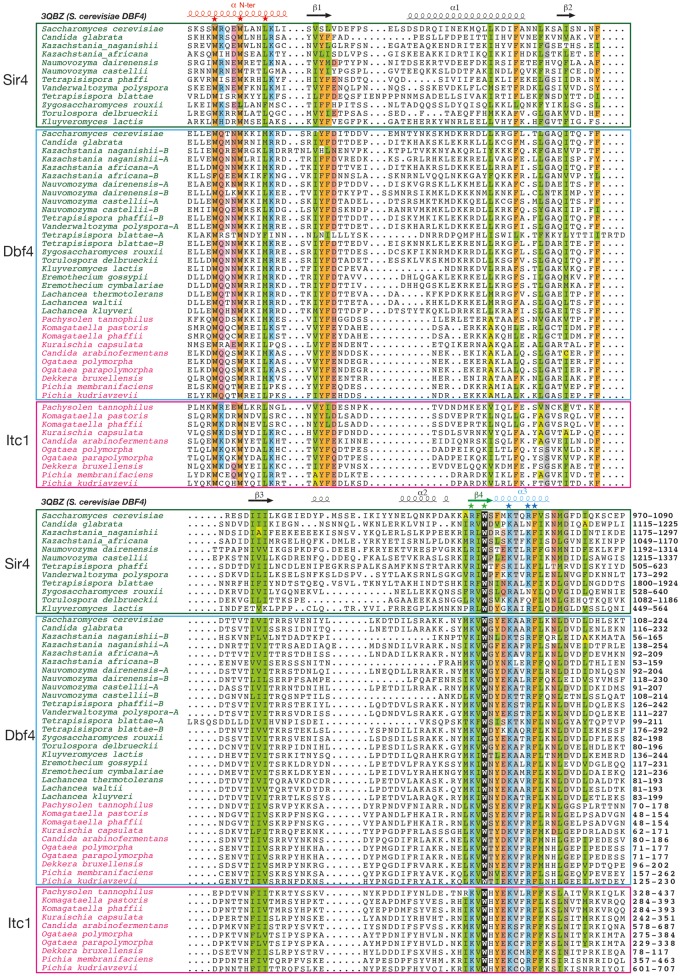
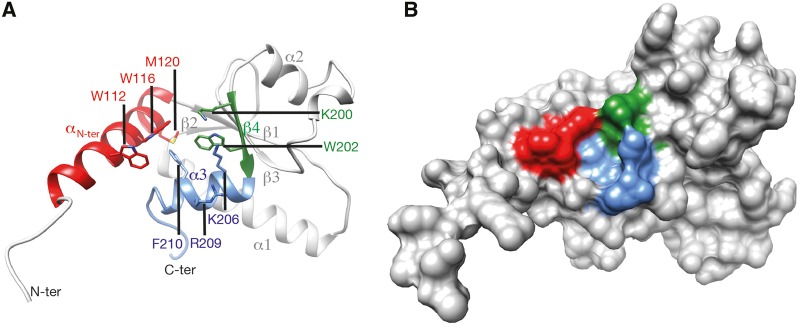
Sir4 is a core component of heterochromatin found in yeasts of the Saccharomycetaceae family, whose general hallmark is to harbor a three-loci mating-type system with two silent loci. However, a large part of the Sir4 amino acid sequences has remained unexplored, belonging to the dark proteome. Here, we analyzed the phylogenetic profile of yet undescribed foldable regions present in Sir4 as well as in Esc1, an Sir4-interacting perinuclear anchoring protein. Within Sir4, we identified a new conserved motif (TOC) adjacent to the N-terminal KU-binding motif. We also found that the Esc1-interacting region of Sir4 is a Dbf4-related H-BRCT domain, only present in species possessing the HO endonuclease and in Kluveryomyces lactis. In addition, we found new motifs within Esc1 including a motif (Esc1-F) that is unique to species where Sir4 possesses an H-BRCT domain. Mutagenesis of conserved amino acids of the Sir4 H-BRCT domain, known to play a critical role in the Dbf4 function, shows that the function of this domain is separable from the essential role of Sir4 in transcriptional silencing and the protection from HO-induced cutting in Saccharomyces cerevisiae. In the more distant methylotrophic clade of yeasts, which often harbor a two-loci mating-type system with one silent locus, we also found a yet undescribed H-BRCT domain in a distinct protein, the ISWI2 chromatin-remodeling factor subunit Itc1. This study provides new insights on yeast heterochromatin evolution and emphasizes the interest of using sensitive methods of sequence analysis for identifying hitherto ignored functional regions within the dark proteome.
Sir4 是酿酒酵母科酵母中异染色质的核心组成部分,其普遍特征是具有两个沉默位点的三基因座交配型系统。然而,Sir4 氨基酸序列的很大一部分仍未被探索,属于暗蛋白组。在这里,我们分析了 Sir4 中以及与 Sir4 相互作用的核周锚定蛋白 Esc1 中尚未描述的可折叠区域的系统发育特征。在 Sir4 中,我们确定了一个新的保守基序(TOC),位于 N 端 KU 结合基序的旁边。我们还发现,Sir4 的 Esc1 相互作用区域是一个 Dbf4 相关的 H-BRCT 结构域,仅存在于具有 HO 内切酶的物种和 Kluveryomyces lactis 中。此外,我们在 Esc1 中发现了新的基序,包括 Esc1-F 基序,该基序仅存在于 Sir4 具有 H-BRCT 结构域的物种中。突变 Sir4 H-BRCT 结构域的保守氨基酸,已知这些氨基酸在 Dbf4 功能中起关键作用,表明该结构域的功能与其在转录沉默中的基本功能以及在酿酒酵母中保护免受 HO 诱导切割的功能是可分离的。在更远的甲基营养酵母分支中,通常具有两个基因座交配型系统和一个沉默位点,我们还在一个不同的蛋白质中发现了一个尚未描述的 H-BRCT 结构域,即 ISWI2 染色质重塑因子亚基 Itc1。这项研究提供了关于酵母异染色质进化的新见解,并强调了使用敏感的序列分析方法来识别暗蛋白组中迄今为止被忽视的功能区域的重要性。