Department of Virology, Veterinary Faculty, Istanbul University-Cerrahpasa, Avcilar, 34320 Istanbul, Turkey.
CEVA Animal Health, Iz Plaza Giz, Eski Büyükdere Caddesi, No-9, Kat-21, Maslak, Istanbul, Turkey.
Poult Sci. 2019 May 1;98(5):1976-1984. doi: 10.3382/ps/pey551.
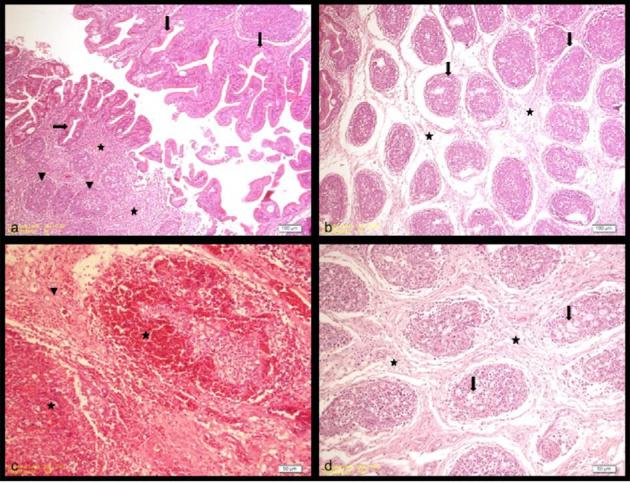
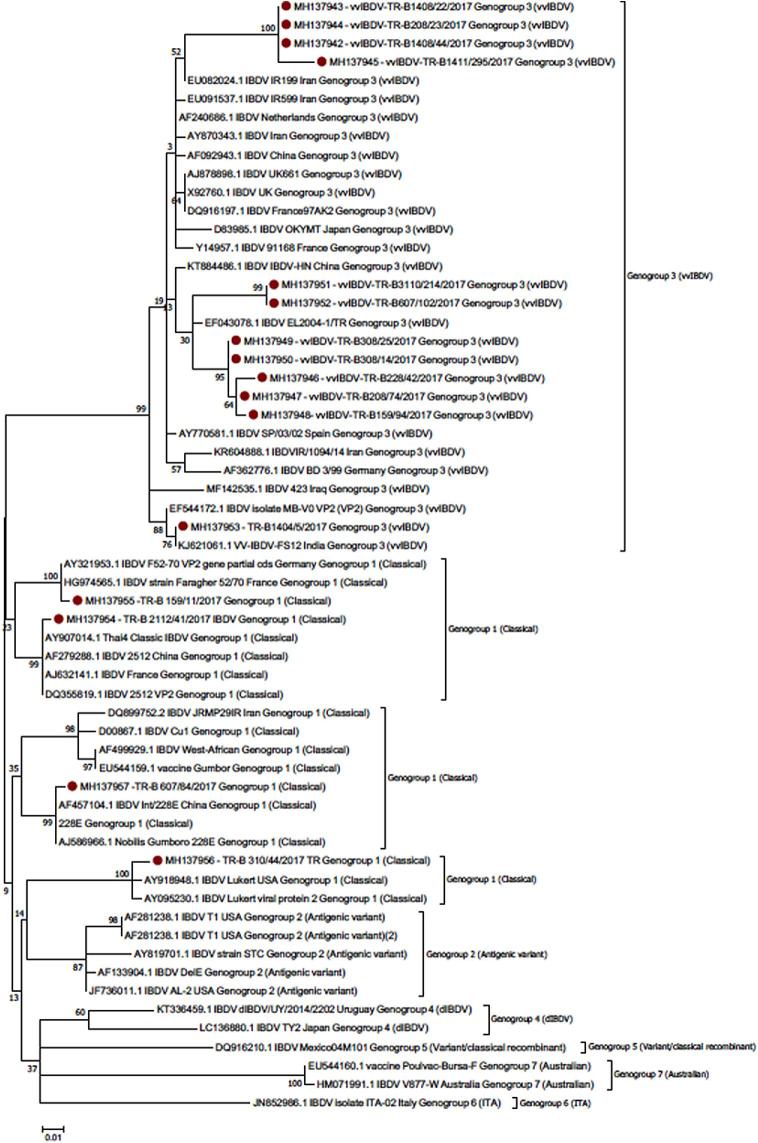
The emergence of new infectious bursal disease virus (IBDV) variants can threaten poultry health and production all over the world causing significant economic losses. Therefore, this study was performed to determine IBDV molecular epidemilogy, VP2 gene variation, and corresponding pathological lesions in IBDV infected chickens in Turkey. For this, 1855 bursa of Fabricius samples were collected from 371 vaccinated broiler flocks. Atrophia and haemorrhages were seen in the bursa Fabricius of very virulent IBDV (vvIBDV) infected chickens. Partial VP2 gene was sequenced and phylogenetic, recombination, and evolutionary analyses were performed. 1548 (83.5%) out of 1855 of bursa of Fabricius samples were IBDV positive and 1525 of those could be sequenced. The recombination analysis did not detect occurrence of any recombination event among the Turkish strains. Among 1525 sequenced samples, 1380 of them were found to be classical strains. Among 1380 classical strains, 1317 were similar to IBDV 2512, 11 to Faragher 52/70, 40 to 228 E, and 12 to Lukert strain. Out of 1525 reverse transcriptase ploymerase chain reaction positive samples, 144 of them were found to be similar to vvIBDV-VP2 gene reported to GenBank previously. The phylogenetic tree performed on a broad sequence dataset demonstrated grouping of vvIBDV Turkish strains in three different clusters, including sequences collected also from Iraq and Kuwait (Cluster 1), Indian (Cluster 2), and a distinct Turkish-only cluster (Cluster 3). The evolutionary rate estimation on branches/clades including Turkish strain mirrored the expected one for RNA viruses and no significant differences were found among different considered branches. In conclusion, results of this study indicate that vvIBDV strains similar to those circulating in various countries in the Middle East are present and undergoing evolution in chickens from Turkish broiler flocks. This point needs to be taken into account in planning adequate control strategies.
新传染性法氏囊病病毒 (IBDV) 变异株的出现可能会威胁到全世界的家禽健康和生产,造成重大经济损失。因此,本研究旨在确定土耳其感染 IBDV 的鸡的 IBDV 分子流行情况、VP2 基因变异和相应的病理损伤。为此,从 371 个接种肉鸡群中采集了 1855 个法氏囊样本。非常强毒力 IBDV (vvIBDV) 感染鸡的法氏囊出现萎缩和出血。对部分 VP2 基因进行了测序,并进行了系统发育、重组和进化分析。在 1855 个法氏囊样本中,有 1548 个(83.5%)为 IBDV 阳性,其中 1525 个可进行测序。重组分析未检测到土耳其毒株之间发生任何重组事件。在 1525 个测序样本中,有 1380 个为经典株。在 1380 个经典株中,有 1317 个与 IBDV 2512 相似,11 个与 Faragher 52/70 相似,40 个与 228E 相似,12 个与 Lukert 株相似。在 1525 个逆转录多聚酶链反应阳性样本中,有 144 个与先前在 GenBank 中报道的 vvIBDV-VP2 基因相似。在一个广泛的序列数据集上进行的系统发育树分析表明,vvIBDV 土耳其株分为三个不同的簇,包括从伊拉克和科威特收集的序列(簇 1)、印度(簇 2)和一个独特的土耳其特有簇(簇 3)。包括土耳其株在内的分支/进化枝的进化率估计反映了 RNA 病毒的预期进化率,并且在不同考虑的分支之间没有发现显著差异。总之,本研究结果表明,与中东各国流行的 IBDV 株相似的 vvIBDV 株存在于土耳其肉鸡群感染的鸡中,并正在进化。在制定适当的控制策略时需要考虑这一点。