Gladstone Institutes, San Francisco, California, United States of America.
Department of Physics, University of California, Berkeley, Berkeley, California, United States of America.
PLoS Biol. 2019 Jan 23;17(1):e3000102. doi: 10.1371/journal.pbio.3000102. eCollection 2019 Jan.
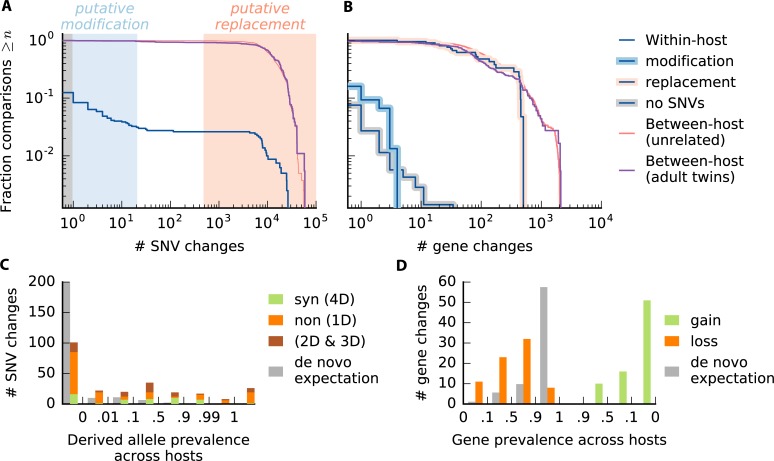
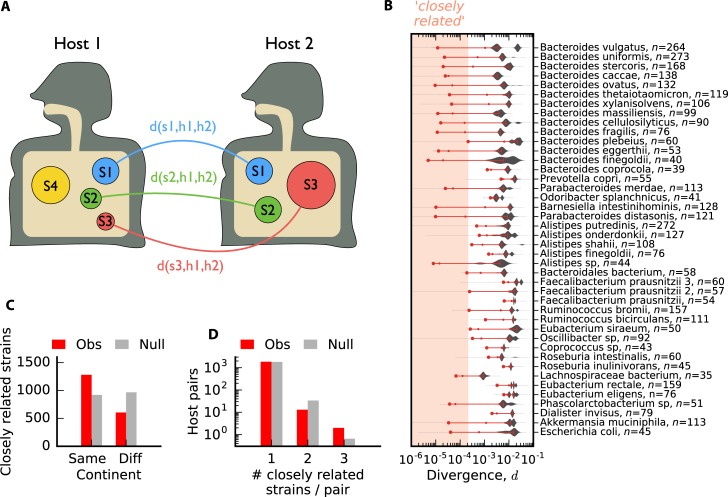
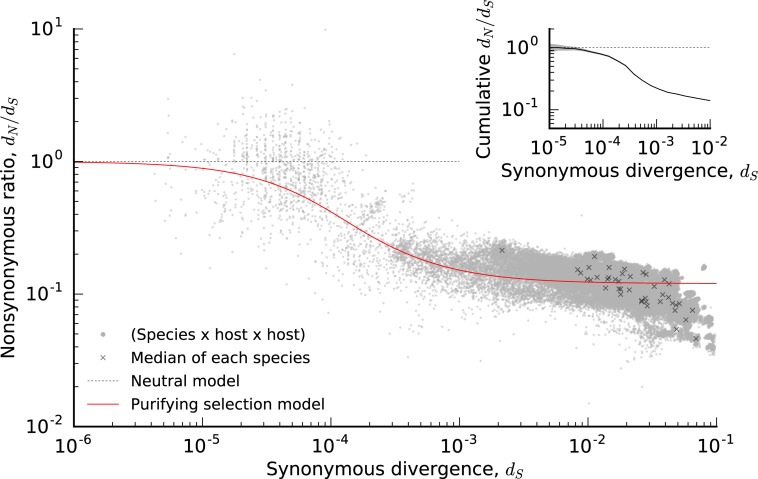
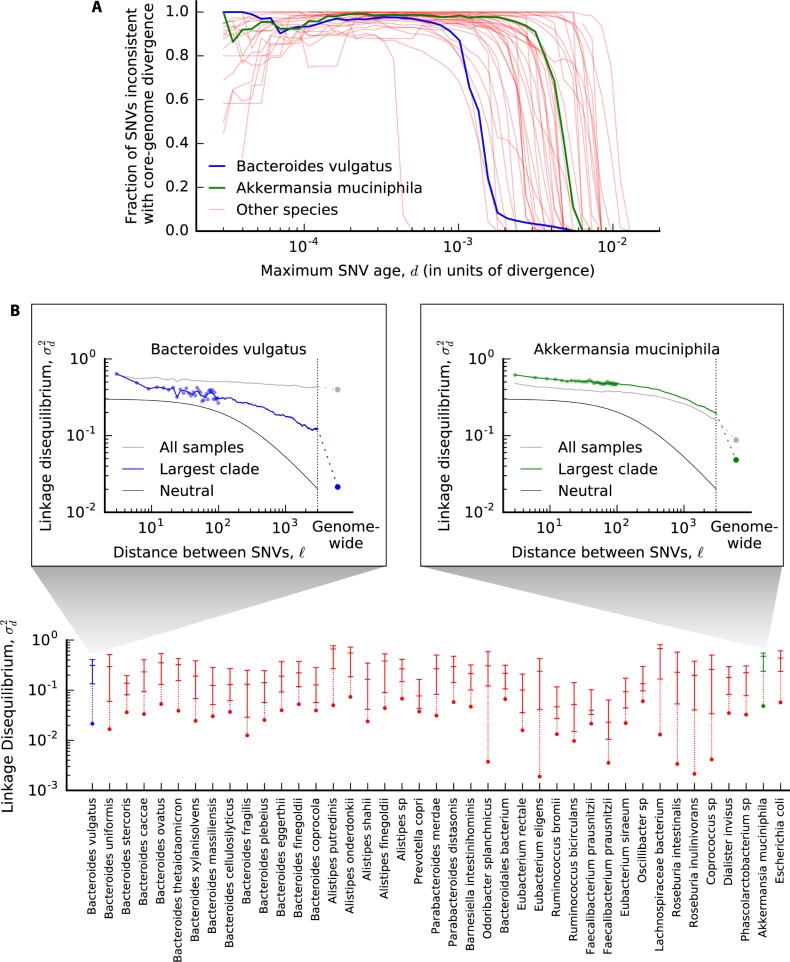
Gut microbiota are shaped by a combination of ecological and evolutionary forces. While the ecological dynamics have been extensively studied, much less is known about how species of gut bacteria evolve over time. Here, we introduce a model-based framework for quantifying evolutionary dynamics within and across hosts using a panel of metagenomic samples. We use this approach to study evolution in approximately 40 prevalent species in the human gut. Although the patterns of between-host diversity are consistent with quasi-sexual evolution and purifying selection on long timescales, we identify new genealogical signatures that challenge standard population genetic models of these processes. Within hosts, we find that genetic differences that accumulate over 6-month timescales are only rarely attributable to replacement by distantly related strains. Instead, the resident strains more commonly acquire a smaller number of putative evolutionary changes, in which nucleotide variants or gene gains or losses rapidly sweep to high frequency. By comparing these mutations with the typical between-host differences, we find evidence that some sweeps may be seeded by recombination, in addition to new mutations. However, comparisons of adult twins suggest that replacement eventually overwhelms evolution over multi-decade timescales, hinting at fundamental limits to the extent of local adaptation. Together, our results suggest that gut bacteria can evolve on human-relevant timescales, and they highlight the connections between these short-term evolutionary dynamics and longer-term evolution across hosts.
肠道微生物群是由生态和进化力量共同塑造的。虽然生态动力学已经得到了广泛的研究,但对于肠道细菌如何随时间进化知之甚少。在这里,我们引入了一个基于模型的框架,用于使用一组宏基因组样本定量衡量宿主内和宿主间的进化动态。我们使用这种方法研究了人类肠道中大约 40 种常见物种的进化。尽管种间多样性的模式与准性进化和长时间尺度上的净化选择一致,但我们发现了新的系统发育特征,这些特征对这些过程的标准群体遗传模型提出了挑战。在宿主内,我们发现,在 6 个月的时间尺度上积累的遗传差异很少归因于与远缘菌株的替换。相反,常驻菌株更常见地获得少量假定的进化变化,其中核苷酸变体或基因增益或损失迅速高频扫荡到高频率。通过将这些突变与典型的种间差异进行比较,我们发现证据表明,一些扫荡可能除了新突变之外,还由重组引发。然而,对成年双胞胎的比较表明,在数十年的时间尺度上,替换最终会压倒进化,这暗示了局部适应的程度存在根本限制。总之,我们的研究结果表明,肠道细菌可以在人类相关的时间尺度上进化,并强调了这些短期进化动态与种间长期进化之间的联系。