Coagulation Laboratory, Department of Clinical Chemistry, Division of Laboratory Medicine, Skåne County Council, Malmö, Sweden.
Department of Haematology, Coagulation Unit, Skåne University Hospital, Lund, Sweden.
PLoS One. 2019 Jan 23;14(1):e0211130. doi: 10.1371/journal.pone.0211130. eCollection 2019.
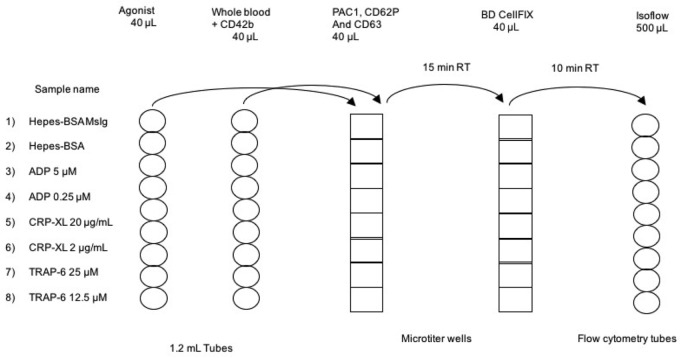
Flow cytometric platelet activation has emerged as an alternative diagnostic test for inherited platelet disorders. It is, however, labor intensive and few studies have directly compared the performance of flow cytometric platelet activation (PACT) to light transmission aggregometry (LTA). The aims of this study were 1/ to develop a simplified flow cytometric platelet activation assay using microtiter plates and 2/ to correlate the outcome to gold standard method LTA, and to clinical bleeding assessment tool scores (BAT score).
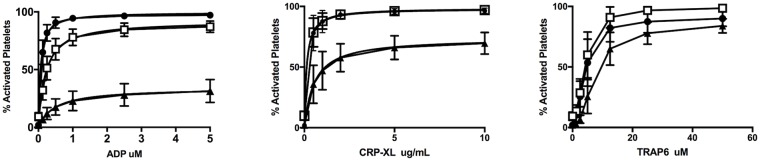
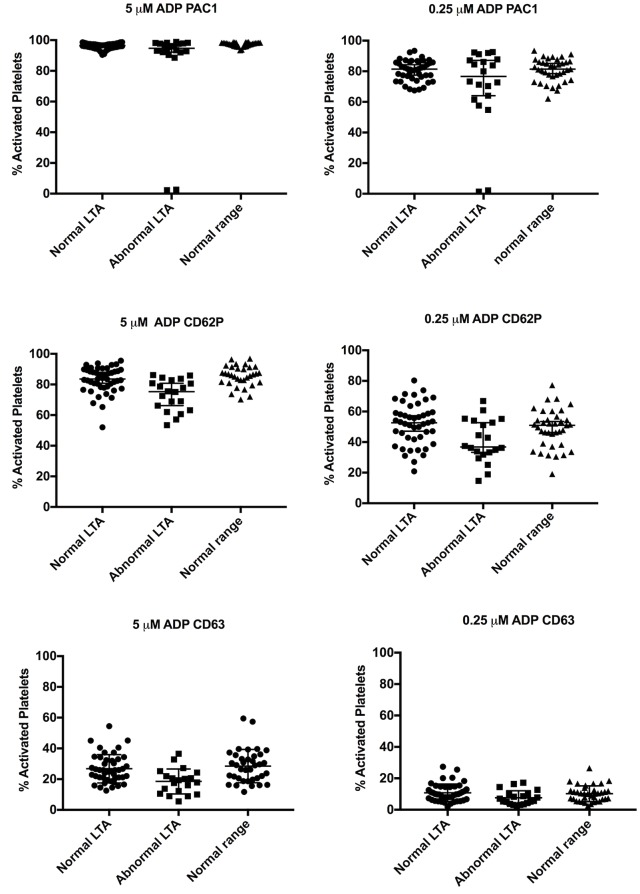
The PACT method was developed in microtiter plates using adenosine diphosphate (ADP), collagen-derived peptide (CRP-XL) and thrombin receptor activator for peptide 6 (TRAP-6) as agonists. Antibodies against GPIIb-IIIa activation epitope (PAC1), P-selectin (CD62P) and lysosome-associated membrane glycoprotein 3 (LAMP3; CD63) were used as platelet activation markers. Sixty-six patients referred to the coagulation unit for bleeding symptoms were included in this single-center observational study. Platelet activation was determined by PACT and LTA. The results of both methods were correlated to BAT score.
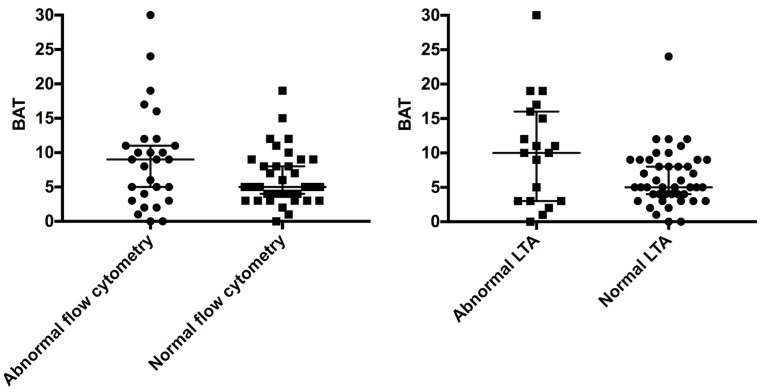
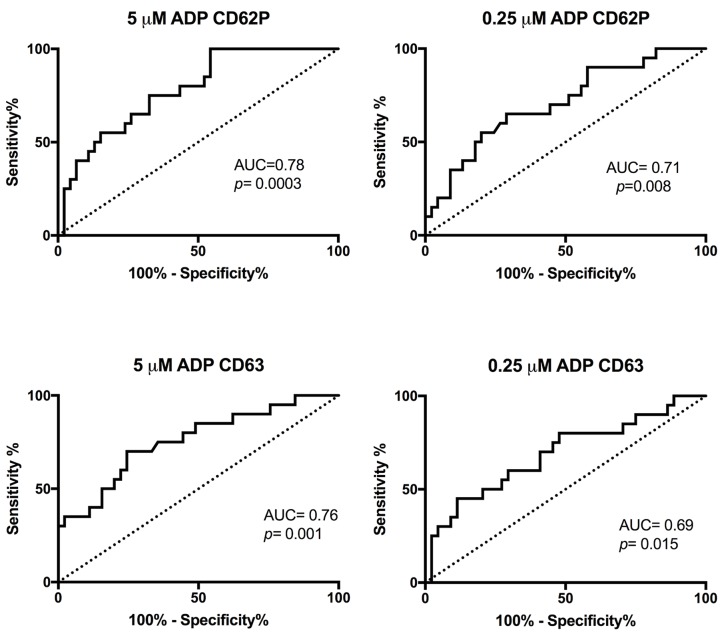
A two-by-two analysis using Cohen's kappa analysis gave moderate agreement between LTA and PACT (82%, kappa = 0.57), when PACT analysis with ADP and CRP-XL was compared to LTA. Using LTA as reference method, positive predictive value was 70% and negative predictive value was 87%. A substantial number of patients had high BAT score and normal LTA and PACT results. Patients with abnormal LTA or PACT results had higher BAT score than patients with normal results, but the difference was not significant.
The performance in microtiter plates simplified the PACT method and enabled analysis of more patients at the same time. Our results indicate that with modification of the current PACT assay, a higher negative predictive value can be obtained. Furthermore, with comparable result to LTA the PACT could be used as a screening assay for inherited platelet disorders.
流式细胞术血小板活化已成为遗传性血小板疾病的替代诊断测试。然而,它需要大量的劳动,并且很少有研究直接比较流式细胞术血小板活化(PACT)与光传输聚集(LTA)的性能。本研究的目的是:1/ 使用微孔板开发简化的流式细胞术血小板活化测定法,2/ 将结果与金标准方法 LTA 相关联,并与临床出血评估工具评分(BAT 评分)相关联。
在微孔板中使用二磷酸腺苷(ADP)、胶原蛋白衍生肽(CRP-XL)和血栓素受体激活肽 6(TRAP-6)作为激动剂开发 PACT 方法。使用针对 GPIIb-IIIa 活化表位(PAC1)、P-选择素(CD62P)和溶酶体相关膜糖蛋白 3(LAMP3;CD63)的抗体作为血小板活化标志物。将 66 名因出血症状而转至凝血单位的患者纳入本单中心观察性研究。通过 PACT 和 LTA 测定血小板活化。将两种方法的结果与 BAT 评分相关联。
使用 Cohen 的 kappa 分析进行的两两分析显示,ADP 和 CRP-XL 分析与 LTA 相比,LTA 与 PACT 之间具有中等程度的一致性(82%,kappa = 0.57)。当使用 LTA 作为参考方法时,阳性预测值为 70%,阴性预测值为 87%。相当数量的患者具有高 BAT 评分和正常的 LTA 和 PACT 结果。与正常结果相比,LTA 或 PACT 结果异常的患者的 BAT 评分更高,但差异无统计学意义。
在微孔板中的性能简化了 PACT 方法,并能够同时分析更多的患者。我们的结果表明,通过对当前 PACT 检测方法进行修改,可以获得更高的阴性预测值。此外,与 LTA 具有可比性的 PACT 可作为遗传性血小板疾病的筛选检测方法。