Zou Yi, Tan Haiping, Zhao Yuanfeng, Zhou Yuan, Cao Lin
Department of Biology, School of Life Science and Technology, Jinan University, Guangzhou, Guangdong 510632, P.R. China.
Department of Anesthesiology of Sun Yat-Sen Memorial Hospital, Sun Yat-Sen University, Guangzhou, Guangdong 510120, P.R. China.
Oncol Lett. 2019 Feb;17(2):1723-1731. doi: 10.3892/ol.2018.9773. Epub 2018 Nov 28.
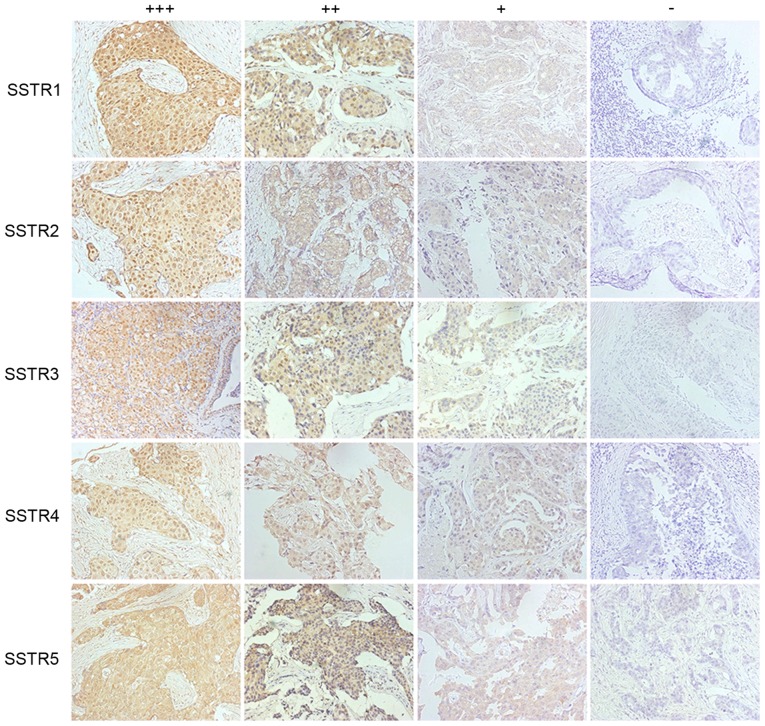
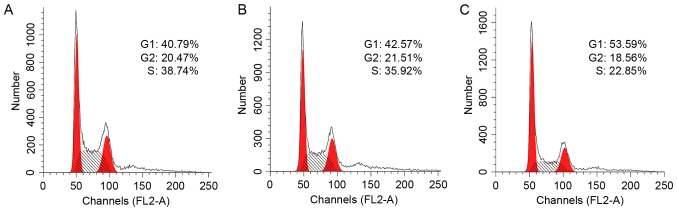
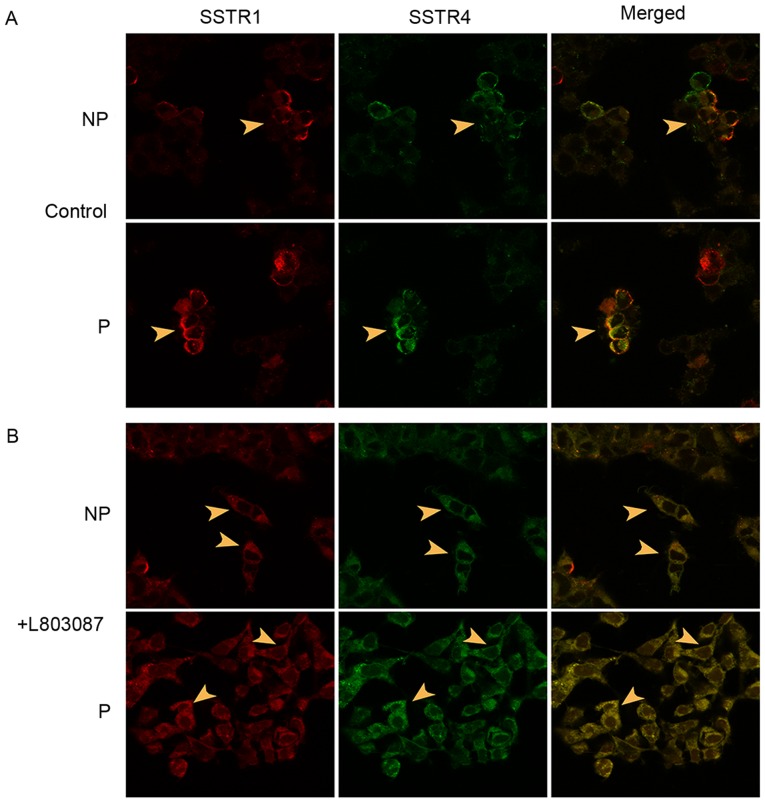
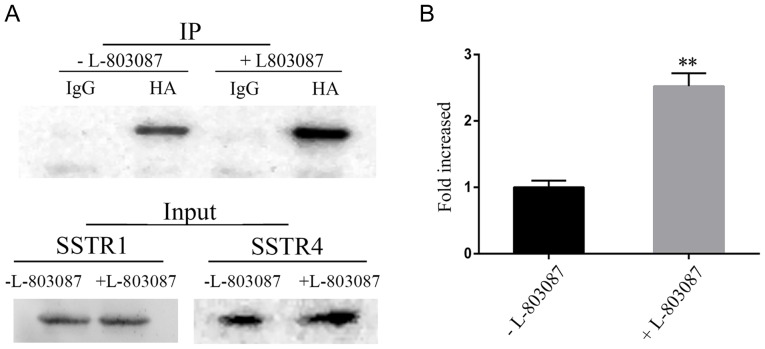
Somatostatin receptors (SSTRs) are G-protein-coupled plasma membrane receptors that have been determined to be expressed in normal and cancer tissues. Activation of SSTRs frequently results in inhibition of cell proliferation and therefore somatostatin analogues (SSAs) have been used in cancer treatment. However, the variable outcomes of SSA treatment were considered to be the consequences of loss-of-expression of SSTRs and/or subtype-specific effects. In the present study, the patterns of SSTR expression in 160 breast cancer tissues were investigated, and the mechanisms of SSTR activation and the influence on cell proliferation were further characterized. The expression levels of SSTR1-5 were determined using immunohistology. Hemagglutinin-SSTR1 and MYC-SSTR4 were transiently overexpressed in MDA-MB-435S cells, and the potential receptor dimerization was determined using immunofluorescence and co-immunoprecipitation. The influence of SSTR1 and SSTR4 expression/activation on cell proliferation was monitored using flow cytometry. The results demonstrated that all five SSTR subtypes were expressed at variable levels in tumor tissues, with the highest positive expression instance being determined for SSTR1 and SSTR4, with positive expression levels in 90.0 and 71.3% of tumor tissues, respectively. Immunofluorescence and co-immunoprecipitation revealed SSTR1/SSTR4 heterodimerization, which was increased in response to receptor activation using the subtype-specific SSA L-803087. The translocation of SSTR1/SSTR4 dimers into the cytoplasm upon receptor activation was also observed. Additionally, it was identified using flow cytometry that co-expression and activation of SSTR1 and SSTR4 in MDA-MB-435S cells resulted in a decreased proportion of S-phase cells. The results of the present study revealed that SSTR1 and SSTR4 are the most frequently expressed SSTR subtypes in breast cancer, and that the cell cycle arrest was mediated by SSTR1/SSTR4 dimerization/activation.
生长抑素受体(SSTRs)是G蛋白偶联的质膜受体,已确定在正常组织和癌组织中表达。SSTRs的激活通常会导致细胞增殖受到抑制,因此生长抑素类似物(SSAs)已被用于癌症治疗。然而,SSA治疗结果的差异被认为是SSTRs表达缺失和/或亚型特异性效应的结果。在本研究中,调查了160例乳腺癌组织中SSTR的表达模式,并进一步表征了SSTR激活的机制及其对细胞增殖的影响。采用免疫组织学方法测定SSTR1-5的表达水平。在MDA-MB-435S细胞中瞬时过表达血凝素-SSTR1和MYC-SSTR4,并采用免疫荧光和免疫共沉淀法测定潜在的受体二聚化。采用流式细胞术监测SSTR1和SSTR4表达/激活对细胞增殖的影响。结果表明,所有五种SSTR亚型在肿瘤组织中的表达水平各不相同,其中SSTR1和SSTR4的阳性表达率最高,分别为90.0%和71.3%。免疫荧光和免疫共沉淀显示SSTR1/SSTR4异二聚化,使用亚型特异性SSA L-803087激活受体后,异二聚化增加。还观察到受体激活后SSTR1/SSTR4二聚体向细胞质的转位。此外,通过流式细胞术鉴定,MDA-MB-435S细胞中SSTR1和SSTR4的共表达和激活导致S期细胞比例降低。本研究结果表明,SSTR1和SSTR4是乳腺癌中最常表达的SSTR亚型,细胞周期停滞是由SSTR1/SSTR4二聚化/激活介导的。