• 文献检索
  • 文档翻译
  • 深度研究
  • 学术资讯
  • Suppr Zotero 插件Zotero 插件
  • 邀请有礼
  • 套餐&价格
  • 历史记录
应用&插件
Suppr Zotero 插件Zotero 插件浏览器插件Mac 客户端Windows 客户端微信小程序
定价
高级版会员购买积分包购买API积分包
服务
文献检索文档翻译深度研究API 文档MCP 服务
关于我们
关于 Suppr公司介绍联系我们用户协议隐私条款
关注我们

Suppr 超能文献

核心技术专利:CN118964589B侵权必究
粤ICP备2023148730 号-1Suppr @ 2026

文献检索

告别复杂PubMed语法,用中文像聊天一样搜索,搜遍4000万医学文献。AI智能推荐,让科研检索更轻松。

立即免费搜索

文件翻译

保留排版,准确专业,支持PDF/Word/PPT等文件格式,支持 12+语言互译。

免费翻译文档

深度研究

AI帮你快速写综述,25分钟生成高质量综述,智能提取关键信息,辅助科研写作。

立即免费体验

载药纳米粒控释地塞米松磷酸钠抑制实验性角膜新生血管。

Controlled release of dexamethasone sodium phosphate with biodegradable nanoparticles for preventing experimental corneal neovascularization.

机构信息

Department of Ophthalmology, Fujian Medical University Union Hospital, Fuzhou, Fujian Province, PR China; Department of Ophthalmology, The Johns Hopkins University School of Medicine, Baltimore, MD, USA; Center for Nanomedicine, Wilmer Eye Institute, The Johns Hopkins University School of Medicine, Baltimore, MD, USA.

Department of Ophthalmology, The Johns Hopkins University School of Medicine, Baltimore, MD, USA; Center for Nanomedicine, Wilmer Eye Institute, The Johns Hopkins University School of Medicine, Baltimore, MD, USA; Department of Ophthalmology, Eye and ENT Hospital of Fudan University, Shanghai, PR China.

出版信息

Nanomedicine. 2019 Apr;17:119-123. doi: 10.1016/j.nano.2019.01.001. Epub 2019 Jan 21.

DOI:10.1016/j.nano.2019.01.001
PMID:30677499
原文链接:https://pmc.ncbi.nlm.nih.gov/articles/PMC6520116/
Abstract

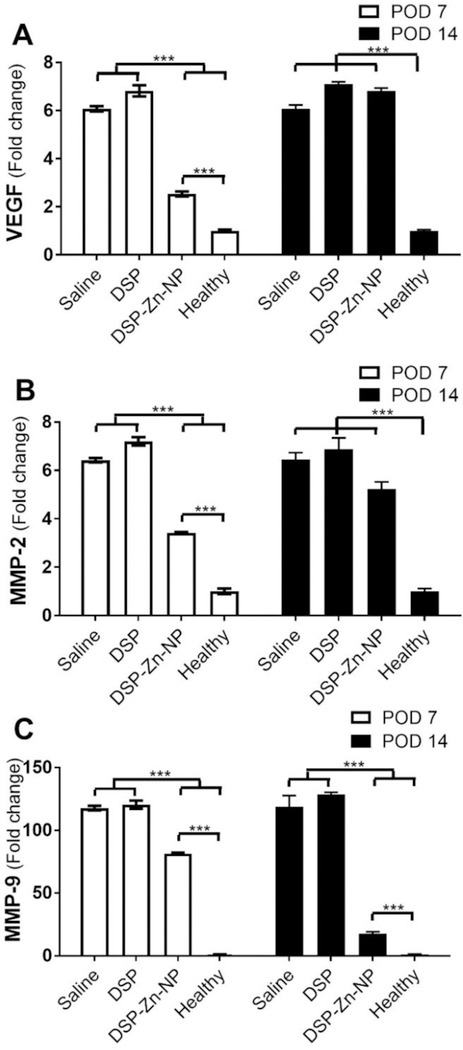
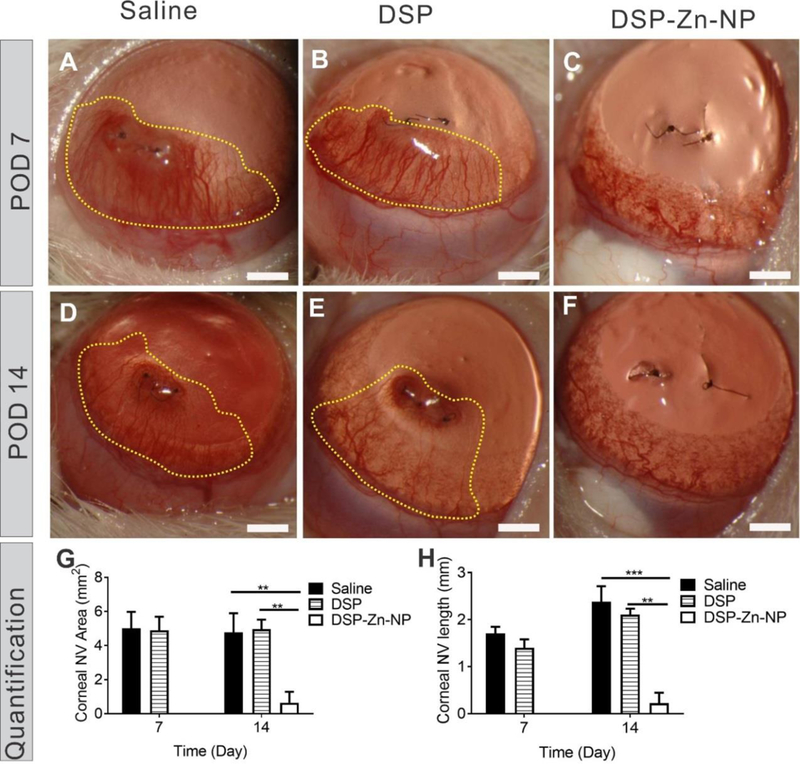
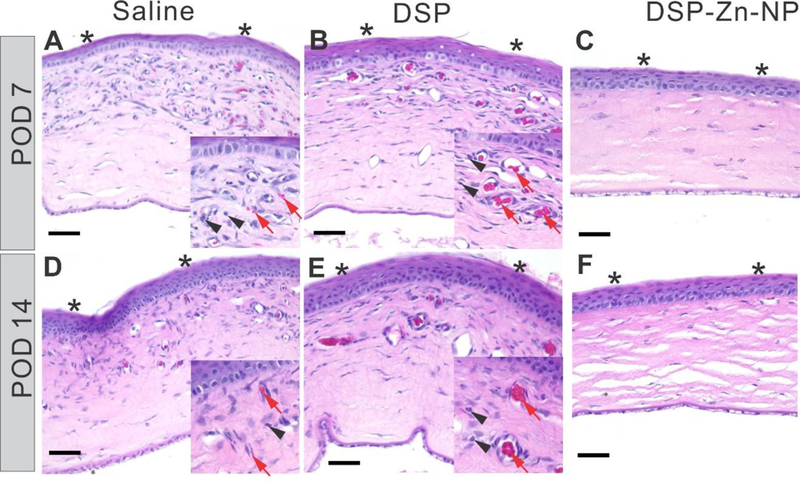
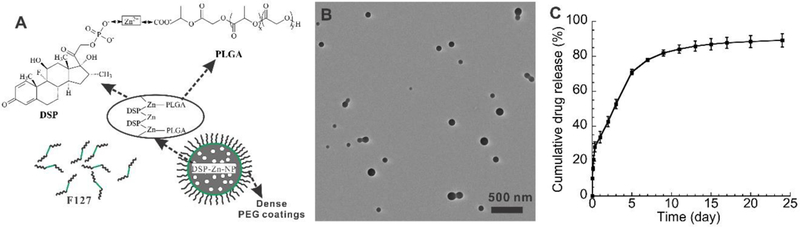
Corneal neovascularization (CNV) leads to the loss of corneal transparency and vision impairment, and can ultimately cause blindness. Topical corticosteroids are the first line treatment for suppressing CNV, but poor ocular bioavailability and rapid clearance of eye drops makes frequent administration necessary. Patient compliance with frequent eye drop application regimens is poor. We developed biodegradable nanoparticles (NP) loaded with dexamethasone sodium phosphate (DSP) using zinc ion bridging, DSP-Zn-NP, with dense coatings of poly(ethylene glycol) (PEG). DSP-Zn-NP were safe and capable of providing sustained delivery of DSP to the front of the eye following subconjunctival (SCT) administration in rats. We reported that a single SCT administration of DSP-Zn-NP prevented suture-induced CNV in rats for two weeks. In contrast, the eyes receiving SCT administration of either saline or DSP solution developed extensive CNV in less than 1 week. SCT administration of DSP-Zn-NP could be an effective strategy in preventing and treating CNV.

摘要

角膜新生血管(CNV)可导致角膜透明度丧失和视力损害,最终可导致失明。局部皮质类固醇是抑制 CNV 的一线治疗方法,但眼部生物利用度差和滴眼液清除迅速,需要频繁给药。患者对频繁滴眼方案的依从性较差。我们使用锌离子桥接开发了负载磷酸二氢钠地塞米松(DSP)的可生物降解纳米颗粒(NP),即 DSP-Zn-NP,其表面覆盖有密集的聚乙二醇(PEG)。DSP-Zn-NP 安全,并且能够在大鼠结膜下(SCT)给药后向眼前部持续递送 DSP。我们报道,单次 SCT 给予 DSP-Zn-NP 可预防大鼠缝线诱导的 CNV 达两周。相比之下,接受 SCT 生理盐水或 DSP 溶液给药的眼睛在不到 1 周内就发生了广泛的 CNV。SCT 给予 DSP-Zn-NP 可能是预防和治疗 CNV 的有效策略。
https://cdn.ncbi.nlm.nih.gov/pmc/blobs/b06f/6520116/61a6710dde0a/nihms-1519202-f0005.jpg
https://cdn.ncbi.nlm.nih.gov/pmc/blobs/b06f/6520116/62cd41bbd0f5/nihms-1519202-f0002.jpg
https://cdn.ncbi.nlm.nih.gov/pmc/blobs/b06f/6520116/72a934f01d7c/nihms-1519202-f0003.jpg
https://cdn.ncbi.nlm.nih.gov/pmc/blobs/b06f/6520116/42b5d176ec65/nihms-1519202-f0004.jpg
https://cdn.ncbi.nlm.nih.gov/pmc/blobs/b06f/6520116/61a6710dde0a/nihms-1519202-f0005.jpg
https://cdn.ncbi.nlm.nih.gov/pmc/blobs/b06f/6520116/62cd41bbd0f5/nihms-1519202-f0002.jpg
https://cdn.ncbi.nlm.nih.gov/pmc/blobs/b06f/6520116/72a934f01d7c/nihms-1519202-f0003.jpg
https://cdn.ncbi.nlm.nih.gov/pmc/blobs/b06f/6520116/42b5d176ec65/nihms-1519202-f0004.jpg
https://cdn.ncbi.nlm.nih.gov/pmc/blobs/b06f/6520116/61a6710dde0a/nihms-1519202-f0005.jpg

相似文献

1
Controlled release of dexamethasone sodium phosphate with biodegradable nanoparticles for preventing experimental corneal neovascularization.载药纳米粒控释地塞米松磷酸钠抑制实验性角膜新生血管。
Nanomedicine. 2019 Apr;17:119-123. doi: 10.1016/j.nano.2019.01.001. Epub 2019 Jan 21.
2
Controlled release of corticosteroid with biodegradable nanoparticles for treating experimental autoimmune uveitis.载药生物可降解纳米粒控释皮质类固醇治疗实验性自身免疫性葡萄膜炎。
J Control Release. 2019 Feb 28;296:68-80. doi: 10.1016/j.jconrel.2019.01.018. Epub 2019 Jan 17.
3
Corticosteroid-loaded biodegradable nanoparticles for prevention of corneal allograft rejection in rats.用于预防大鼠角膜移植排斥反应的载皮质类固醇可生物降解纳米颗粒
J Control Release. 2015 Mar 10;201:32-40. doi: 10.1016/j.jconrel.2015.01.009. Epub 2015 Jan 8.
4
Dexamethasone sodium phosphate loaded nanoparticles for prevention of nitrogen mustard induced corneal injury.载有地塞米松磷酸钠的纳米颗粒预防氮芥诱导的角膜损伤。
Exp Eye Res. 2024 Jun;243:109902. doi: 10.1016/j.exer.2024.109902. Epub 2024 Apr 18.
5
pH-Sensitive cationic copolymers of different macromolecular architecture as potential dexamethasone sodium phosphate delivery systems.具有不同大分子结构的pH敏感阳离子共聚物作为潜在的地塞米松磷酸钠递送系统。
J Pharm Sci. 2014 Aug;103(8):2406-13. doi: 10.1002/jps.24059. Epub 2014 Jun 24.
6
Six-month effective treatment of corneal graft rejection.角膜移植排斥的六个月有效治疗。
Sci Adv. 2023 Mar 22;9(12):eadf4608. doi: 10.1126/sciadv.adf4608.
7
In vivo effect of bevacizumab-loaded albumin nanoparticles in the treatment of corneal neovascularization.载贝伐单抗白蛋白纳米粒对角膜新生血管的体内作用。
Exp Eye Res. 2019 Aug;185:107697. doi: 10.1016/j.exer.2019.107697. Epub 2019 Jun 19.
8
Dexamethasone-loaded ROS stimuli-responsive nanogels for topical ocular therapy of corneal neovascularization.载有地塞米松的 ROS 刺激响应纳米凝胶用于角膜新生血管化的局部眼治疗。
J Control Release. 2024 Aug;372:874-884. doi: 10.1016/j.jconrel.2024.07.012. Epub 2024 Jul 9.
9
Effect of caffeic acid phenethyl ester on corneal neovascularization in rats.咖啡酸苯乙酯对大鼠角膜新生血管形成的影响。
Curr Eye Res. 2001 Oct;23(4):291-7. doi: 10.1076/ceyr.23.4.291.5453.
10
Noninvasive Ocular Drug Delivery System of Dexamethasone Sodium Phosphate in the Treatment of Experimental Uveitis Rabbit.地塞米松磷酸钠非侵入性眼部给药系统治疗实验性葡萄膜炎兔
J Ocul Pharmacol Ther. 2017 Dec;33(10):753-762. doi: 10.1089/jop.2017.0053. Epub 2017 Oct 12.

引用本文的文献

1
Advancements and Prospects in Nanorobotic Applications for Ophthalmic Therapy.眼科治疗中纳米机器人应用的进展与前景
ACS Biomater Sci Eng. 2025 Feb 10;11(2):958-980. doi: 10.1021/acsbiomaterials.4c02368. Epub 2025 Jan 17.
2
Dexamethasone sodium phosphate loaded nanoparticles for prevention of nitrogen mustard induced corneal injury.载有地塞米松磷酸钠的纳米颗粒预防氮芥诱导的角膜损伤。
Exp Eye Res. 2024 Jun;243:109902. doi: 10.1016/j.exer.2024.109902. Epub 2024 Apr 18.
3
Biodegradable Polymer-Based Drug-Delivery Systems for Ocular Diseases.

本文引用的文献

1
Corticosteroid-loaded biodegradable nanoparticles for prevention of corneal allograft rejection in rats.用于预防大鼠角膜移植排斥反应的载皮质类固醇可生物降解纳米颗粒
J Control Release. 2015 Mar 10;201:32-40. doi: 10.1016/j.jconrel.2015.01.009. Epub 2015 Jan 8.
2
Inhibition of corneal neovascularization by topical and subconjunctival tigecycline.局部及结膜下应用替加环素抑制角膜新生血管形成
J Ophthalmol. 2014;2014:452685. doi: 10.1155/2014/452685. Epub 2014 Aug 17.
3
Ocular-specific ER stress reduction rescues glaucoma in murine glucocorticoid-induced glaucoma.
基于可生物降解聚合物的眼部疾病药物传递系统。
Int J Mol Sci. 2023 Aug 19;24(16):12976. doi: 10.3390/ijms241612976.
4
Ionically bridged dexamethasone sodium phosphate-zinc-PLGA nanocomplex in alginate microgel for the local treatment of ulcerative colitis.离子桥接的地塞米松磷酸钠-锌-PLGA 纳米复合物在海藻酸钠微凝胶中用于溃疡性结肠炎的局部治疗。
Arch Pharm Res. 2023 Jul;46(7):646-658. doi: 10.1007/s12272-023-01456-z. Epub 2023 Aug 3.
5
Conceptualization and Investigation of Multicomponent Polymer Networks as Prospective Corticosteroid Carriers.多组分聚合物网络作为潜在皮质类固醇载体的概念化与研究
Gels. 2023 Jun 7;9(6):470. doi: 10.3390/gels9060470.
6
Targeted dexamethasone nano-prodrug for corneal neovascularization management.靶向地塞米松前药纳米载体用于角膜新生血管管理。
Biomed J. 2024 Feb;47(1):100592. doi: 10.1016/j.bj.2023.03.005. Epub 2023 Mar 31.
7
Updates on Biodegradable Formulations for Ocular Drug Delivery.眼部给药用可生物降解制剂的研究进展
Pharmaceutics. 2023 Feb 22;15(3):734. doi: 10.3390/pharmaceutics15030734.
8
Fenofibrate suppresses corneal neovascularization by regulating lipid metabolism through PPARα signaling pathway.非诺贝特通过过氧化物酶体增殖物激活受体α(PPARα)信号通路调节脂质代谢,从而抑制角膜新生血管形成。
Front Pharmacol. 2022 Dec 16;13:1000254. doi: 10.3389/fphar.2022.1000254. eCollection 2022.
9
An Update on Novel Ocular Nanosystems with Possible Benefits in the Treatment of Corneal Neovascularization.新型眼部纳米系统在治疗角膜新生血管方面的可能益处的最新进展。
Int J Nanomedicine. 2022 Oct 19;17:4911-4931. doi: 10.2147/IJN.S375570. eCollection 2022.
10
Alternative Controlling Agent of Pests: Nanoscale Surface and Fractal Analysis of Gelatin/PCL Loaded Particles Containing Essential Oil.害虫的替代控制剂:含精油的明胶/聚己内酯负载颗粒的纳米级表面和分形分析
Nanomaterials (Basel). 2022 Aug 7;12(15):2712. doi: 10.3390/nano12152712.
眼特异性内质网应激减轻可挽救糖皮质激素诱导性青光眼小鼠的青光眼。
J Clin Invest. 2014 May;124(5):1956-65. doi: 10.1172/JCI69774. Epub 2014 Apr 1.
4
Effects of subconjunctivally injected bevacizumab, etanercept, and the combination of both drugs on experimental corneal neovascularization.贝伐单抗、依那西普经结膜下注射及其联合用药对实验性角膜新生血管的影响。
Can J Ophthalmol. 2013 Apr;48(2):115-20. doi: 10.1016/j.jcjo.2012.12.003.
5
Activated macrophages induce neovascularization through upregulation of MMP-9 and VEGF in rat corneas.活化的巨噬细胞通过上调大鼠角膜中的 MMP-9 和 VEGF 诱导血管新生。
Cornea. 2012 Sep;31(9):1028-35. doi: 10.1097/ICO.0b013e31823f8b40.
6
Anti-angiogenic effect of KR-31831 on corneal and choroidal neovascularization in rat models.KR-31831 对大鼠模型角膜和脉络膜新生血管的抗血管生成作用。
Invest Ophthalmol Vis Sci. 2012 May 31;53(6):3111-9. doi: 10.1167/iovs.11-8499.
7
Treatments for corneal neovascularization: a review.角膜新生血管治疗:综述。
Cornea. 2011 Aug;30(8):927-38. doi: 10.1097/ICO.0b013e318201405a.
8
Biodegradable nanoparticles composed entirely of safe materials that rapidly penetrate human mucus.完全由安全材料组成的可生物降解纳米颗粒,能迅速穿透人体黏液。
Angew Chem Int Ed Engl. 2011 Mar 7;50(11):2597-600. doi: 10.1002/anie.201006849. Epub 2011 Feb 18.
9
Inhibition of corneal neovascularization after alkali burn: comparison of different doses of bevacizumab in monotherapy or associated with dexamethasone.碱烧伤后角膜新生血管的抑制:不同剂量贝伐单抗单药治疗或联合地塞米松治疗的比较。
Clin Exp Ophthalmol. 2010 May;38(4):346-52. doi: 10.1111/j.1442-9071.2010.02252.x.
10
Inhibition of corneal neovascularization by topical bevacizumab (Anti-VEGF) and Sunitinib (Anti-VEGF and Anti-PDGF) in an animal model.在动物模型中,局部应用贝伐单抗(抗 VEGF)和舒尼替尼(抗 VEGF 和抗 PDGF)抑制角膜新生血管形成。
Am J Ophthalmol. 2010 Oct;150(4):519-528.e1. doi: 10.1016/j.ajo.2010.04.024. Epub 2010 Jun 29.