Departamento de Ecologia, Universidade de São Paulo, São Paulo, SP, 05508-900, Brazil.
Sci Rep. 2019 Jan 24;9(1):676. doi: 10.1038/s41598-018-35803-8.
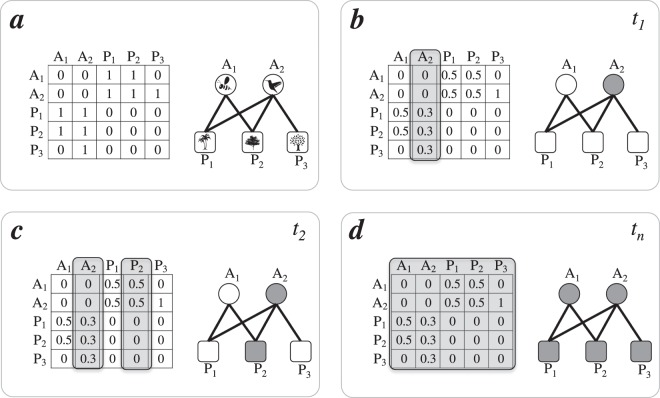
Perturbations, such as fluctuations in abundance, can ripple across species assemblages through ecological interactions. Furthermore, the way in which ecological interactions are organized into a network and the interaction strengths connecting species may be important for cascading effects. Previous work revealed that network structure determines how cascading effects spread across species assemblages. A next step is to understand how interaction strengths influence cascading effects. Here, we assume that perturbations have negative effects, and we evaluate whether interaction strength affects network robustness to cascading effects in mutualistic interactions, and examine the role of network structure in mediating perturbation cascades when interaction strength is incorporated. We combine empirical data on 18 mutualistic networks, two simulations scenarios, and network theory, to investigate how network structure affects perturbation spreading time, a proxy of network robustness to cascading effects. Simulations in which we included interaction strength presented higher mean spreading time, indicating that interaction strength increases network robustness. Richness, modularity, and nestedness had a strong, positive effect, on mean perturbation spreading time regardless of the interaction strengths. We found that network structure and the distribution of interaction strengths affected communities' robustness to perturbation spreading. Our results contribute to the discussion on the danger that ecosystems face when species, and interactions alike, become extinct.
扰动,如丰度波动,可能通过生态相互作用在物种组合中产生连锁反应。此外,生态相互作用如何组织成网络以及连接物种的相互作用强度对于级联效应可能很重要。先前的工作表明,网络结构决定了级联效应在物种组合中的传播方式。下一步是了解相互作用强度如何影响级联效应。在这里,我们假设扰动有负面影响,并评估相互作用强度是否会影响互惠关系中网络对级联效应的鲁棒性,并在纳入相互作用强度时检查网络结构在调解扰动级联中所起的作用。我们结合了 18 个互惠网络、两个模拟情景和网络理论的实证数据,以研究网络结构如何影响扰动传播时间,这是网络对级联效应鲁棒性的一个代理指标。我们纳入相互作用强度的模拟结果呈现出更高的平均传播时间,表明相互作用强度增加了网络的鲁棒性。无论相互作用强度如何,丰富度、模块性和嵌套性对平均扰动传播时间都有强烈的积极影响。我们发现,网络结构和相互作用强度的分布影响了群落对扰动传播的鲁棒性。我们的研究结果为讨论当物种和相互作用一样灭绝时,生态系统面临的危险提供了依据。