Ecology Department, College of Bioscience and Biotechnology, Hunan Provincial Key Laboratory of Rural Ecosystem Health in Dongting Lake Area, Hunan Agricultural University, Changsha, 410128, China.
Department of Biology, Lund University, SE-223 62, Lund, Sweden.
Sci Rep. 2019 Jan 24;9(1):511. doi: 10.1038/s41598-018-36997-7.
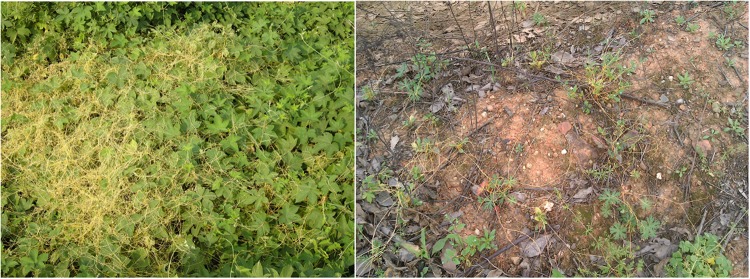
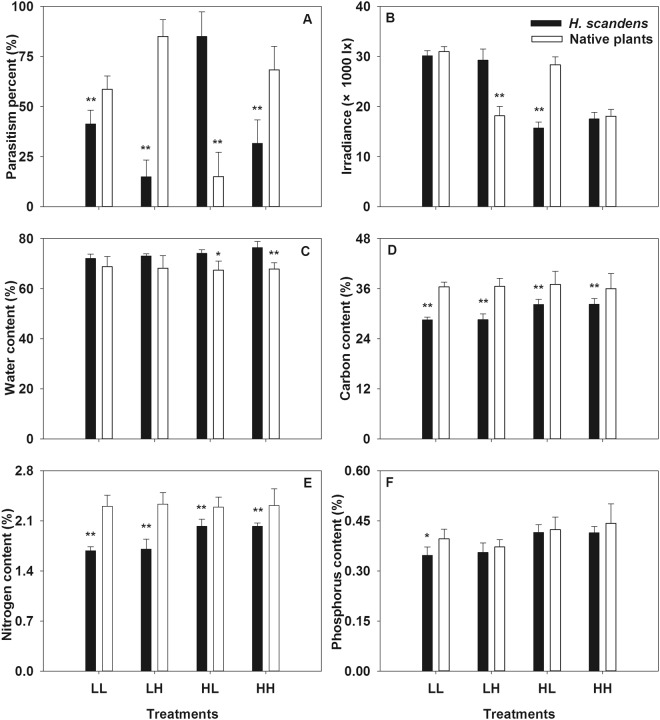
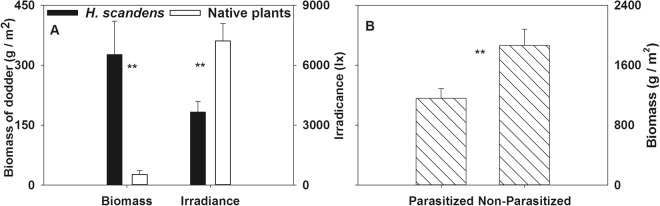
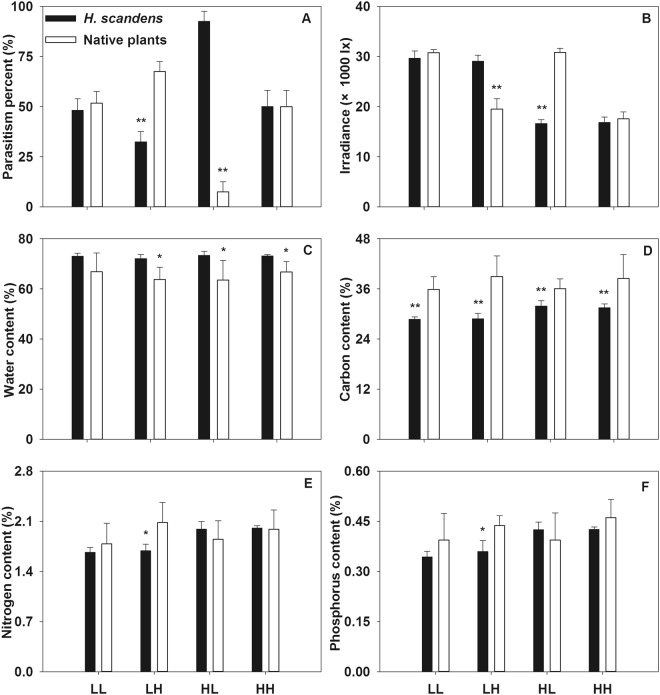
In weed management, using native parasites to control exotic weeds is considered a better alternative than classical biological control. But the risk must be assessed because of the potential damage caused by these agents. We conducted this project to investigate the mechanism driving the choice of a native obligate parasite, Cuscuta australis, between the exotic, Humulus scandens, and native plants as its host through field and pot experiments. The results showed that C. australis preferred the exotic weed over native (naturalized) hosts and caused a notable reduction in the biomass of H. scandens in the field. In contrast, the results of the pot experimentindicated that C. australis preferred a mix of native (naturalized) hosts over the exotic weed. Both texperiments indicated that the parasitic preference of C. australis was induced more by light irradiance than plant water, carbon (C), nitrogen (N) and phosphorus (P) contents, indicating that the native parasite can only be used to control H. scandens when the exotic weed forms mono-cultures or dominates the community. Accordingly, induction and release of C. australis to control H. scandens should be conducted with great caution.
在杂草管理中,利用本地寄生植物来控制外来杂草被认为是比传统生物控制更好的选择。但是,由于这些生物可能会造成潜在的破坏,因此必须进行风险评估。我们进行了这个项目,通过野外和盆栽实验,研究了本地专性寄生植物菟丝子在选择外来植物葎草和本地植物作为宿主时的驱动机制。结果表明,菟丝子更喜欢外来杂草作为宿主,而不是本地(归化)宿主,这导致葎草在野外的生物量显著减少。相比之下,盆栽实验的结果表明,菟丝子更喜欢混合的本地(归化)宿主,而不是外来杂草。这两个实验都表明,菟丝子的寄生偏好更多地受到光照强度的诱导,而不是植物的水分、碳(C)、氮(N)和磷(P)含量的影响,这表明当外来杂草形成单一种群或占据群落优势时,本地寄生虫才能被用来控制葎草。因此,在利用菟丝子诱导和释放来控制葎草时应该非常谨慎。