Department of Medicine, Washington University School of Medicine, St. Louis, MO, USA.
Department of Orthopaedic Surgery, Washington University School of Medicine, St. Louis, MO, USA.
Sci Rep. 2019 Jan 24;9(1):442. doi: 10.1038/s41598-018-37018-3.
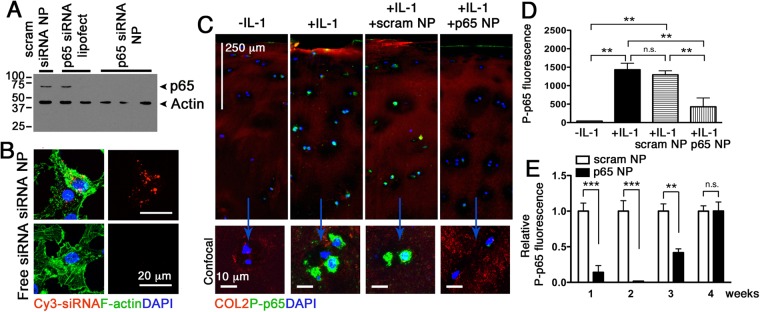
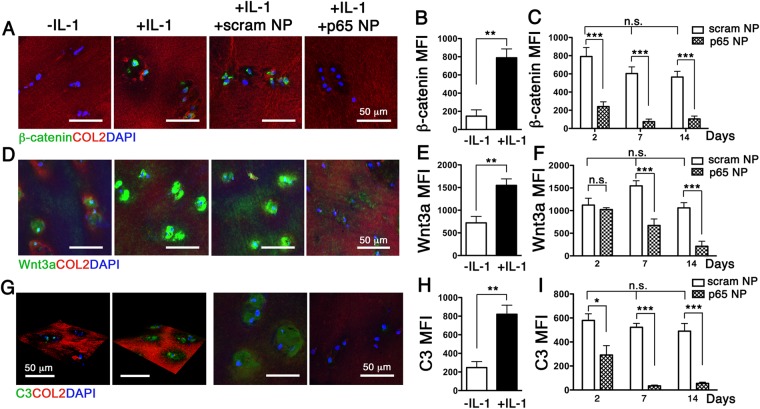
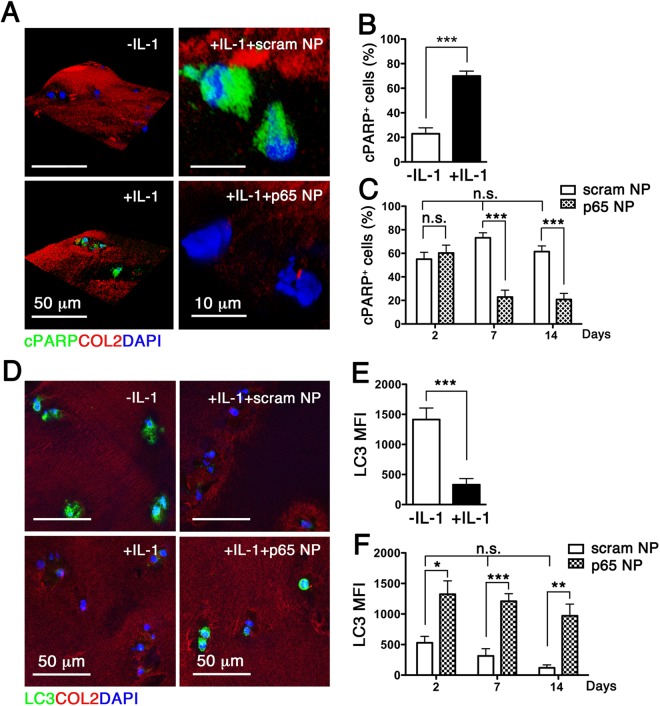
Delivery of therapeutic small interfering RNAs (siRNAs) in an effective dose to articular cartilage is very challenging as the cartilage dense extracellular matrix renders the chondrocytes inaccessible, even to intra-articular injections. Herein, we used a self-assembling peptidic nanoparticle (NP) platform featuring a cell penetrating peptide complexed to NF-κB p65 siRNA. We show that it efficiently and deeply penetrated human cartilage to deliver its siRNA cargo up to a depth of at least 700 μm. To simulate osteoarthritis in vitro, human articular cartilage explants were placed in culture and treated with IL-1β, a cytokine with known cartilage catabolic and pro-inflammatory effects. Exposure of peptide-siRNA NP to cartilage explants markedly suppressed p65 activation, an effect that persisted up to 3 weeks after an initial 48 h exposure to NP and in the presence of continuous IL-1β stimulation. Suppression of IL-1β-induced p65 activity attenuated chondrocyte apoptosis and maintained cartilage homeostasis. These findings confirm our previous in vivo studies in a murine model of post-traumatic osteoarthritis and suggest that the ability of peptide-siRNA NP to specifically modulate NF-κB pathway, a central regulator of the inflammatory responses in chondrocytes, may potentially mitigate the progression of cartilage degeneration.
将治疗性小干扰 RNA(siRNA)有效递送到关节软骨中非常具有挑战性,因为软骨致密的细胞外基质使软骨细胞难以接近,即使是关节内注射也是如此。在此,我们使用了一种自组装肽纳米颗粒(NP)平台,该平台具有与 NF-κB p65 siRNA 复合的细胞穿透肽。我们证明它能够高效且深入地穿透人软骨,将其 siRNA 有效递送到至少 700μm 的深度。为了模拟体外骨关节炎,将人关节软骨标本置于培养物中,并使用白细胞介素 1β(IL-1β)进行处理,IL-1β 是一种具有已知软骨分解代谢和促炎作用的细胞因子。肽-siRNA NP 暴露于软骨标本可显著抑制 p65 激活,这种作用在初始 48 小时暴露于 NP 后持续 3 周,并在持续 IL-1β刺激下持续存在。抑制 IL-1β 诱导的 p65 活性可减轻软骨细胞凋亡并维持软骨稳态。这些发现证实了我们之前在创伤后骨关节炎的小鼠模型中的体内研究,并表明肽-siRNA NP 特异性调节 NF-κB 途径(软骨细胞中炎症反应的中心调节剂)的能力可能潜在地减轻软骨退化的进展。