Kärcher Oskar, Hering Daniel, Frank Karin, Markovic Danijela
Faculty of Business Management and Social Sciences Osnabrück University of Applied Sciences Osnabrück Germany.
Faculty of Biology, Aquatic Ecology University of Duisburg-Essen Essen Germany.
Ecol Evol. 2018 Dec 18;9(1):111-124. doi: 10.1002/ece3.4659. eCollection 2019 Jan.
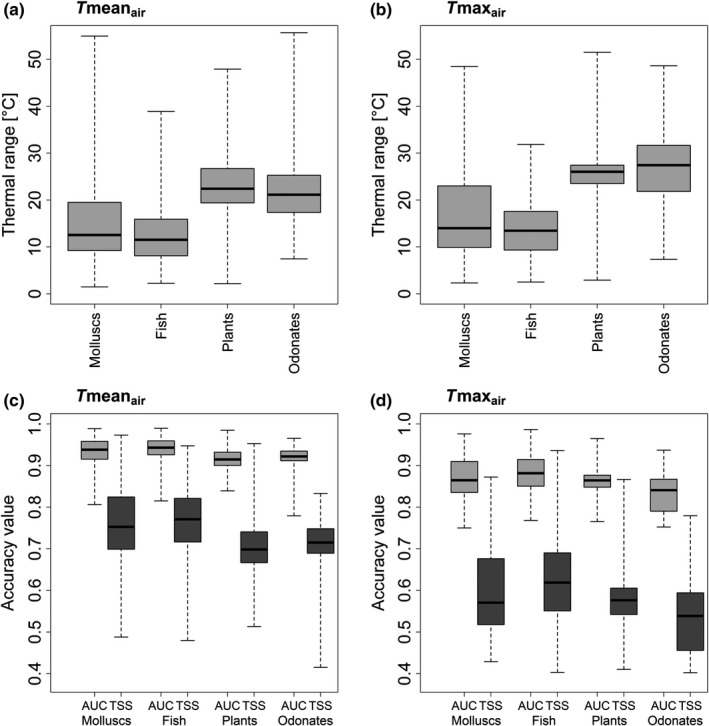
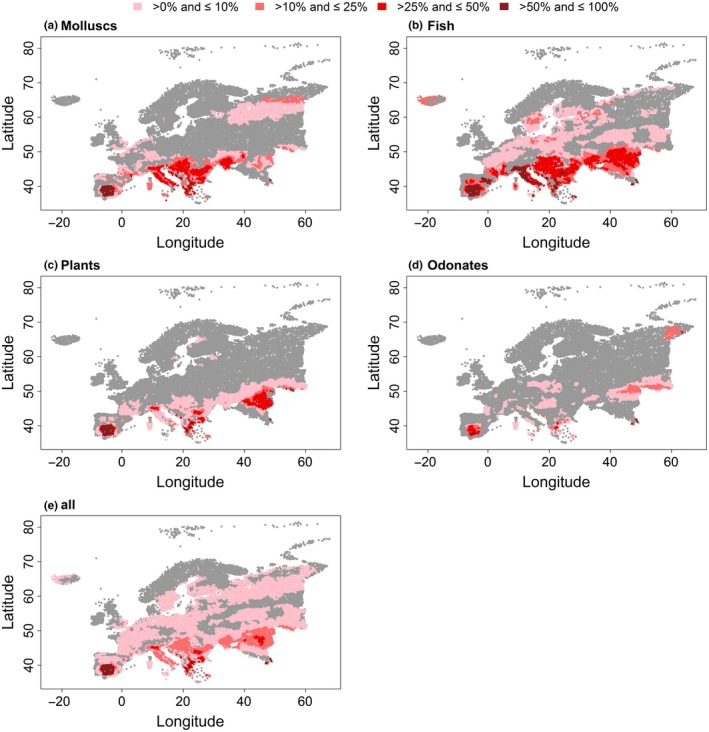
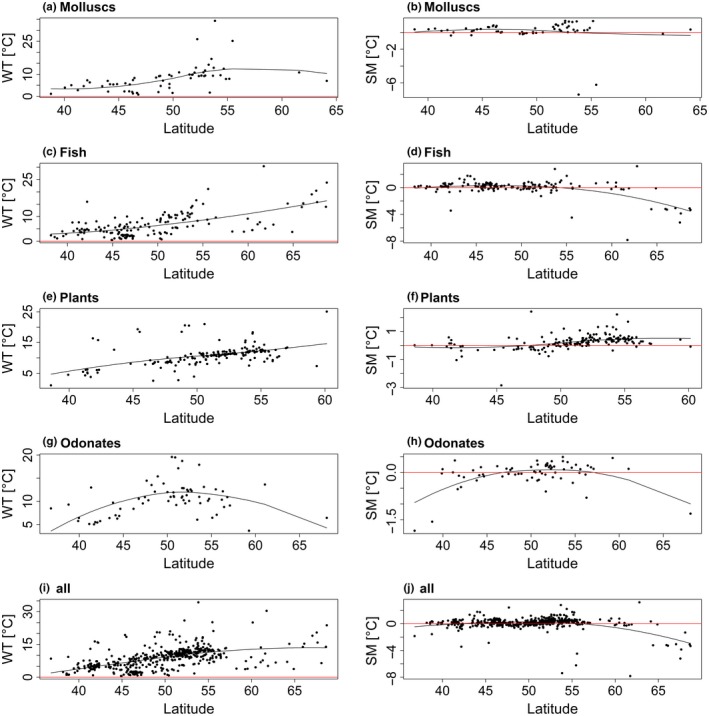
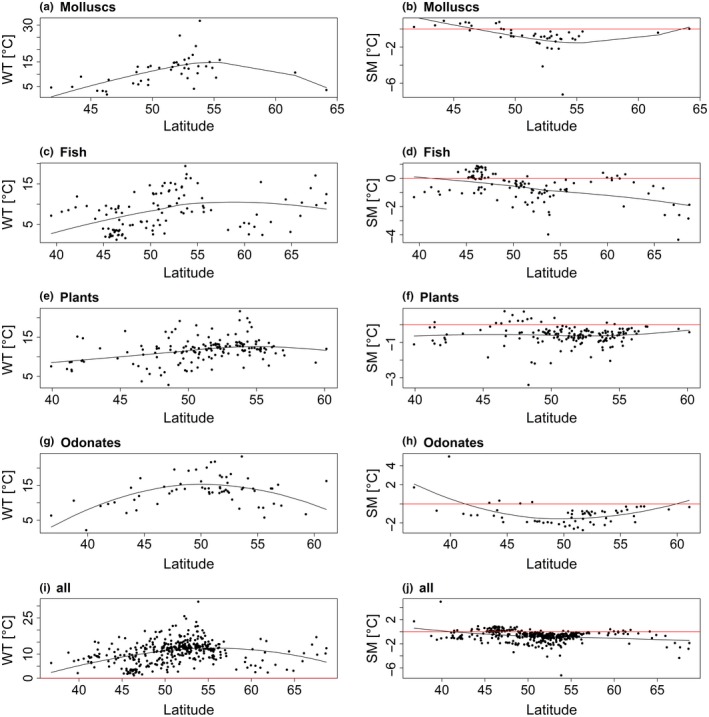
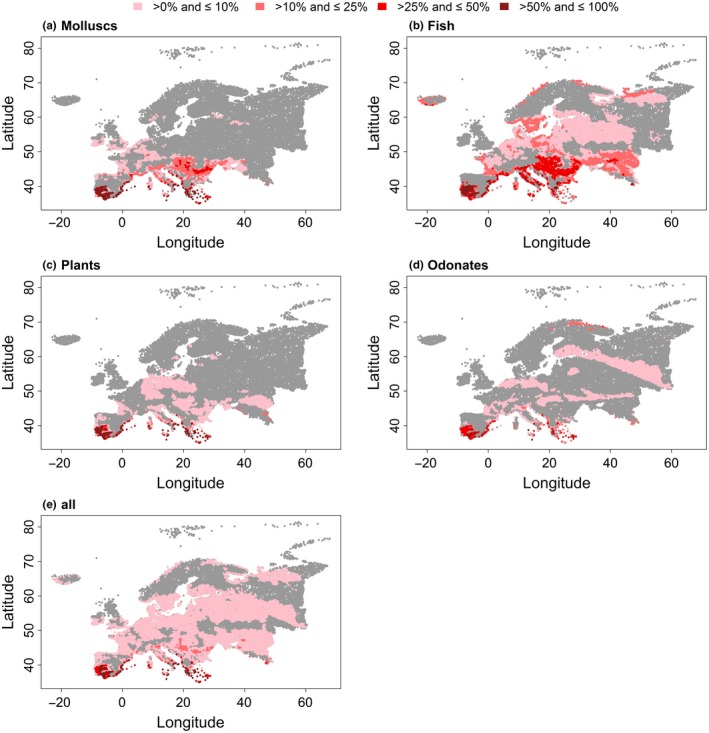
The distribution of a species along a thermal gradient is commonly approximated by a unimodal response curve, with a characteristic single optimum near the temperature where a species is most likely to be found, and a decreasing probability of occurrence away from the optimum. We aimed at identifying thermal response curves (TRCs) of European freshwater species and evaluating the potential impact of climate warming across species, taxonomic groups, and latitude. We first applied generalized additive models using catchment-scale global data on distribution ranges of 577 freshwater species native to Europe and four different temperature variables (the current annual mean air/water temperature and the maximum air/water temperature of the warmest month) to describe species TRCs. We then classified TRCs into one of eight curve types and identified spatial patterns in thermal responses. Finally, we integrated empirical TRCs and the projected geographic distribution of climate warming to evaluate the effect of rising temperatures on species' distributions. For the different temperature variables, 390-463 of 577 species (67.6%-80.2%) were characterized by a unimodal TRC. The number of species with a unimodal TRC decreased from central toward northern and southern Europe. Warming tolerance (WT = maximum temperature of occurrence-preferred temperature) was higher at higher latitudes. Preferred temperature of many species is already exceeded. Rising temperatures will affect most Mediterranean species. We demonstrated that freshwater species' occurrence probabilities are most frequently unimodal. The impact of the global climate warming on species distributions is species and latitude dependent. Among the studied taxonomic groups, rising temperatures will be most detrimental to fish. Our findings support the efforts of catchment-based freshwater management and conservation in the face of global warming.
一个物种沿热梯度的分布通常由单峰响应曲线近似表示,在最有可能发现该物种的温度附近有一个特征性的单一最优值,并且远离最优值时出现的概率降低。我们旨在确定欧洲淡水物种的热响应曲线(TRC),并评估气候变暖对不同物种、分类群和纬度的潜在影响。我们首先应用广义相加模型,使用欧洲本土577种淡水物种分布范围的流域尺度全球数据以及四个不同的温度变量(当前年平均气温/水温以及最暖月的最高气温/水温)来描述物种的TRC。然后,我们将TRC分类为八种曲线类型之一,并确定热响应的空间模式。最后,我们整合了经验TRC和气候变暖的预测地理分布,以评估温度上升对物种分布的影响。对于不同的温度变量,577个物种中的390 - 463个(67.6% - 80.2%)具有单峰TRC特征。具有单峰TRC的物种数量从欧洲中部向北部和南部减少。较高纬度地区的耐热性(WT = 出现的最高温度 - 偏好温度)更高。许多物种的偏好温度已经被超过。温度上升将影响大多数地中海物种。我们证明淡水物种的出现概率最常为单峰。全球气候变暖对物种分布的影响取决于物种和纬度。在所研究的分类群中,温度上升对鱼类的危害最大。我们的研究结果支持了在全球变暖背景下基于流域的淡水管理和保护工作。