Department of Zoonotic, Food- and Waterborne Infections, Division for Infection Control and Environmental Health, Norwegian Institute of Public Health (NIPH), Postboks 4404, Nydalen, NO-0403, Oslo, Norway.
Faculty of Medicine, University of Oslo, Oslo, Norway.
Eur J Clin Microbiol Infect Dis. 2019 Apr;38(4):801-809. doi: 10.1007/s10096-019-03475-5. Epub 2019 Jan 24.
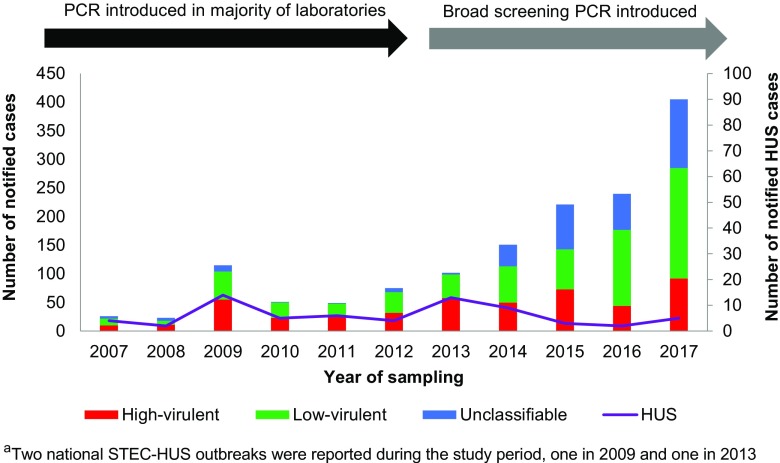
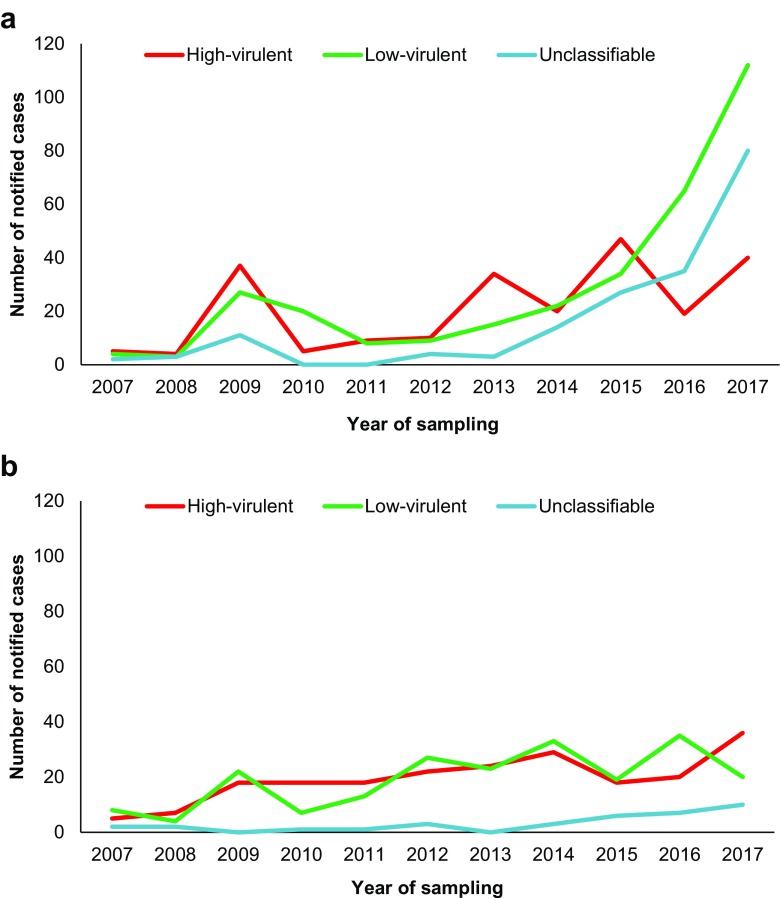
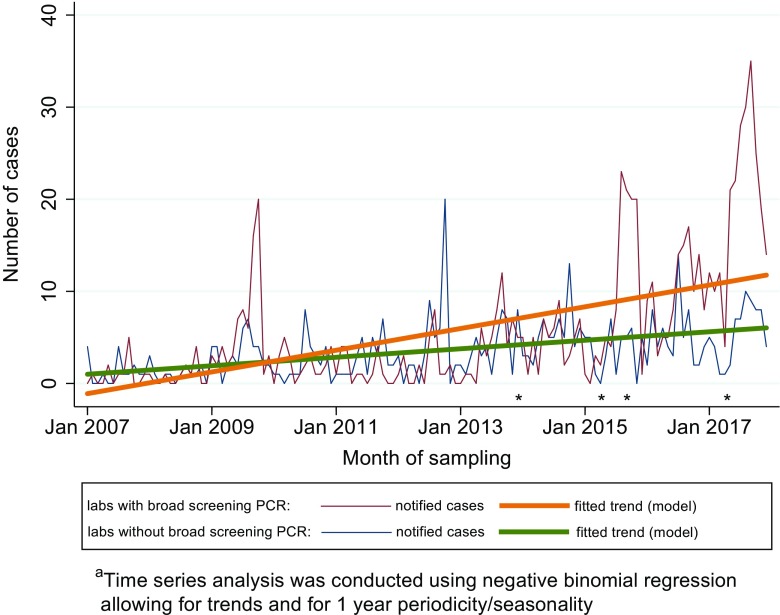
The aim of this study was to investigate implementation of multiplex PCR assays (broad screening PCR) on the distribution and characteristics of notified Shiga toxin-producing Escherichia coli (STEC) cases in Norway, 2007-2017. We described STEC cases notified to the Norwegian Surveillance System for Communicable Diseases (MSIS), 2007-2017 and categorised cases as high-virulent, low-virulent or unclassifiable STEC infections based on guidelines for follow-up of STEC cases. We conducted descriptive analysis and time series analysis allowing for trends and seasonality, and calculated adjusted incidence rate ratios (aIRR) using negative binomial regression for laboratories with and without broad screening PCR. A total of 1458 STEC cases were notified to MSIS (2007-2017), median age 21 years, 51% female. Cases were categorised as having 475 (33%) high-virulent, 652 (45%) low-virulent, and 331 (23%) unclassifiable STEC infections. We observed a higher increasing monthly trend in cases (aIRR = 1.020; 95% CI 1.016-1.024) notified from laboratories with broad screening PCR (n = 4) compared to laboratories (n = 17) without (aIRR = 1.011; 95% CI 1.007-1.014). Notification of low-virulent STEC infections increased from laboratories with broad screening PCR. The increase in notified STEC cases was prominent in cases categorised with a low-virulent STEC infection and largely attributable to unselective screening methods. We recommend NIPH to maintain differentiated control measures for STEC cases to avoid follow-up of low-virulent STEC infections. We recommend microbiological laboratories in Norway to consider a more cost-effective broad screening PCR strategy that enables differentiation of high-virulent STEC infections.
本研究旨在调查挪威 2007-2017 年间多重 PCR 检测(广泛筛查 PCR)在 notified Shiga 毒素产生大肠杆菌(STEC)病例分布和特征中的应用。我们描述了 2007-2017 年向挪威传染病监测系统(MSIS)报告的 STEC 病例,并根据 STEC 病例随访指南将病例分为高毒力、低毒力或无法分类的 STEC 感染。我们进行了描述性分析和时间序列分析,以考虑趋势和季节性,并使用负二项回归计算了具有和不具有广泛筛查 PCR 的实验室的调整发病率比(aIRR)。共有 1458 例 STEC 病例向 MSIS 报告(2007-2017 年),中位年龄 21 岁,女性占 51%。病例被分为具有 475 例(33%)高毒力、652 例(45%)低毒力和 331 例(23%)无法分类的 STEC 感染。我们观察到,在具有广泛筛查 PCR 的实验室(n=4)报告的病例中,每月病例呈更高的上升趋势(aIRR=1.020;95%CI 1.016-1.024),而在没有广泛筛查 PCR 的实验室(n=17)中,每月病例呈上升趋势(aIRR=1.011;95%CI 1.007-1.014)。低毒力 STEC 感染的病例从具有广泛筛查 PCR 的实验室中报告的病例数量有所增加。在低毒力 STEC 感染分类的病例中,报告的 STEC 病例增加显著,这主要归因于无选择性筛查方法。我们建议 NIPH 维持针对 STEC 病例的差异化控制措施,以避免对低毒力 STEC 感染的随访。我们建议挪威的微生物学实验室考虑采用更具成本效益的广泛筛查 PCR 策略,以区分高毒力 STEC 感染。