University Medical Center Göttingen, Department of Cardiology and Pneumology, Georg-August University, Göttingen, Germany.
German Center for Cardiovascular Research (DZHK), partner site Göttingen, Göttingen, Germany.
PLoS One. 2019 Jan 25;14(1):e0210127. doi: 10.1371/journal.pone.0210127. eCollection 2019.
Cardiovascular magnetic resonance feature tracking (CMR-FT) is increasingly used for myocardial deformation assessment including ventricular strain, showing prognostic value beyond established risk markers if used in experienced centres. Little is known about the impact of appropriate training on CMR-FT performance. Consequently, this study aimed to evaluate the impact of training on observer variance using different commercially available CMR-FT software.
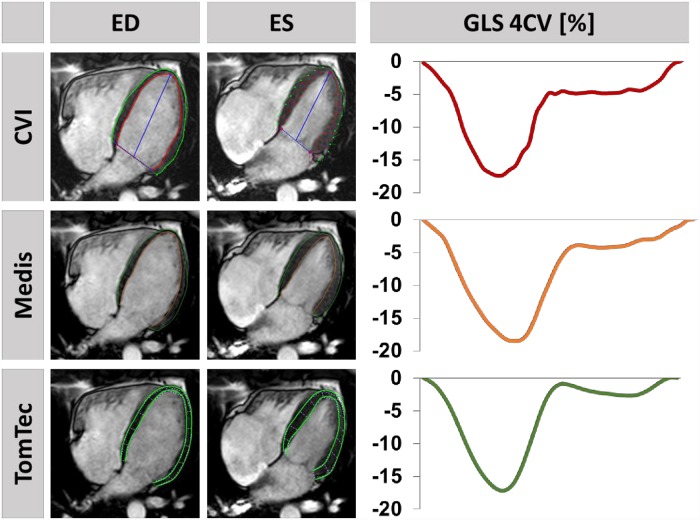
Intra- and inter-observer reproducibility was assessed prior to and after dedicated one-hour observer training. Employed FT software included 3 different commercially available platforms (TomTec, Medis, Circle). Left (LV) and right (RV) ventricular global longitudinal as well as LV circumferential and radial strains (GLS, GCS and GRS) were studied in 12 heart failure patients and 12 healthy volunteers.
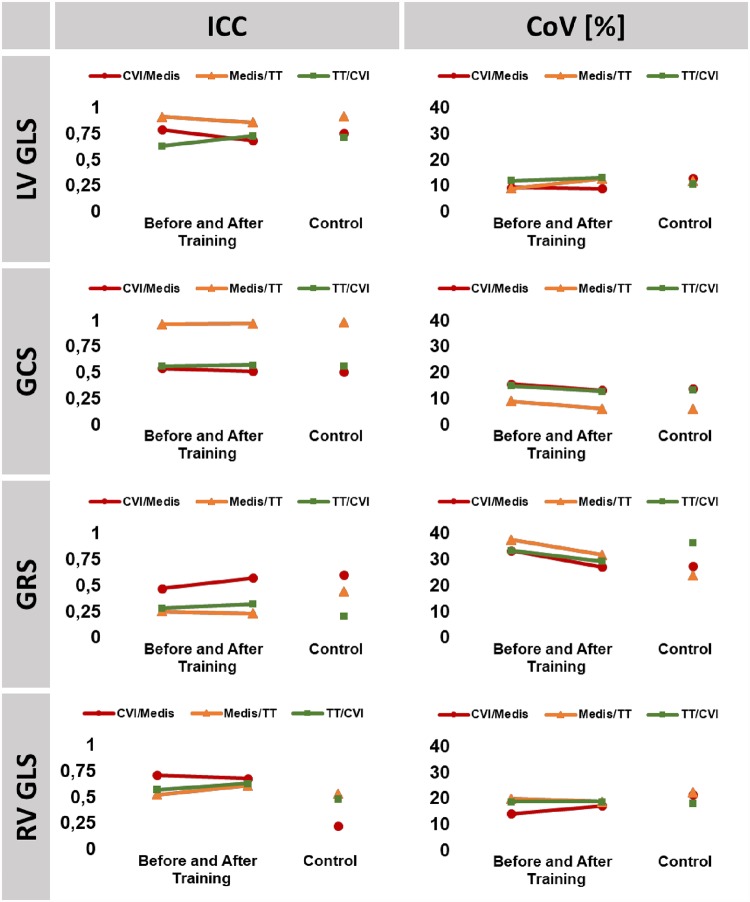
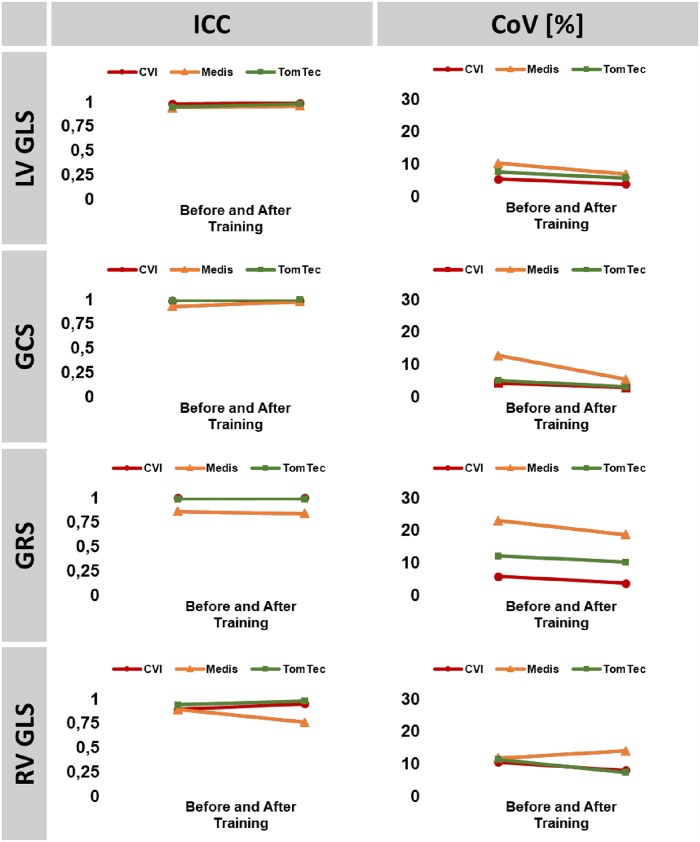
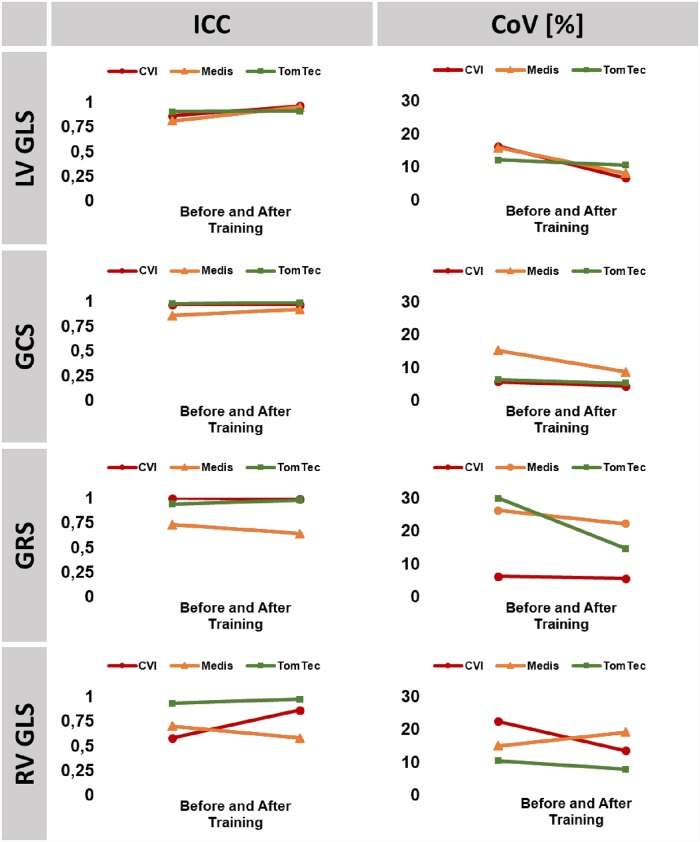
Training improved intra- and inter-observer reproducibility. GCS and LV GLS showed the highest reproducibility before (ICC >0.86 and >0.81) and after training (ICC >0.91 and >0.92). RV GLS and GRS were more susceptible to tracking inaccuracies and reproducibility was lower. Inter-observer reproducibility was lower than intra-observer reproducibility prior to training with more pronounced improvements after training. Before training, LV strain reproducibility was lower in healthy volunteers as compared to patients with no differences after training. Whilst LV strain reproducibility was sufficient within individual software solutions inter-software comparisons revealed considerable software related variance.
Observer experience is an important source of variance in CMR-FT derived strain assessment. Dedicated observer training significantly improves reproducibility with most profound benefits in states of high myocardial contractility and potential to facilitate widespread clinical implementation due to optimized robustness and diagnostic performance.
心血管磁共振特征追踪(CMR-FT)越来越多地用于心肌变形评估,包括心室应变,如果在有经验的中心使用,其预后价值超出了既定的风险标志物。关于适当培训对 CMR-FT 性能的影响知之甚少。因此,本研究旨在评估使用不同商业可用的 CMR-FT 软件进行培训对观察者变异性的影响。
在专门的一小时观察者培训前后评估了观察者内和观察者间的可重复性。使用的 FT 软件包括 3 种不同的商业可用平台(TomTec、Medis、Circle)。在 12 例心力衰竭患者和 12 例健康志愿者中研究了左心室(LV)和右心室(RV)整体纵向应变以及 LV 环向和径向应变(GLS、GCS 和 GRS)。
培训提高了观察者内和观察者间的可重复性。GCS 和 LV GLS 在培训前后均具有最高的可重复性(ICC >0.86 和 >0.81)。RV GLS 和 GRS 更容易受到跟踪不准确的影响,可重复性较低。在培训前,观察者间的可重复性低于观察者内的可重复性,培训后改善更为明显。在培训前,健康志愿者的 LV 应变可重复性低于患者,但培训后无差异。虽然 LV 应变的可重复性在单个软件解决方案内是足够的,但软件间的比较显示出相当大的软件相关变异性。
观察者经验是 CMR-FT 衍生应变评估中变异性的一个重要来源。专门的观察者培训显著提高了可重复性,在心肌收缩力高的情况下获益最大,并由于优化的稳健性和诊断性能,有可能促进广泛的临床应用。