Department of Cryo- and Stem Cell Technology, Fraunhofer Institute for Biomedical Engineering (IBMT), Joseph-von-Fraunhofer-Weg 1, Sulzbach, Germany.
Division of Cytoskeletal Fibers, Leibniz Institute for New Materials, Campus D2 2, Saarbrücken, Germany.
PLoS One. 2019 Jan 25;14(1):e0211382. doi: 10.1371/journal.pone.0211382. eCollection 2019.
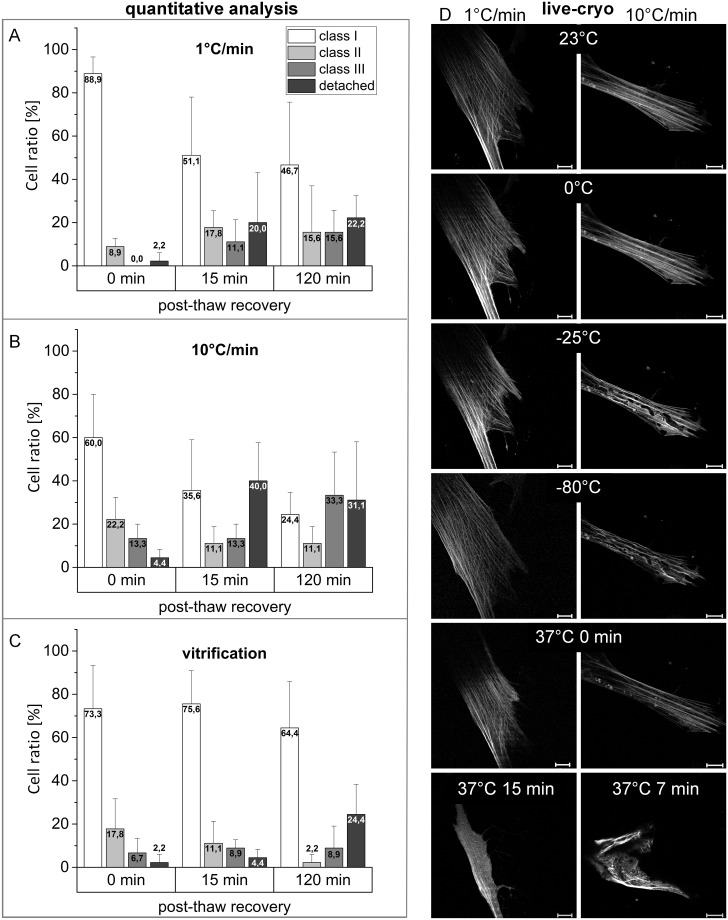
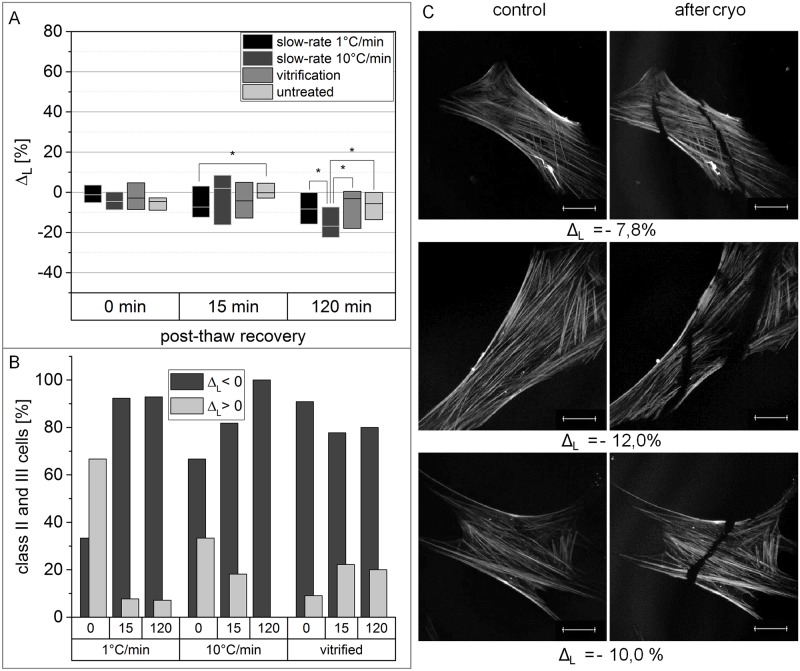
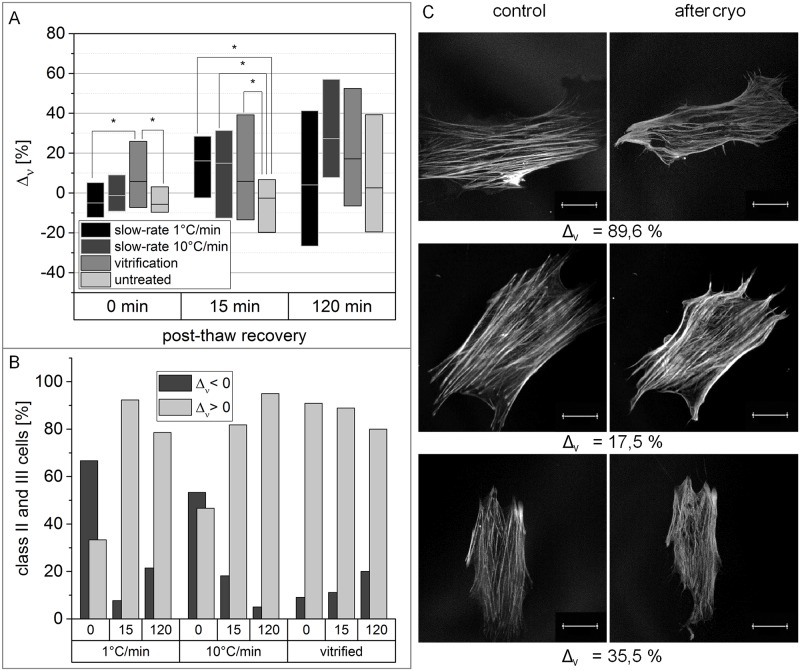
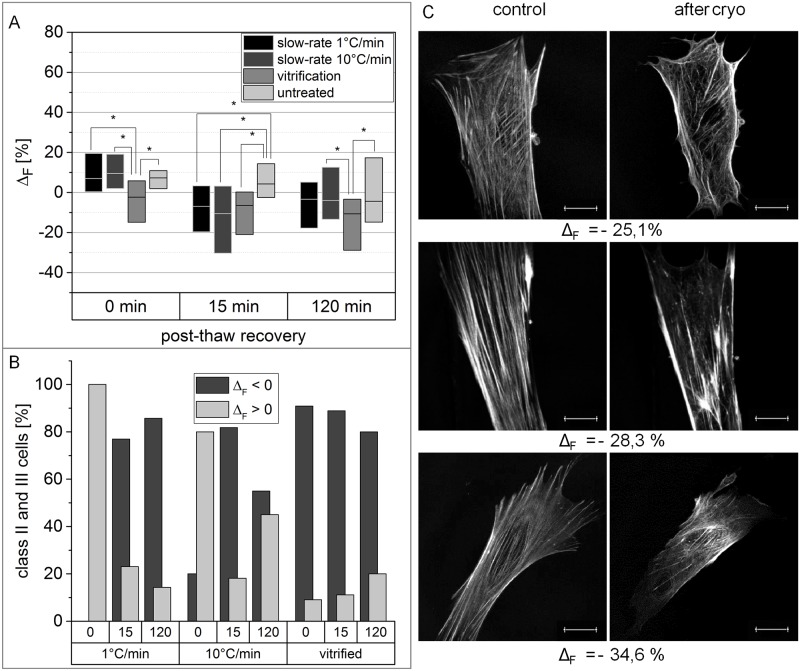
Cryopreservation is an essential tool to meet the increasing demand for stem cells in medical applications. To ensure maintenance of cell function upon thawing, the preservation of the actin cytoskeleton is crucial, but so far there is little quantitative data on the influence of cryopreservation on cytoskeletal structures. For this reason, our study aims to quantitatively describe cryopreservation induced alterations to F-actin in adherent human mesenchymal stem cells, as a basic model for biomedical applications. Here we have characterised the actin cytoskeleton on single-cell level by calculating the circular standard deviation of filament orientation, F-actin content, and average filament length. Cryo-induced alterations of these parameters in identical cells pre and post cryopreservation provide the basis of our investigation. Differences between the impact of slow-freezing and vitrification are qualitatively analyzed and highlighted. Our analysis is supported by live cryo imaging of the actin cytoskeleton via two photon microscopy. We found similar actin alterations in slow-frozen and vitrified cells including buckling of actin filaments, reduction of F-actin content and filament shortening. These alterations indicate limited functionality of the respective cells. However, there are substantial differences in the frequency and time dependence of F-actin disruptions among the applied cryopreservation strategies; immediately after thawing, cytoskeletal structures show least disruption after slow freezing at a rate of 1°C/min. As post-thaw recovery progresses, the ratio of cells with actin disruptions increases, particularly in slow frozen cells. After 120 min of recovery the proportion of cells with an intact actin cytoskeleton is higher in vitrified than in slow frozen cells. Freezing at 10°C/min is associated with a high ratio of impaired cells throughout the post-thawing culture.
冷冻保存是满足医学应用中对干细胞日益增长需求的重要工具。为了确保细胞解冻后功能的维持,肌动蛋白细胞骨架的保存至关重要,但迄今为止,关于冷冻保存对细胞骨架结构影响的定量数据很少。出于这个原因,我们的研究旨在定量描述冷冻保存对贴壁人骨髓间充质干细胞中 F-肌动蛋白的诱导变化,作为生物医学应用的基本模型。在这里,我们通过计算纤维取向的圆形标准偏差、F-肌动蛋白含量和平均纤维长度,在单细胞水平上对肌动蛋白细胞骨架进行了特征描述。冷冻保存前后相同细胞中这些参数的变化为我们的研究提供了基础。我们定性分析并突出了慢速冻和玻璃化冷冻的影响之间的差异。我们的分析得到了通过双光子显微镜对肌动蛋白细胞骨架进行活冷冻成像的支持。我们发现慢速冻和玻璃化冷冻细胞中的肌动蛋白变化相似,包括肌动蛋白纤维的弯曲、F-肌动蛋白含量的减少和纤维缩短。这些变化表明相应细胞的功能有限。然而,在应用的冷冻保存策略中,F-肌动蛋白破坏的频率和时间依赖性存在很大差异;解冻后立即,以 1°C/min 的速率进行慢速冻时,细胞骨架结构的破坏最小。随着解冻后恢复的进行,具有肌动蛋白破坏的细胞比例增加,特别是在慢速冻细胞中。解冻后 120 分钟,玻璃化细胞中具有完整肌动蛋白细胞骨架的细胞比例高于慢速冻细胞。以 10°C/min 的速度冷冻会导致整个解冻后培养过程中受损细胞的比例很高。