Al-Boloushi Zaid, Gómez-Trullén Eva María, Bellosta-López Pablo, López-Royo María Pilar, Fernández Daniel, Herrero Pablo
Department of Physical Medicine and Rehabilitation and Nursing, Health Sciences Faculty, University of Zaragoza, C/ Domingo Miral s/n, 50009, Zaragoza, Spain.
iPhysio Research Group, Universidad San Jorge, Campus Universitario, Autov. A23 km 299, 50830. Villanueva de Gállego, Zaragoza, Spain.
J Orthop Surg Res. 2019 Jan 25;14(1):31. doi: 10.1186/s13018-019-1066-4.
Both manual therapy techniques and dry needling have shown to be effective treatment options for the treatment of plantar heel pain; however, in recent years, other techniques based on dry needling (DN), such as percutaneous needle electrolysis (PNE), have also emerged. Currently, PNE is being used in clinical practice to manage myofascial trigger points, despite the lack of studies comparing the effects of this technique over dry needling. Therefore, the aim of this randomized controlled study is to compare the effectiveness of DN versus PNE for improving the level of pain experienced by patients suffering from plantar heel pain provoked by myofascial trigger points.
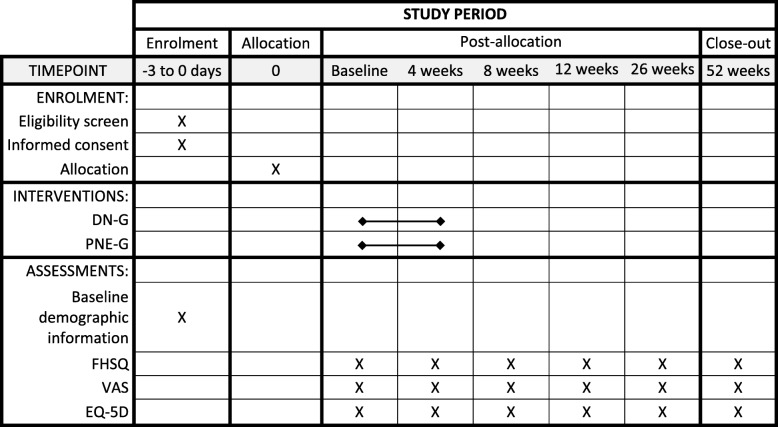
A randomized controlled trial will be conducted with blinded participants and outcome assessors. A sample of 94 patients with a medical diagnosis of plantar heel pain will be recruited and divided into two treatment groups. Eligible participants will be randomly allocated to either (a) treatment group with DN and a self-stretching home program or (b) treatment group with PNE and a self-stretching home program. Each group will receive one treatment session per week over a period of 4 weeks. The primary outcome measure will be the pain subscale of the Foot Health Status Questionnaire. The secondary outcome measures will be a visual analogue scale for pain (average and highest level of pain experienced during the previous 48 h; level of pain immediately after the treatment session) and health-related quality of life (assessed using the EuroQoL-5 dimensions). Cost-effectiveness data will be extracted based on the EuroQoL-5 dimensions. Follow-up measurements will take place at baseline and at 4, 8, 12, 26, and 52 weeks.
The justification for this trial is the need to improve current understanding regarding the effectiveness of treatments targeting the rehabilitation of plantar heel pain. This study will be the first randomized controlled trial to directly compare the effectiveness of DN and PNE combined with a specific stretching program for the treatment of plantar heel pain provoked by myofascial trigger points.
Clinical Trials NCT03236779. Registered at clinicaltrials.gov 2 August 2017.
手法治疗技术和干针疗法均已被证明是治疗足底足跟痛的有效治疗选择;然而,近年来,其他基于干针疗法(DN)的技术,如经皮针电解疗法(PNE)也已出现。目前,PNE正在临床实践中用于处理肌筋膜触发点,尽管缺乏比较该技术与干针疗法效果的研究。因此,这项随机对照研究的目的是比较DN与PNE在改善由肌筋膜触发点引发的足底足跟痛患者的疼痛程度方面的有效性。
将进行一项随机对照试验,参与者和结果评估者均为盲法。招募94名医学诊断为足底足跟痛的患者样本,并分为两个治疗组。符合条件的参与者将被随机分配至以下两组之一:(a)接受DN治疗并配合家庭自我拉伸计划的治疗组,或(b)接受PNE治疗并配合家庭自我拉伸计划的治疗组。每组将在4周的时间内每周接受一次治疗。主要结局指标将是足部健康状况问卷的疼痛子量表。次要结局指标将是疼痛视觉模拟量表(过去48小时内经历的疼痛平均水平和最高水平;治疗后即刻的疼痛水平)以及健康相关生活质量(使用欧洲五维健康量表进行评估)。将基于欧洲五维健康量表提取成本效益数据。随访测量将在基线以及第4、8、12、26和52周进行。
开展这项试验的理由是需要增进目前对针对足底足跟痛康复治疗有效性的理解。本研究将是第一项直接比较DN和PNE联合特定拉伸计划治疗由肌筋膜触发点引发的足底足跟痛有效性的随机对照试验。
临床试验编号NCT03236779。于2017年8月2日在clinicaltrials.gov注册。