CAS Key Laboratory of Biobased Materials, Qingdao Institute of Bioenergy and Bioprocess Technology, Chinese Academy of Sciences, No. 189 Songling Road, Qingdao, 266101, China.
College of Chemistry and Chemical Engineering, Ocean University of China, No. 238 Songling Road, Qingdao, 266003, China.
Nat Commun. 2019 Jan 25;10(1):437. doi: 10.1038/s41467-018-07879-3.
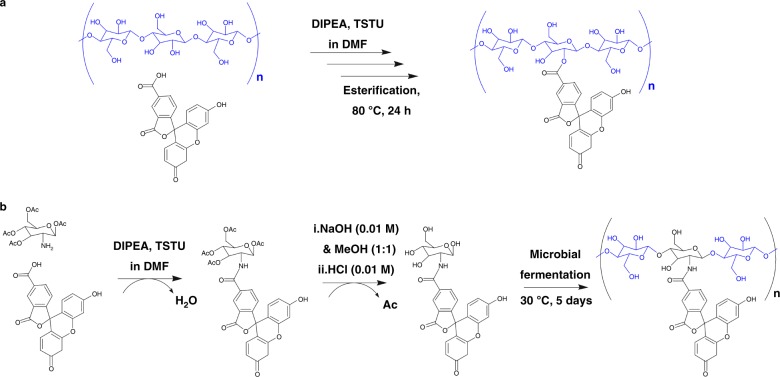
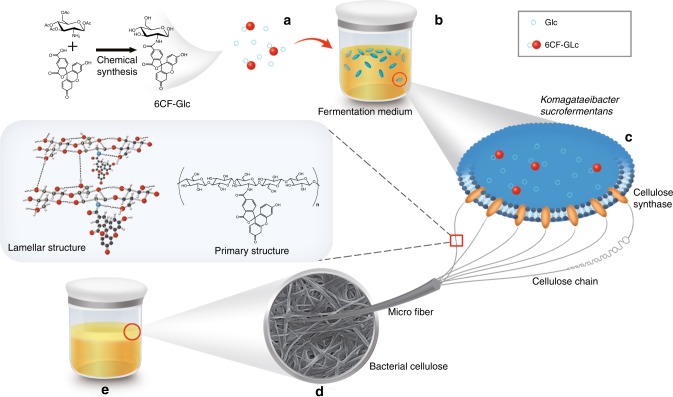
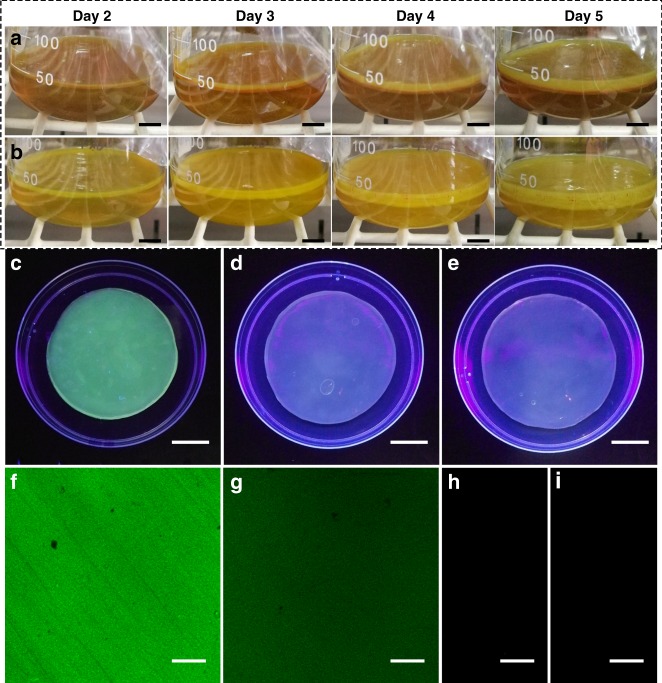
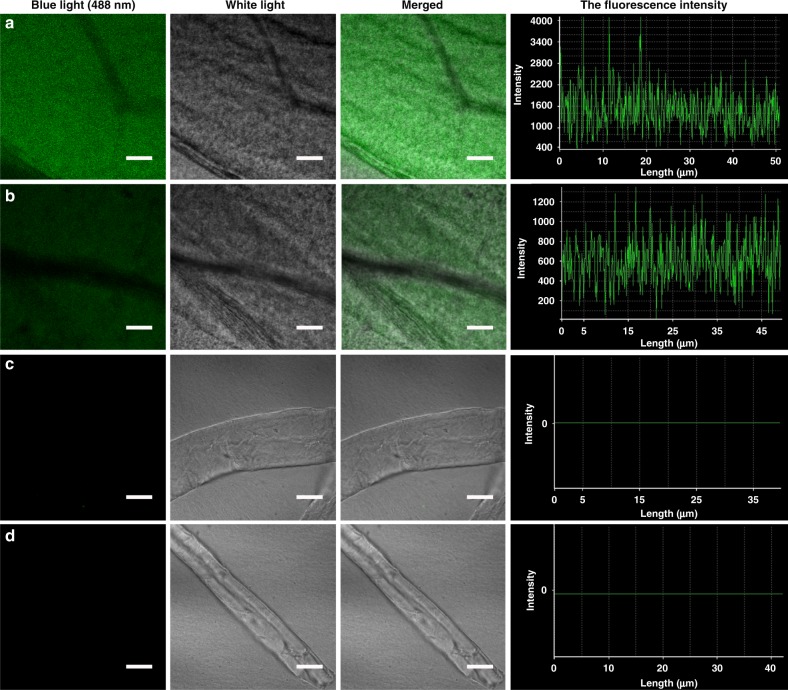
The functionalization methods of materials based on bacterial cellulose (BC) mainly focus on the chemical modification or physical coating of fermentation products, which may cause several problems, such as environment pollution, low reaction efficiency and easy loss of functional moieties during application. Here, we develop a modification method utilizing the in situ microbial fermentation method combined with 6-carboxyfluorescein-modified glucose (6CF-Glc) as a substrate using Komagataeibacter sucrofermentans to produce functional BC with a nonnatural characteristic fluorescence. Our results indicate that the microbial synthesis method is more efficient, controllable and environmentally friendly than traditional modification methods. Therefore, this work confirms that BC can be functionalized by using a microbial synthesis system with functionalized glucose, which provides insights not only for the functionalization of BC but also for the in situ synthesis of other functional materials through microbial synthetic systems.
基于细菌纤维素(BC)的材料功能化方法主要集中在发酵产物的化学修饰或物理涂层上,这可能会导致一些问题,如环境污染、低反应效率以及在应用过程中功能基团容易丢失。在这里,我们开发了一种利用原位微生物发酵方法结合 6-羧基荧光素修饰葡萄糖(6CF-Glc)作为基质的修饰方法,使用嗜糖纤维弧菌(Komagataeibacter sucrofermentans)来生产具有非天然特征荧光的功能性 BC。我们的结果表明,微生物合成方法比传统的修饰方法更高效、可控和环保。因此,这项工作证实 BC 可以通过使用带有功能化葡萄糖的微生物合成系统进行功能化,这不仅为 BC 的功能化提供了思路,也为通过微生物合成系统原位合成其他功能材料提供了思路。