• 文献检索
  • 文档翻译
  • 深度研究
  • 学术资讯
  • Suppr Zotero 插件Zotero 插件
  • 邀请有礼
  • 套餐&价格
  • 历史记录
应用&插件
Suppr Zotero 插件Zotero 插件浏览器插件Mac 客户端Windows 客户端微信小程序
定价
高级版会员购买积分包购买API积分包
服务
文献检索文档翻译深度研究API 文档MCP 服务
关于我们
关于 Suppr公司介绍联系我们用户协议隐私条款
关注我们

Suppr 超能文献

核心技术专利:CN118964589B侵权必究
粤ICP备2023148730 号-1Suppr @ 2026

文献检索

告别复杂PubMed语法,用中文像聊天一样搜索,搜遍4000万医学文献。AI智能推荐,让科研检索更轻松。

立即免费搜索

文件翻译

保留排版,准确专业,支持PDF/Word/PPT等文件格式,支持 12+语言互译。

免费翻译文档

深度研究

AI帮你快速写综述,25分钟生成高质量综述,智能提取关键信息,辅助科研写作。

立即免费体验

多发性硬化症患者对用于疾病管理的移动健康应用程序的接受度:基于网络的调查研究

Acceptance of Mobile Health Apps for Disease Management Among People With Multiple Sclerosis: Web-Based Survey Study.

作者信息

Apolinário-Hagen Jennifer, Menzel Mireille, Hennemann Severin, Salewski Christel

机构信息

Department of Health Psychology, Faculty of Psychology, University of Hagen, Hagen, Germany.

Department of Clinical Psychology, Psychotherapy and Experimental Psychopathology, Institute of Psychology, University of Mainz, Mainz, Germany.

出版信息

JMIR Form Res. 2018 Dec 12;2(2):e11977. doi: 10.2196/11977.

DOI:10.2196/11977
PMID:30684408
原文链接:https://pmc.ncbi.nlm.nih.gov/articles/PMC6334710/
Abstract

BACKGROUND

Mobile health (mHealth) apps might have the potential to promote self-management of people with multiple sclerosis (MS) in everyday life. However, the uptake of MS apps remains poor, and little is known about the facilitators and barriers for their efficient utilization, such as technology acceptance.

OBJECTIVE

The aim of this study was to examine the acceptance of mHealth apps for disease management in the sense of behavioral intentions to use and explore determinants of utilization among people with MS based on the Unified Theory of Acceptance and Use of Technology (UTAUT).

METHODS

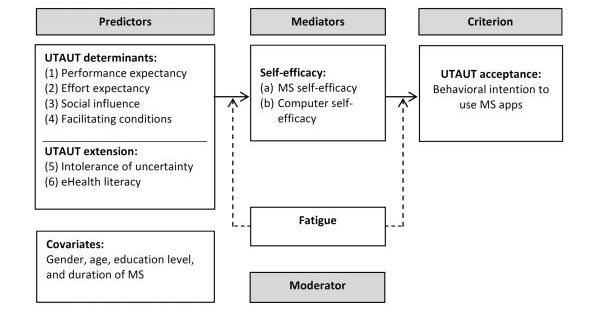
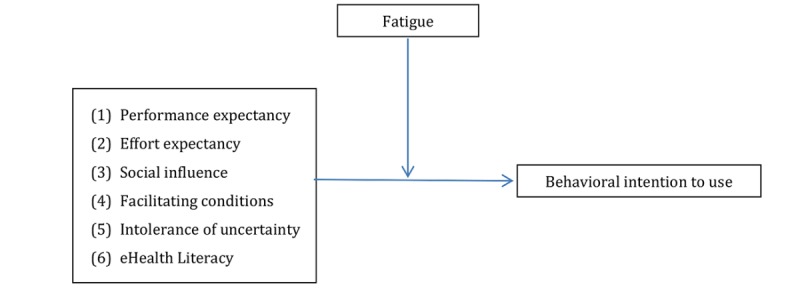
Participants for this Web-based cross-sectional study were recruited throughout Germany with the support of regional MS associations and self-help groups. To identify determinants of intention to use MS apps, a measure based on the UTAUT was adapted with 4 key determinants (performance expectancy, effort expectancy, social influence, and facilitating conditions) and extended by Intolerance of Uncertainty (IU) and electronic health literacy. Potential influencing effects of both MS and computer self-efficacy (C-SE) as mediators and fatigue as a moderator were analyzed using Hayes's PROCESS macro (SPSS version 3.0) for IBM SPSS version 24.0.

RESULTS

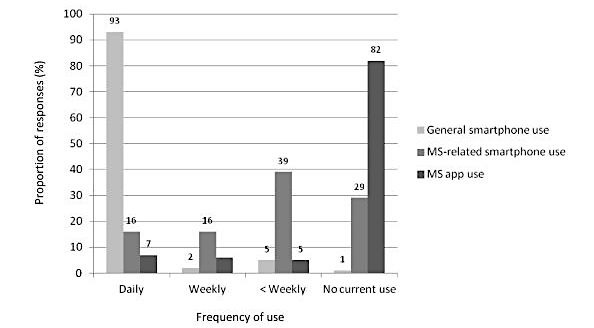
A total of 98 participants (mean age 47.03 years, SD 10.17; 66/98, 67% female) with moderate fatigue levels completed the survey. Although most participants (91/98, 92%) were daily smartphone users, almost two-thirds (62/98, 63%) reported no experience with MS apps. Overall, the acceptance was moderate on average (mean 3.11, SD 1.31, minimum=1 and maximum=5), with lower scores among persons with no experience (P=.04) and higher scores among current users (P<.001). In multiple regression analysis (R=63% variance explained), performance expectancy (beta=.41) and social influence (beta=.33) were identified as significant predictors of acceptance (all P<.001). C-SE was confirmed as a partial mediator in the relationship between IU and acceptance (indirect effect: B=-.095, 95% CI -0.227 to -0.01). Furthermore, a moderated mediation by C-SE was shown in the relationship between IU and behavioral intentions to use MS apps for low (95% CI -0.42 to -0.01) and moderate levels (95% CI -0.27 to -0.01) of fatigue.

CONCLUSIONS

Overall, this exploratory pilot study indicates for the first time that positive expectations about the helpfulness for self-management purposes and social support might be important factors to be considered for improving the acceptance of MS apps among smartphone users with MS. However, given some inconsistent findings, especially regarding the role of effort expectancy and IU and self-efficacy, the conceptual model needs replication with a larger sample of people with MS, varying more in fatigue levels, and a longitudinal assessment of the actual usage of MS apps predicted by acceptance in the sense of behavioral intentions to use.
https://cdn.ncbi.nlm.nih.gov/pmc/blobs/0c37/6334710/52b9aa410d2a/formative_v2i2e11977_fig3.jpg
https://cdn.ncbi.nlm.nih.gov/pmc/blobs/0c37/6334710/2aeab28ecd88/formative_v2i2e11977_fig1.jpg
https://cdn.ncbi.nlm.nih.gov/pmc/blobs/0c37/6334710/84baddbb737e/formative_v2i2e11977_fig2.jpg
https://cdn.ncbi.nlm.nih.gov/pmc/blobs/0c37/6334710/52b9aa410d2a/formative_v2i2e11977_fig3.jpg
https://cdn.ncbi.nlm.nih.gov/pmc/blobs/0c37/6334710/2aeab28ecd88/formative_v2i2e11977_fig1.jpg
https://cdn.ncbi.nlm.nih.gov/pmc/blobs/0c37/6334710/84baddbb737e/formative_v2i2e11977_fig2.jpg
https://cdn.ncbi.nlm.nih.gov/pmc/blobs/0c37/6334710/52b9aa410d2a/formative_v2i2e11977_fig3.jpg
摘要

背景

移动健康(mHealth)应用程序可能有潜力促进多发性硬化症(MS)患者在日常生活中的自我管理。然而,MS应用程序的使用率仍然很低,对于其有效利用的促进因素和障碍,如技术接受度,人们了解甚少。

目的

本研究的目的是基于技术接受与使用统一理论(UTAUT),从使用行为意图的角度检验mHealth应用程序在疾病管理方面的接受度,并探索MS患者中应用程序使用的决定因素。

方法

在德国各地的地区MS协会和自助团体的支持下,招募了参与这项基于网络的横断面研究的参与者。为了确定使用MS应用程序的意图的决定因素,采用了基于UTAUT的测量方法,包括4个关键决定因素(绩效期望、努力期望、社会影响和促进条件),并通过不确定性不耐受(IU)和电子健康素养进行扩展。使用IBM SPSS 24.0版本的Hayes PROCESS宏分析了MS和计算机自我效能(C-SE)作为中介以及疲劳作为调节因素的潜在影响效应。

结果

共有98名中度疲劳水平的参与者(平均年龄47.03岁,标准差10.17;66/98,67%为女性)完成了调查。尽管大多数参与者(91/98,92%)是日常智能手机用户,但几乎三分之二(62/98,63%)表示没有使用过MS应用程序的经验。总体而言,接受度平均适中(平均3.11,标准差1.31,最小值=1,最大值=5),没有经验的人得分较低(P=0.04),当前用户得分较高(P<0.001)。在多元回归分析(R=63%,解释方差)中,绩效期望(β=0.41)和社会影响(β=0.33)被确定为接受度的显著预测因素(所有P<0.001)。C-SE被确认为IU与接受度之间关系的部分中介因素(间接效应:B=-0.095,95%CI -0.227至-0.01)。此外,在IU与使用MS应用程序的行为意图之间的关系中,对于低(95%CI -0.42至-0.01)和中度(95%CI -0.27至-0.01)疲劳水平,显示出C-SE的调节中介作用。

结论

总体而言,这项探索性试点研究首次表明,对自我管理目的的帮助和社会支持的积极期望可能是提高MS智能手机用户对MS应用程序接受度时需要考虑的重要因素。然而,鉴于一些不一致的发现,特别是关于努力期望、IU和自我效能的作用,该概念模型需要在更大的MS患者样本中进行复制,这些样本的疲劳水平差异更大,并对基于使用行为意图接受度预测的MS应用程序的实际使用情况进行纵向评估。

相似文献

1
Acceptance of Mobile Health Apps for Disease Management Among People With Multiple Sclerosis: Web-Based Survey Study.多发性硬化症患者对用于疾病管理的移动健康应用程序的接受度:基于网络的调查研究
JMIR Form Res. 2018 Dec 12;2(2):e11977. doi: 10.2196/11977.
2
Comparing the Acceptance of Mobile Hypertension Apps for Disease Management Among Patients Versus Clinical Use Among Physicians: Cross-sectional Survey.比较患者对用于疾病管理的移动高血压应用程序的接受度与医生的临床使用情况:横断面调查。
JMIR Cardio. 2022 Jan 6;6(1):e31617. doi: 10.2196/31617.
3
Acceptance of mHealth Apps for Self-Management Among People with Hypertension.高血压患者对用于自我管理的移动健康应用程序的接受度。
Stud Health Technol Inform. 2019 Sep 3;267:282-288. doi: 10.3233/SHTI190839.
4
Determinants of Fitness App Usage and Moderating Impacts of Education-, Motivation-, and Gamification-Related App Features on Physical Activity Intentions: Cross-sectional Survey Study.健身应用程序使用的决定因素,以及教育、动机和游戏化相关应用程序功能对身体活动意向的调节作用:横断面调查研究。
J Med Internet Res. 2021 Jul 13;23(7):e26063. doi: 10.2196/26063.
5
Factors Influencing Patients' Intentions to Use Diabetes Management Apps Based on an Extended Unified Theory of Acceptance and Use of Technology Model: Web-Based Survey.基于扩展的技术接受与使用统一理论模型探讨影响患者使用糖尿病管理应用程序意愿的因素:网络调查
J Med Internet Res. 2019 Aug 13;21(8):e15023. doi: 10.2196/15023.
6
Determinant Factors of Public Acceptance of Stress Management Apps: Survey Study.公众对压力管理应用程序接受度的决定因素:调查研究
JMIR Ment Health. 2019 Nov 7;6(11):e15373. doi: 10.2196/15373.
7
Barriers and Drivers Regarding the Use of Mobile Health Apps Among Patients With Type 2 Diabetes Mellitus in the Netherlands: Explanatory Sequential Design Study.荷兰2型糖尿病患者使用移动健康应用程序的障碍与驱动因素:解释性序列设计研究
JMIR Diabetes. 2022 Jan 27;7(1):e31451. doi: 10.2196/31451.
8
The Mediating Influence of the Unified Theory of Acceptance and Use of Technology on the Relationship Between Internal Health Locus of Control and Mobile Health Adoption: Cross-sectional Study.统一科技接受与使用理论在内部控制健康源与移动医疗采纳关系中的中介作用:横断面研究。
J Med Internet Res. 2021 Dec 29;23(12):e28086. doi: 10.2196/28086.
9
Smartphone Alcohol Use Disorder Recovery Apps: Cross-sectional Survey of Behavioral Intention to Use.智能手机酒精使用障碍康复应用程序:使用行为意图的横断面调查
JMIR Hum Factors. 2022 Apr 1;9(2):e33493. doi: 10.2196/33493.
10
Determining the Influencing Factors on Acceptance of eHealth Pain Management Interventions Among Patients With Chronic Pain Using the Unified Theory of Acceptance and Use of Technology: Cross-sectional Study.运用技术接受与使用统一理论确定慢性疼痛患者对电子健康疼痛管理干预措施接受度的影响因素:横断面研究
JMIR Form Res. 2022 Aug 17;6(8):e37682. doi: 10.2196/37682.

引用本文的文献

1
How do electronic personal health information technologies enhance obesity prevention behaviors? Examining the roles of obesity risk perception and body weight.电子个人健康信息技术如何增强肥胖预防行为?审视肥胖风险认知和体重的作用。
BMC Public Health. 2025 Mar 27;25(1):1155. doi: 10.1186/s12889-025-22225-1.
2
User Experience and Extended Technology Acceptance Model in Commercial Health Care App Usage Among Patients With Cancer: Mixed Methods Study.癌症患者商业医疗保健应用程序使用中的用户体验与扩展技术接受模型:混合方法研究
J Med Internet Res. 2024 Dec 18;26:e55176. doi: 10.2196/55176.
3
Acceptance of a Web-Based Intervention in Individuals Who Committed Sexual Offenses Against Children: Cross-Sectional Study.

本文引用的文献

1
Use of eHealth and mHealth technology by persons with multiple sclerosis.多发性硬化症患者使用电子健康和移动健康技术。
Mult Scler Relat Disord. 2019 Jan;27:13-19. doi: 10.1016/j.msard.2018.09.036. Epub 2018 Oct 2.
2
Attitudes towards digital treatment for depression: A European stakeholder survey.对抑郁症数字治疗的态度:一项欧洲利益相关者调查。
Internet Interv. 2017 Jan 25;8:1-9. doi: 10.1016/j.invent.2017.01.001. eCollection 2017 Jun.
3
A Web-Based Acceptance-Facilitating Intervention for Identifying Patients' Acceptance, Uptake, and Adherence of Internet- and Mobile-Based Pain Interventions: Randomized Controlled Trial.
对针对儿童实施性犯罪者进行基于网络干预的接受度:横断面研究。
JMIR Form Res. 2024 Jan 26;8:e48880. doi: 10.2196/48880.
4
Mobile health interventions in multiple sclerosis: A systematic review.移动医疗干预多发性硬化症:系统评价。
Mult Scler. 2023 Dec;29(14):1709-1720. doi: 10.1177/13524585231201089. Epub 2023 Oct 28.
5
Portuguese Validation of the Unified Theory of Acceptance and Use of Technology Scale (UTAUT) to a COVID-19 Mobile Application: A Pilot Study.技术接受与使用统一理论量表(UTAUT)对一款COVID-19移动应用的葡萄牙语验证:一项试点研究。
Healthcare (Basel). 2023 Jul 3;11(13):1916. doi: 10.3390/healthcare11131916.
6
The role of uncertainty intolerance in adjusting to long-term physical health conditions: A systematic review.不确定性不耐受在适应长期身体状况中的作用:系统评价。
PLoS One. 2023 Jun 2;18(6):e0286198. doi: 10.1371/journal.pone.0286198. eCollection 2023.
7
Factors affecting wearable ECG device adoption by general practitioners for atrial fibrillation screening: cross-sectional study.影响全科医生采用可穿戴心电图设备进行房颤筛查的因素:横断面研究。
Front Public Health. 2023 May 5;11:1128127. doi: 10.3389/fpubh.2023.1128127. eCollection 2023.
8
Negotiating with digital self-monitoring: A qualitative study on how patients with multiple sclerosis use and experience digital self-monitoring within a scientific study.与数字自我监测协商:一项关于多发性硬化症患者在科学研究中如何使用和体验数字自我监测的定性研究。
Health (London). 2024 May;28(3):333-351. doi: 10.1177/13634593231175321. Epub 2023 May 17.
9
Digital health for chronic disease management: An exploratory method to investigating technology adoption potential.数字健康在慢性病管理中的应用:一项探索技术采用潜力的研究方法。
PLoS One. 2023 Apr 13;18(4):e0284477. doi: 10.1371/journal.pone.0284477. eCollection 2023.
10
Usability of a mHealth Solution using Speech Recognition for Point-of-care Diagnostic Management.使用语音识别的移动医疗解决方案在即时诊断管理中的可用性。
J Med Syst. 2023 Feb 2;47(1):18. doi: 10.1007/s10916-022-01896-y.
一项基于网络的促进接受度干预措施,用于识别患者对基于互联网和移动设备的疼痛干预措施的接受度、采用率和依从性:随机对照试验。
J Med Internet Res. 2018 Aug 21;20(8):e244. doi: 10.2196/jmir.9925.
4
Fake news, influencers and health-related professional participation on the Web: A pilot study on a social-network of people with Multiple Sclerosis.假新闻、网红和与健康相关的专业人士在网络上的参与:多发性硬化症患者社交网络的初步研究。
Mult Scler Relat Disord. 2018 Oct;25:175-178. doi: 10.1016/j.msard.2018.07.046. Epub 2018 Jul 31.
5
Supply and Demand in mHealth Apps for Persons With Multiple Sclerosis: Systematic Search in App Stores and Scoping Literature Review.多发性硬化症患者移动健康应用程序的供需情况:应用商店系统搜索与文献综述
JMIR Mhealth Uhealth. 2018 May 23;6(5):e10512. doi: 10.2196/10512.
6
The Use of Digital and Remote Communication Technologies as a Tool for Multiple Sclerosis Management: Narrative Review.数字和远程通信技术作为多发性硬化症管理工具的应用:叙述性综述
JMIR Rehabil Assist Technol. 2018 Apr 24;5(1):e5. doi: 10.2196/rehab.7805.
7
Tolerance of uncertainty: A systematic review of health and healthcare-related outcomes.不确定性容忍度:健康和医疗保健相关结果的系统评价。
Patient Educ Couns. 2018 Sep;101(9):1518-1537. doi: 10.1016/j.pec.2018.03.030. Epub 2018 Apr 6.
8
More Stamina, a Gamified mHealth Solution for Persons with Multiple Sclerosis: Research Through Design.“更多耐力”,一种针对多发性硬化症患者的游戏化移动健康解决方案:通过设计进行研究。
JMIR Mhealth Uhealth. 2018 Mar 2;6(3):e51. doi: 10.2196/mhealth.9437.
9
Exploring the Specific Needs of Persons with Multiple Sclerosis for mHealth Solutions for Physical Activity: Mixed-Methods Study.探索多发性硬化症患者对身体活动的移动健康解决方案的特定需求:混合方法研究。
JMIR Mhealth Uhealth. 2018 Feb 9;6(2):e37. doi: 10.2196/mhealth.8996.
10
Multiple Sclerosis Re-Examined: Essential and Emerging Clinical Concepts.多发性硬化症再审视:重要和新兴的临床概念。
Am J Med. 2018 May;131(5):464-472. doi: 10.1016/j.amjmed.2017.11.044. Epub 2017 Dec 21.