Faculty of Education, Health and Wellbeing, University of Wolverhampton, Wolverhampton, UK.
Faculty of Sciences and Technology, Middlesex University, London, UK.
J Alzheimers Dis. 2019;70(s1):S87-S99. doi: 10.3233/JAD-180763.
It is unclear whether overweight and obesity in older age reduces or increases the risk of incident dementia.
To assess the impacts of overweight and obesity in older age on incident dementia.
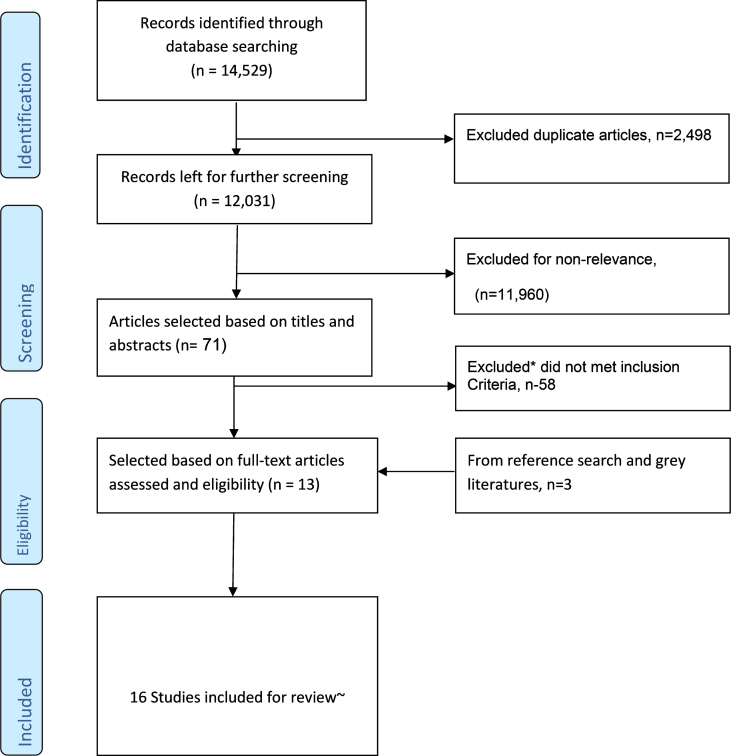
We searched cohort studies reporting body weight measured in older age and dementia through PubMed, Embase, Medline, PyschInfo, and Cochrane library until July 2016. Sixteen articles were identified for the review. We pooled data from them and a new unpublished study from China, to calculate relative risk (RR) of incident dementia in relation to body mass index (BMI) and waist circumference (WC).
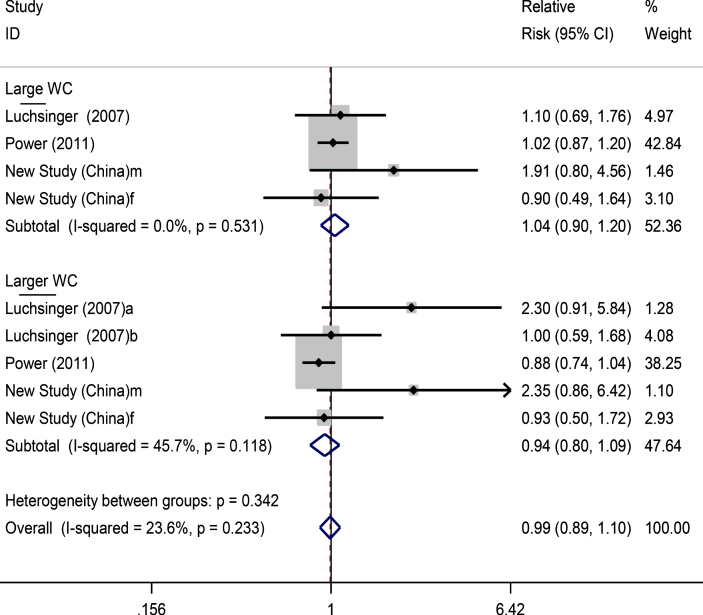
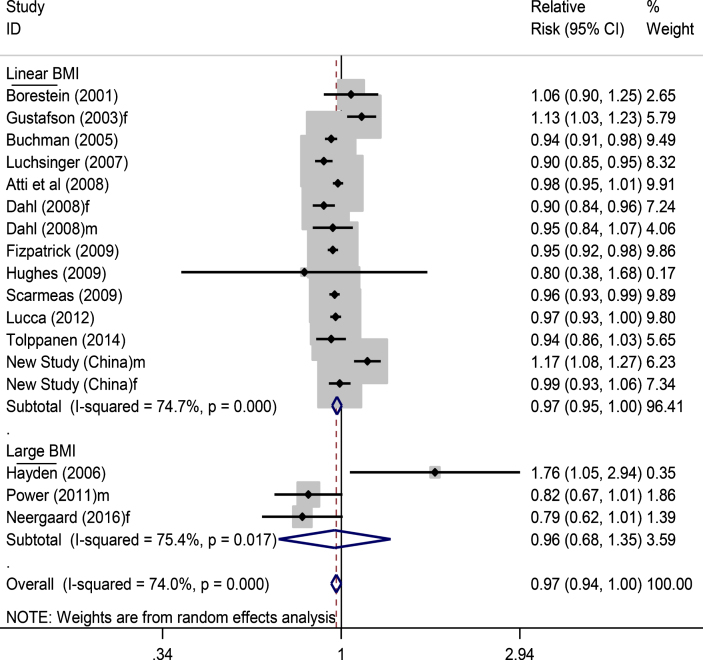
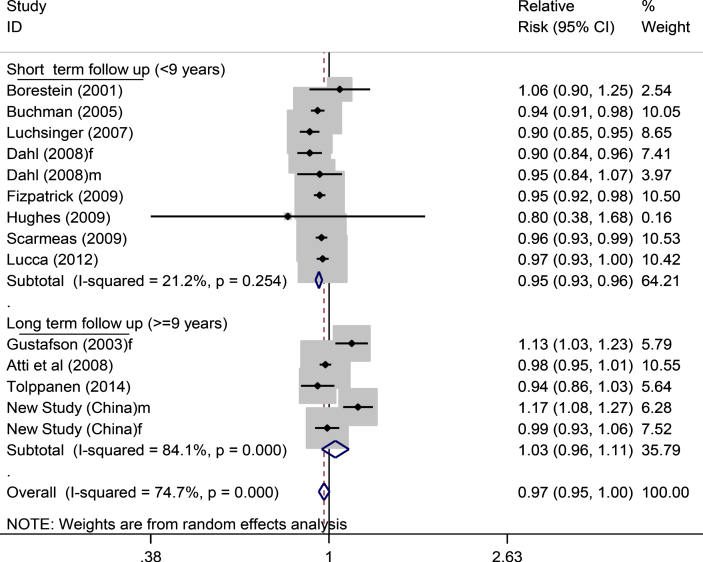
All 16 cohort studies were undertaken in high income countries, with follow-up periods ranging between 3 to 18 years. Thirteen studies showed an inverse association between BMI and dementia, and three studies demonstrated a positive association. Pooled RR of dementia in relation to continuous BMI from 14 studied populations, including the new Chinese data, was 0.97 (95% CI 0.95-1.00); in those followed up <9 years it was 0.95 (0.93-0.96) while in ≥9 years follow-up it was 1.03 (0.96-1.11). In five studied populations examining categorical BMI, RR of dementia in older people classified as overweight and obese was 0.98 (0.54-1.77) and 1.17 (0.65-2.10) respectively, in comparison with other weights. The pooled WC data showed no association between increased WC and reduced risk of dementia.
The current evidence did not support a paradox on beneficial impacts of overweight and obesity in older age on incident dementia. More studies with long term follow up are needed to clarify the association of body weight in older age with dementia risk.
老年人超重和肥胖是否降低或增加痴呆症的发病风险尚不清楚。
评估老年人超重和肥胖对痴呆症发病的影响。
我们通过 PubMed、Embase、Medline、PyschInfo 和 Cochrane 图书馆检索了截至 2016 年 7 月报告老年人体重和痴呆症的队列研究。对 16 项研究进行了综述。我们对来自这些研究和中国一项新的未发表研究的数据进行了汇总,以计算体重指数(BMI)和腰围(WC)与痴呆症发病风险的相对风险(RR)。
所有 16 项队列研究均在高收入国家进行,随访时间为 3 至 18 年。13 项研究表明 BMI 与痴呆症呈负相关,3 项研究表明 BMI 与痴呆症呈正相关。来自 14 个研究人群(包括中国新数据)的连续 BMI 与痴呆症的汇总 RR 为 0.97(95%CI 0.95-1.00);随访<9 年时为 0.95(0.93-0.96),随访≥9 年时为 1.03(0.96-1.11)。在五个研究人群中,对超重和肥胖的老年人进行分类,与其他体重相比,痴呆症的 RR 分别为 0.98(0.54-1.77)和 1.17(0.65-2.10)。汇总的 WC 数据显示,WC 增加与痴呆症风险降低之间没有关联。
目前的证据不支持老年人超重和肥胖对痴呆症发病有有益影响的悖论。需要更多具有长期随访的研究来阐明老年人体重与痴呆症风险之间的关系。