Chen Yi-Hsin, Fu Yun-Ching, Wu Ming-Ju
Institute of Clinical Medicine, National Yang-Ming University, Taipei 112, Taiwan.
Department of Nephrology, Taichung Tzu Chi Hospital, Buddhist Tzu Chi Medical Foundation, Taichung 427, Taiwan.
J Clin Med. 2019 Jan 27;8(2):147. doi: 10.3390/jcm8020147.
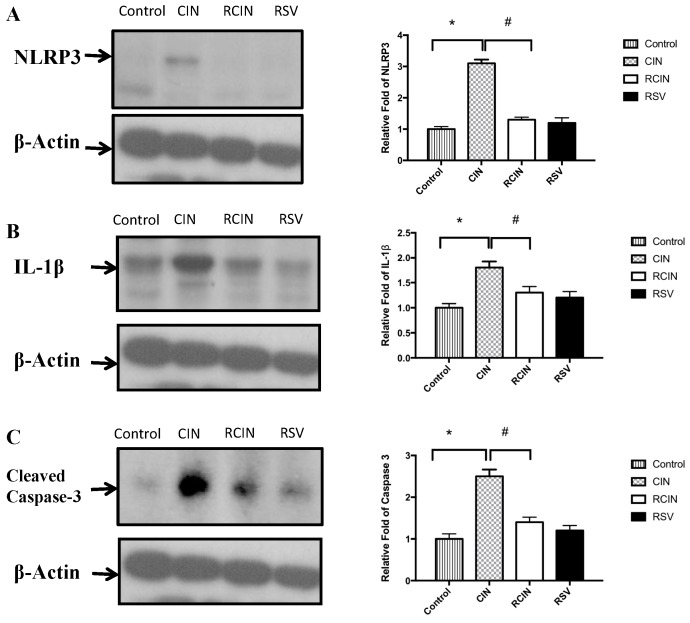
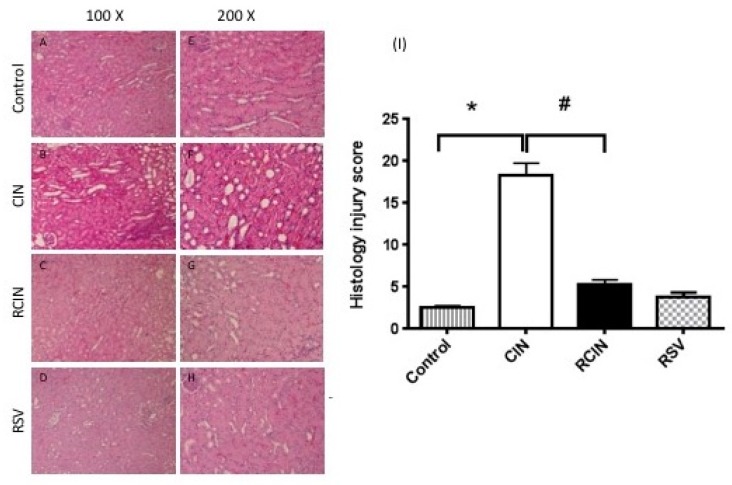
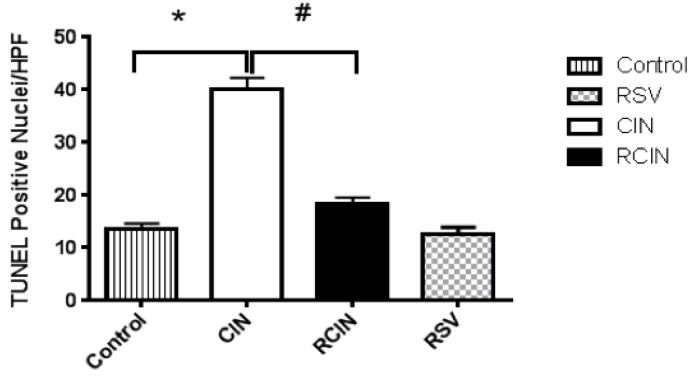
Contrast is widely used in invasive image examinations such as computed tomography (CT) and angiography; however, the risk of contrast-induced nephropathy (CIN) is high. The aim of this study was to investigate the protective effect of resveratrol in a rat model of CIN. Sprague-Dawley rats were divided into four groups: the control group (0.9% saline infusion only); resveratrol group (RSV, resveratrol, 30 mg/kg); contrast media group (CIN); and resveratrol + contrast media group (RCIN, resveratrol 30 mg/kg 60 min before CIN). CIN was induced via an intravenous injection of a single dose of indomethacin (10 mg/kg), one dose of N-nitro-L-arginine methyl ester (10 mg/kg), and a single dose of contrast medium iopromide (2 g/kg). Blood urea nitrogen, creatinine, and neutrophil gelatinase-associated lipocalin (NGAL) were higher in the CIN group compared to the other groups. Histopathological tubule injury scores were also higher in the CIN group compared to the other groups ( < 0.01). NLPR3 in kidney tissue were higher in the CIN group compared to the other groups; however, these results were improved by resveratrol in the RCIN group compared with the CIN group. The expressions of IL-1β and the percentage of apoptotic cells were higher in the CIN group than in the control and RSV groups, but they were lower in the RCIN group than in the CIN group. The expression of cleaved caspase-3 was higher in the CIN group than in the control and RSV groups, but lower in the RCIN group than in the CIN group. Resveratrol treatment attenuated both injury processes and apoptosis and inhibited the inflammasome pathway in this rat CIN model.
造影剂广泛应用于计算机断层扫描(CT)和血管造影等侵入性影像检查;然而,造影剂诱导的肾病(CIN)风险很高。本研究的目的是探讨白藜芦醇在CIN大鼠模型中的保护作用。将Sprague-Dawley大鼠分为四组:对照组(仅输注0.9%生理盐水);白藜芦醇组(RSV,白藜芦醇,30mg/kg);造影剂组(CIN);白藜芦醇+造影剂组(RCIN,在CIN前60分钟给予白藜芦醇30mg/kg)。通过静脉注射单剂量吲哚美辛(10mg/kg)、单剂量N-硝基-L-精氨酸甲酯(10mg/kg)和单剂量造影剂碘普罗胺(2g/kg)诱导CIN。与其他组相比,CIN组的血尿素氮、肌酐和中性粒细胞明胶酶相关脂质运载蛋白(NGAL)更高。与其他组相比,CIN组的组织病理学肾小管损伤评分也更高(<0.01)。与其他组相比,CIN组肾组织中的NLPR3更高;然而,与CIN组相比,白藜芦醇在RCIN组改善了这些结果。CIN组中IL-1β的表达和凋亡细胞百分比高于对照组和RSV组,但RCIN组低于CIN组。裂解的半胱天冬酶-3的表达在CIN组高于对照组和RSV组,但在RCIN组低于CIN组。在该大鼠CIN模型中,白藜芦醇治疗减轻了损伤过程和凋亡,并抑制了炎性小体途径。