Center of Infection and Immunity of Lille, Institut Pasteur de Lille, Lille, France.
Inserm U1019, Lille, France.
Front Immunol. 2019 Jan 14;9:3068. doi: 10.3389/fimmu.2018.03068. eCollection 2018.
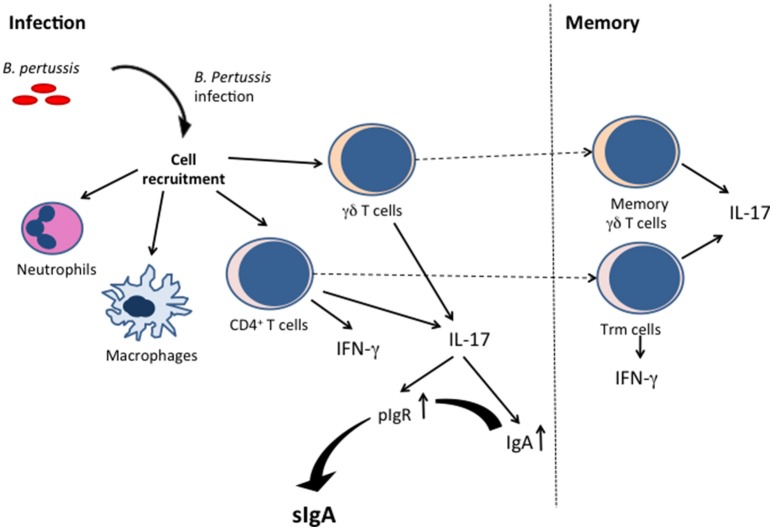
Pertussis or whooping cough, mainly caused by , is a severe respiratory disease that can affect all age groups but is most severe and can be life-threatening in young children. Vaccines against this disease are widely available since the 1950s. Despite high global vaccination coverage, the disease is not under control in any country, and its incidence is even increasing in several parts of the world. Epidemiological and experimental evidence has shown that the vaccines fail to prevent infection and transmission, although they are very effective in preventing disease. Given the high infection rate of , effective control of the disease likely requires prevention of infection and transmission in addition to protection against disease. With rare exceptions infections are restricted to the airways and do not usually disseminate beyond the respiratory epithelium. Therefore, protection at the level of the respiratory mucosa may be helpful for an improved control of pertussis. Yet, compared to systemic responses, mucosal immune responses have attracted relatively little attention in the context of pertussis vaccine development. In this review we summarize the available literature on the role of mucosal immunity in the prevention of infection. In contrast to vaccination, natural infection in humans and experimental infections in animals induce strong secretory IgA responses in the naso-pharynx and in the lungs. Several studies have shown that secretory IgA may be instrumental in the control of infection. Furthermore, studies in mouse models have revealed that infection, but not immunization with current acellular pertussis vaccines induces resident memory T cells, which may also contribute to protection against colonization by . As these resident memory T cells are long lived, vaccines that are able to induce them should provide long-lasting immunity. As of today, only one vaccine designed to induce potent mucosal immunity is in clinical development. This vaccine is a live attenuated strain delivered nasally in order to mimic the natural route of infection. Due to its ability to induce mucosal immunity it is expected that this approach will contribute to improved control of pertussis.
百日咳,主要由 引起,是一种严重的呼吸道疾病,可影响所有年龄组,但在幼儿中最为严重,可危及生命。自 20 世纪 50 年代以来,针对这种疾病的疫苗已广泛使用。尽管全球疫苗接种覆盖率很高,但没有任何一个国家能够控制这种疾病,而且在世界上的几个地区,其发病率甚至在上升。流行病学和实验证据表明,疫苗虽然能非常有效地预防疾病,但不能预防 感染和传播。鉴于 的高感染率,有效控制该疾病可能需要除预防疾病之外,还需要预防感染和传播。除了极少数例外, 感染局限于气道,通常不会扩散到呼吸道上皮之外。因此,在呼吸道黏膜水平进行保护可能有助于更好地控制百日咳。然而,与全身反应相比,黏膜免疫反应在百日咳疫苗开发方面引起的关注相对较少。在这篇综述中,我们总结了有关黏膜免疫在预防 感染中的作用的现有文献。与接种疫苗不同,人类自然感染和动物实验感染会在鼻咽部和肺部引起强烈的分泌型 IgA 反应。多项研究表明,分泌型 IgA 可能在控制 感染方面发挥作用。此外,在小鼠模型中的研究表明, 感染而非用当前无细胞百日咳疫苗进行免疫会诱导常驻记忆 T 细胞,这也可能有助于防止 定植。由于这些常驻记忆 T 细胞寿命长,能够诱导它们的疫苗应该提供持久的免疫力。截至今天,只有一种旨在诱导强烈黏膜免疫的疫苗正在临床开发中。这种疫苗是一种通过鼻腔接种的减毒 株,以模拟自然感染途径。由于其诱导黏膜免疫的能力,预计这种方法将有助于更好地控制百日咳。