Department of Biology, University of Waterloo, Waterloo, ON, Canada.
Front Immunol. 2019 Jan 14;9:3128. doi: 10.3389/fimmu.2018.03128. eCollection 2018.
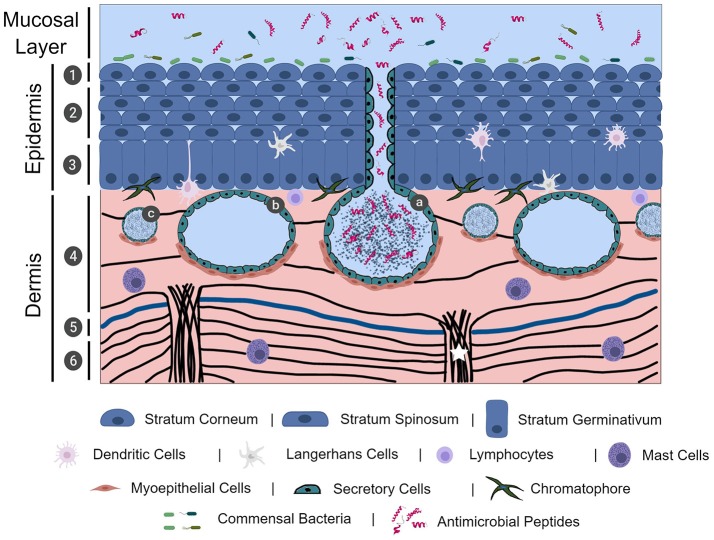
Amphibian skin is a mucosal surface in direct and continuous contact with a microbially diverse and laden aquatic and/or terrestrial environment. As such, frog skin is an important innate immune organ and first line of defence against pathogens in the environment. Critical to the innate immune functions of frog skin are the maintenance of physical, chemical, cellular, and microbiological barriers and the complex network of interactions that occur across all the barriers. Despite the global decline in amphibian populations, largely as a result of emerging infectious diseases, we understand little regarding the cellular and molecular mechanisms that underlie the innate immune function of amphibian skin and defence against pathogens. In this review, we discuss the structure, cell composition and cellular junctions that contribute to the skin physical barrier, the antimicrobial peptide arsenal that, in part, comprises the chemical barrier, the pattern recognition receptors involved in recognizing pathogens and initiating innate immune responses in the skin, and the contribution of commensal microbes on the skin to pathogen defence. We briefly discuss the influence of environmental abiotic factors (natural and anthropogenic) and pathogens on the immunocompetency of frog skin defences. Although some aspects of frog innate immunity, such as antimicrobial peptides are well-studied; other components and how they contribute to the skin innate immune barrier, are lacking. Elucidating the complex network of interactions occurring at the interface of the frog's external and internal environments will yield insight into the crucial role amphibian skin plays in host defence and the environmental factors leading to compromised barrier integrity, disease, and host mortality.
两栖动物的皮肤是与微生物多样且充满的水生和/或陆生环境直接且持续接触的黏膜表面。因此,青蛙的皮肤是重要的先天免疫器官,是抵御环境中病原体的第一道防线。青蛙皮肤的先天免疫功能的关键是维持物理、化学、细胞和微生物屏障,以及跨越所有屏障的复杂相互作用网络。尽管由于新出现的传染病,全球两栖动物的数量在减少,但我们对构成青蛙皮肤先天免疫功能和抵御病原体的细胞和分子机制知之甚少。在这篇综述中,我们讨论了有助于皮肤物理屏障的结构、细胞组成和细胞连接,部分构成化学屏障的抗菌肽武器库,参与识别病原体并在皮肤中引发先天免疫反应的模式识别受体,以及皮肤上共生微生物对病原体防御的贡献。我们简要讨论了环境非生物因素(自然和人为)和病原体对青蛙皮肤防御免疫能力的影响。尽管青蛙先天免疫的某些方面,如抗菌肽,已经得到了很好的研究;但其他成分以及它们如何有助于皮肤先天免疫屏障,仍缺乏研究。阐明发生在青蛙外部和内部环境界面的复杂相互作用网络将深入了解两栖动物皮肤在宿主防御和导致屏障完整性受损、疾病和宿主死亡的环境因素中所起的关键作用。