Biology Department, Acadia University, Wolfville, NS B4P 2R6, Canada.
Department of Pathology, Dalhousie University, Halifax, NS B3H 4R2, Canada.
Molecules. 2020 Nov 20;25(22):5436. doi: 10.3390/molecules25225436.
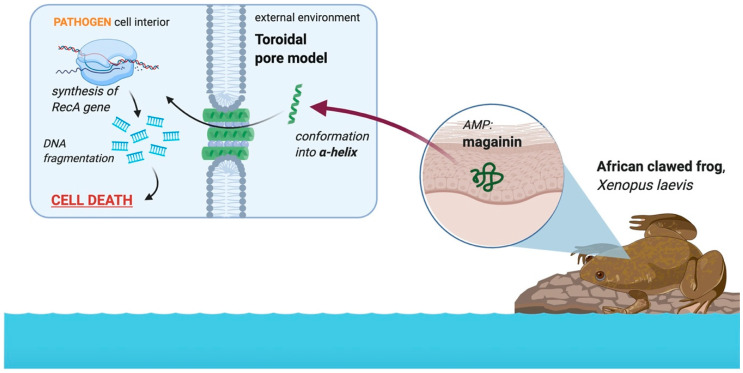
Host defense peptides (HDPs) are a group of antimicrobial peptides (AMPs) that are crucial components of the innate immune system of many different organisms. These small peptides actively kill microbes and prevent infection. Despite the presence of AMPs in the amphibian immune system, populations of these organisms are in decline globally. Magainin is an AMP derived from the African clawed frog () and has displayed potent antimicrobial effects against a wide variety of microbes. Included in this group of microbes are known pathogens of the African clawed frog and other amphibian species. Arguably, the most deleterious amphibious pathogen is , a chytrid fungus. Investigating the mechanism of action of magainin can help understand how to effectively fight off infection. By understanding amphibian AMPs' role in the frog, a potential conservation strategy can be developed for other species of amphibians that are susceptible to infections, such as the North American green frog (). Considering that population declines of these organisms are occurring globally, this effort is crucial to protect not only these organisms but the ecosystems they inhabit as well.
宿主防御肽 (HDP) 是一组抗菌肽 (AMP),是许多不同生物体先天免疫系统的重要组成部分。这些小肽可以主动杀死微生物并预防感染。尽管两栖动物的免疫系统中存在 AMP,但这些生物的数量在全球范围内正在减少。蛙皮素是一种从非洲爪蟾中提取的 AMP,对多种微生物表现出强大的抗菌作用。在这组微生物中,包括非洲爪蟾和其他两栖动物物种的已知病原体。可以说,最具危害性的两栖动物病原体是蛙壶菌,一种真菌。研究蛙皮素的作用机制有助于了解如何有效地抵抗感染。通过了解两栖动物 AMP 在青蛙中的作用,可以为其他易受感染的两栖动物物种制定潜在的保护策略,例如北美绿蛙。考虑到这些生物的数量在全球范围内正在减少,这项工作对于保护这些生物以及它们所栖息的生态系统至关重要。