College of Life Science, Jilin Agricultural University, Changchun 130118, China.
College of Animal Science and Technology, Jilin Agricultural University, Changchun 130118, China.
Oxid Med Cell Longev. 2018 Dec 30;2018:4296985. doi: 10.1155/2018/4296985. eCollection 2018.
Pathogenic infection in broilers has become an important issue in the development of poultry industry. Xylooligosaccharides released from xylan via xylanase and fermented polysaccharide of (FPHC) have antimicrobial potential against many pathogens.
We aimed to explore the effects of xylanase and FPHC on pathogenic infection in the broilers ().
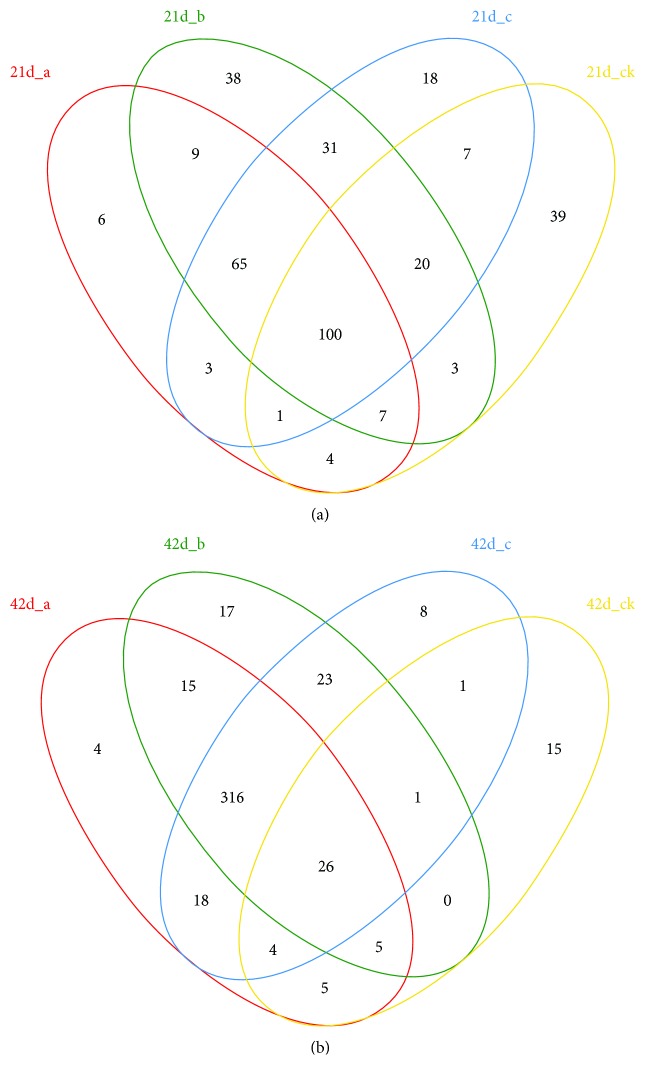
Three hundred and thirty 21-day male broilers were assigned into four groups: control group (CG, basic diet), xylanase group (XG, basic diet + xylanase), FPHC group (HG, basic diet + FPHC), and XHG group (basic diet + xylanase + FPHC). Average daily feed intake (ADFI) and daily gain (ADG) were measured. Microflora from broiler feces was analyzed using 16S rRNA sequencing. Serum tumor necrosis factor- (TNF-) , interleukin-1 (IL-1), IL-1 receptor antagonist (IL-1ra), IL-10, total antioxidant capacity (T-AOC), superoxide dismutase (SOD), glutathione peroxidase (GSH-Px), and malondialdehyde (MDA) contents were detected using kits. The variables were compared using the Student -test between two groups.
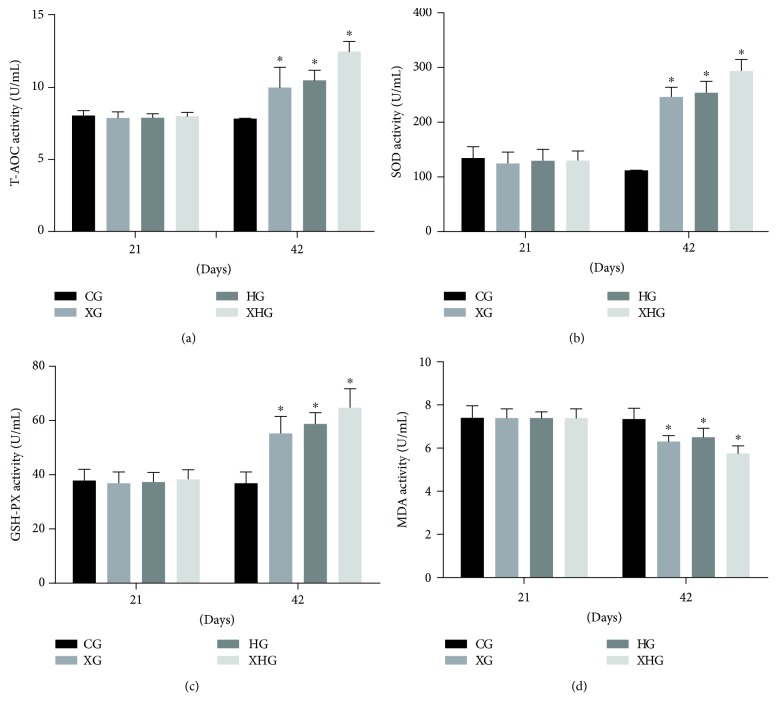
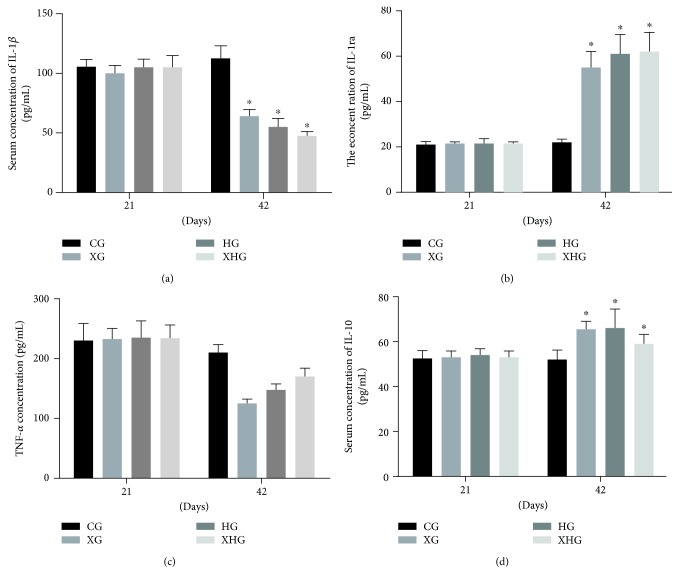
Microbiological investigations showed that 75% of broilers were affected by bacterial pathogens in the CG group, most notably by coagulase-negative staphylococci. Comparatively, 15%, 26%, and 5% of broilers were affected by bacterial pathogens in the XG, HG, and XHG groups, respectively. Xylanase and FPHC treatment increased the ratio of ADG to ADFI and antioxidant capacity by increasing the levels of T-AOC, SOD, and GSH-Px and reducing the levels of MDA ( < 0.05). Xylanase and FPHC treatment improved anti-inflammatory capacity by increasing serum levels of IL-1ra and IL-10 and reducing the levels of IL-1 and TNF-. On the other hand, the treatment increased probiotic concentration of , , and ( < 0.05), which were also proved in cell culture.
Xylanase and FPHC ameliorate pathogen infection by increasing antioxidant and anti-inflammatory activities of broilers via the increase of probiotics.
禽病在肉鸡养殖中的发生已成为禽类养殖业发展的重要问题。木聚糖酶从木聚糖中释放出的纤维二糖和发酵多糖(FPHC)对许多病原体具有抗菌潜力。
我们旨在研究木聚糖酶和 FPHC 对肉鸡()中致病性感染的影响。
将 330 只 21 日龄雄性肉鸡分为 4 组:对照组(CG,基础日粮)、木聚糖酶组(XG,基础日粮+木聚糖酶)、FPHC 组(HG,基础日粮+FPHC)和 XHG 组(基础日粮+木聚糖酶+FPHC)。测量平均日采食量(ADFI)和日增重(ADG)。采用 16S rRNA 测序分析肉鸡粪便中的微生物菌群。采用试剂盒检测血清肿瘤坏死因子-(TNF-)、白细胞介素-1(IL-1)、白细胞介素-1 受体拮抗剂(IL-1ra)、白细胞介素-10(IL-10)、总抗氧化能力(T-AOC)、超氧化物歧化酶(SOD)、谷胱甘肽过氧化物酶(GSH-Px)和丙二醛(MDA)含量。两组间比较采用 Student -检验。
微生物学研究表明,CG 组 75%的肉鸡受到细菌病原体的影响,最常见的是凝固酶阴性葡萄球菌。相比之下,XG、HG 和 XHG 组分别有 15%、26%和 5%的肉鸡受到细菌病原体的影响。木聚糖酶和 FPHC 处理通过增加 T-AOC、SOD 和 GSH-Px 的水平和降低 MDA 的水平,增加了 ADG 与 ADFI 的比值和抗氧化能力( < 0.05)。木聚糖酶和 FPHC 处理通过增加血清中 IL-1ra 和 IL-10 的水平和降低 IL-1 和 TNF-的水平,改善了抗炎能力( < 0.05)。另一方面,处理增加了 、 和 的益生菌浓度( < 0.05),这在细胞培养中也得到了证实。
木聚糖酶和 FPHC 通过增加益生菌来提高肉鸡的抗氧化和抗炎活性,从而改善病原体感染。