Afiukwa F N, Nwele D E, Uguru O E, Ibiam G A, Onwe C S, Ikpo A U, Agumah N B, Odoemena O F
Department of Applied Microbiology, Faculty of Science, Ebonyi State University Abakaliki, Nigeria.
Department of Applied Biology, Faculty of Science, Ebonyi State University Abakaliki, Nigeria.
J Parasitol Res. 2019 Jan 1;2019:7596069. doi: 10.1155/2019/7596069. eCollection 2019.
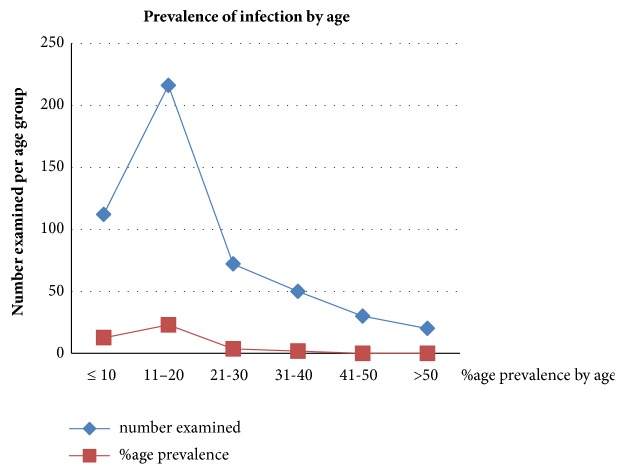
This study accessed the dynamics of urogenital schistosomiasis transmission in Nkalagu Community. A total of 500 mid-day urine samples were collected and transported to Microbiology Laboratory, Ebonyi State University, for analysis. 10ml each of the urine samples was centrifuged at 2500 rpm for 5 minutes. Transmission potential of snail intermediate host of Schistosomes collected from different sampling station at the transmission sites within the study community was equally accessed. The snail species collected were placed individually into a clean beaker with little quantity of water and then subjected to shedding light for 2 hours. Data obtained were entered in excel spread sheet and analyzed using chi square test. The result obtained shows that 205 (41%) out of 500 individuals examined were excreting ova in their urine. The highest prevalence of infection (23%) was found among 11-20-year age groups. Males were more infected (25.4%) than their female counterparts (15.6%), although this was not statistically significant (p > 0.05). A total of 283 snails belonging to two Bulinus species ( and ) were collected from the four sites sampled. recorded the highest species abundance (177) with the highest occurrence in site A. 52 (18.4%) out of 283 snails collected were infected with cercariae, and the highest cercariae infection (12.0%) was recorded among . With prevalence of 41% among the human population and the prevalence of 18.4% patent infection among the snail intermediate hosts, urogenital schistosomiasis is still a public health problem in the study area and falls within the WHO classification of endemic area. Public health campaign is recommended in order to educate the people on the mode of transmission and control of the disease.
本研究调查了恩卡拉古社区泌尿生殖系统血吸虫病的传播动态。共采集了500份午间尿液样本,并运至埃邦伊州立大学微生物实验室进行分析。每份10ml尿液样本以2500转/分钟的速度离心5分钟。对从研究社区内传播地点不同采样站采集的血吸虫中间宿主蜗牛的传播潜力进行了同样的调查。将采集到的蜗牛种类分别放入装有少量水的干净烧杯中,然后置于光照下2小时。将获得的数据录入Excel电子表格,并使用卡方检验进行分析。结果显示,在500名受检个体中,有205人(41%)尿液中排出虫卵。在11至20岁年龄组中发现感染率最高(23%)。男性感染率(25.4%)高于女性(15.6%),尽管这在统计学上不显著(p>0.05)。从四个采样地点共采集到283只属于两种双脐螺属( 和 )的蜗牛。 记录到最高的物种丰度(177只),在A地点出现的频率最高。在采集到的283只蜗牛中,有52只(18.4%)感染了尾蚴, 中记录到最高的尾蚴感染率(12.0%)。鉴于人群中患病率为41%,蜗牛中间宿主中显性感染患病率为18.4%,泌尿生殖系统血吸虫病在研究地区仍是一个公共卫生问题,属于世界卫生组织地方病分类范围。建议开展公共卫生宣传活动,以便向人们宣传该疾病的传播方式和控制方法。