Department of Microbiology and Infectious Diseases, B. P. Koirala Institute of Health Sciences, Dharan, Sunsari, 56700, Nepal.
Department of Pediatrics and Adolescent Medicine, B. P. Koirala Institute of Health Sciences, Dharan, Sunsari, 56700, Nepal.
BMC Pediatr. 2019 Jan 29;19(1):36. doi: 10.1186/s12887-019-1410-1.
Urinary tract infection (UTI) is one of most common pediatric infections. The study was designed to assess the clinical profile, common bacterial microorganisms causing UTI and their antimicrobial susceptibility patterns at B. P. Koirala Institute of Health Sciences (BPKIHS) hospital.
This is a prospective cross-sectional study conducted at Department of Microbiology and Infectious Diseases for 6 months (January to June 2018). A total of 1962 non-repetitive urine specimens (midstream, nappy pad, catheter aspirated) of pediatric patients (0-14 years age) suspected of UTI were obtained in the Microbiology laboratory. Clinical data was obtained from requisition form and hospital software. Culture and bacterial identification was done by using standard microbiological guidelines. Antimicrobial susceptibility testing was done by Kirby-Bauer disc diffusion method following clinical and laboratory standards institute (CLSI) guidelines. Resistance to methicillin and vancomycin were confirmed by calculating minimum inhibitory concentration using broth dilution method.
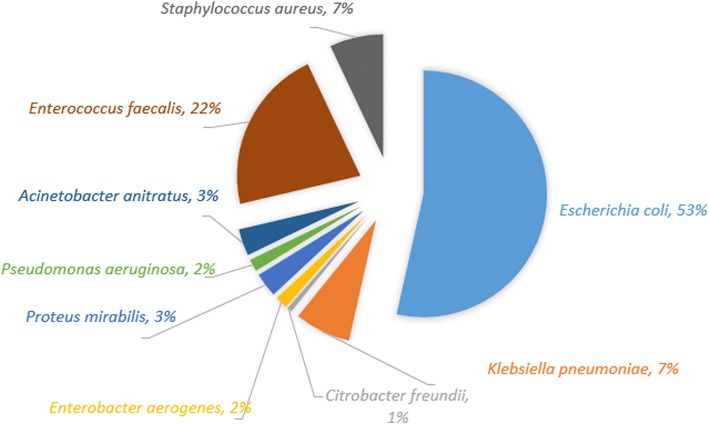
Among 1962 samples, 314 (16%) were positive for bacterial infection. Fever, irritability and poor feeding was the most common symptoms in neonates while older children presented with fever and urinary symptoms. E. coli was reported the most common etiological agent (53%), followed by Enterococcus faecalis (22%), Klebsiella pneumoniae (7%) and Staphylococcus aureus (7%). Multidrug resistant (MDR) isolates accounted for 32% of isolates, while 5% were extensively drug resistant (XDR). Fourty percentage of gram-negative bacilli were ESBL producer, 38% of S. aureus were methicillin resistant Staphylococcus aureus (MRSA) and 5% E. faecalis were vacomycin resistant enterococci (VRE). E coli was highly resistant to Ampicillin (87%), Ceftriaxone (62%) and Ofloxacin (62%). Amikacin (11% resistance) and Nitrofurantoin (5% resistance) are the most effective drugs for gram-negative bacilli (GNB) while vancomycin and linezolid are functional against gram-positive cocci.
High-level antimicrobial resistance was observed in pediatric UTI with alarming incidence superbugs like MDR, XDR, ESBL and MRSA. Regular surveillance should be carried out to determine the local prevalence of organisms and antimicrobial susceptibilities in order to guide the proper management of children.
尿路感染(UTI)是最常见的儿科感染之一。本研究旨在评估 B.P. Koirala 健康科学研究所(BPKIHS)医院的 UTI 临床特征、引起 UTI 的常见细菌微生物及其抗菌药物敏感性模式。
这是一项在微生物学和传染病科进行的前瞻性横断面研究,持续 6 个月(2018 年 1 月至 6 月)。从微生物学实验室获得了 1962 份疑似 UTI 的儿科患者(0-14 岁)的非重复中段尿、尿布垫和导管抽吸尿标本。临床数据从申请单和医院软件中获得。采用标准微生物学指南进行培养和细菌鉴定。按照临床和实验室标准协会(CLSI)指南,采用 Kirby-Bauer 纸片扩散法进行抗菌药物敏感性试验。使用肉汤稀释法计算最小抑菌浓度来确认耐甲氧西林和万古霉素的情况。
在 1962 个样本中,有 314 个(16%)样本呈细菌感染阳性。发热、烦躁和喂养不良是新生儿最常见的症状,而年龄较大的儿童则表现出发热和泌尿道症状。大肠埃希菌是最常见的病原体(53%),其次是粪肠球菌(22%)、肺炎克雷伯菌(7%)和金黄色葡萄球菌(7%)。多药耐药(MDR)分离株占分离株的 32%,5%为广泛耐药(XDR)。40%的革兰氏阴性杆菌为超广谱β-内酰胺酶(ESBL)产生菌,38%的金黄色葡萄球菌为耐甲氧西林金黄色葡萄球菌(MRSA),5%的粪肠球菌为万古霉素耐药肠球菌(VRE)。大肠埃希菌对氨苄西林(87%)、头孢曲松(62%)和氧氟沙星(62%)的耐药率较高。阿米卡星(11%耐药)和呋喃妥因(5%耐药)是革兰氏阴性杆菌(GNB)最有效的药物,而万古霉素和利奈唑胺对革兰氏阳性球菌有效。
儿科 UTI 中观察到高水平的抗菌药物耐药性,令人警惕的超级细菌如 MDR、XDR、ESBL 和 MRSA 的发生率很高。应定期进行监测,以确定当地病原体和抗菌药物敏感性的流行情况,从而指导儿童的合理管理。