Ślęzak M, Ślęzak T, Dróżdż P, Matlak B, Matlak K, Kozioł-Rachwał A, Zając M, Korecki J
AGH University of Science and Technology, Faculty of Physics and Applied Computer Science, Kraków, Poland.
National Synchrotron Radiation Centre SOLARIS, Jagiellonian University, Kraków, Poland.
Sci Rep. 2019 Jan 29;9(1):889. doi: 10.1038/s41598-018-37110-8.
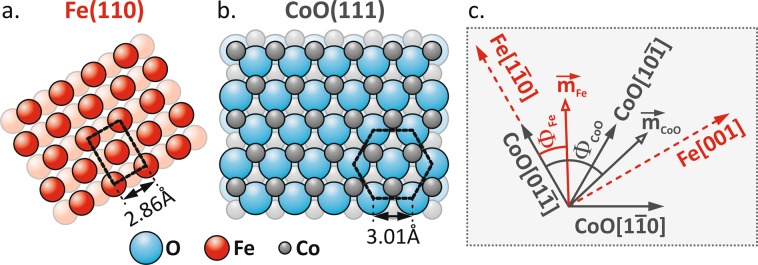
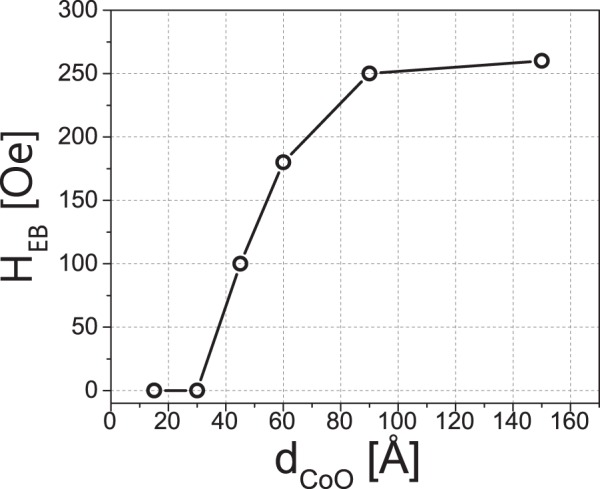
Antiferromagnet/ferromagnet (AFM/FM) bilayers that display the exchange bias (EB) effect have been subjected to intensive material research, being the key elements of novel spintronics systems. In a commonly accepted picture, the antiferromagnet, considered as a rigid material due to its high anisotropy and magnetic hardness, controls the magnetic properties of the ferromagnet, such as a shift of the hysteresis loop or coercivity. We show that this AFM-FM master-slave hierarchy is not generally valid and that the influence of the ferromagnet on the magnetic anisotropy (MA) of the neighbouring antiferromagnet must be considered. Our computer simulation and experimental studies of EB in an epitaxial CoO/Fe(110) bilayer show that the ferromagnetic layer with strong uniaxial magnetic anisotropy determines the interfacial spin orientations of the neighbouring AFM layer and rotates its easy axis. This effect has a strong feedback on the EB effect experienced by the FM layer. Our results show new physics behind the EB effect, providing a route for grafting a desired anisotropy onto the AFM and for precise tailoring of EB in AFM/FM systems.
具有交换偏置(EB)效应的反铁磁体/铁磁体(AFM/FM)双层结构一直是材料研究的重点,是新型自旋电子学系统的关键元件。在一个被广泛接受的概念中,由于其高各向异性和磁硬度,反铁磁体被视为一种刚性材料,它控制着铁磁体的磁性能,比如磁滞回线的移动或矫顽力。我们发现这种AFM-FM的主从层级关系并不普遍成立,必须考虑铁磁体对相邻反铁磁体磁各向异性(MA)的影响。我们对外延CoO/Fe(110)双层结构中EB的计算机模拟和实验研究表明,具有强单轴磁各向异性的铁磁层决定了相邻AFM层的界面自旋取向,并使其易轴发生旋转。这种效应会对FM层所经历的EB效应产生强烈的反馈。我们的结果揭示了EB效应背后的新物理现象,为在AFM上引入所需的各向异性以及在AFM/FM系统中精确调控EB提供了一条途径。