Berni Roberto, Romi Marco, Cantini Claudio, Hausman Jean-Francois, Guerriero Gea, Cai Giampiero
Department of Life Sciences, University of Siena, Siena, Italy.
Trees and Timber Institute-National Research Council of Italy (CNR-IVALSA), Follonica, Italy.
Front Plant Sci. 2019 Jan 15;9:1983. doi: 10.3389/fpls.2018.01983. eCollection 2018.
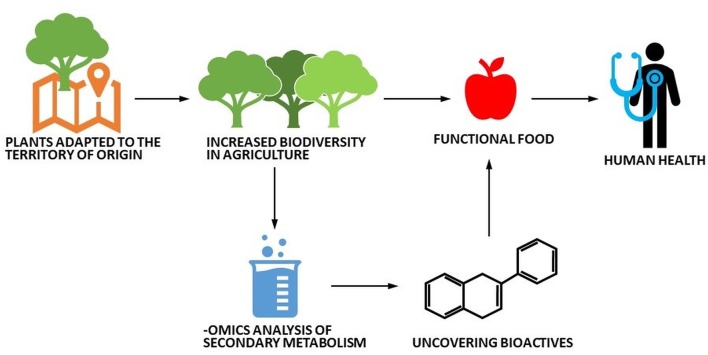
The human diet is characterized by highly energetic molecules, but it also requires non-energetic compounds that are equally useful for cell functioning and for preserving the organism's health status. These "functional" molecules are represented by a wide variety of plant secondary metabolites, such as terpenoids, vitamins and polyphenols with antioxidant power. Widespread commercial crop varieties often contain scarce levels of functional molecules, because they have been mostly selected for productivity, rather than for the content of secondary metabolites. Different scenarios (global economic situation, foreseeable environmental changes) are pushing farmers to review the use of high yield crops and to focus on the valorization of locally-adapted plants. This renewed interest is strengthened by the growing need of consumers for functional foods with beneficial effects on human health and by the willingness to promote sustainable low-input agricultural practices exploiting local climate, soil, water, and (micro)biota. Here, we want to discuss a specific case study concerning locally-adapted crops in Tuscany (Italy). Analyses of nutraceutical molecules in locally-grown crop varieties (namely tomatoes, sweet cherries and onions) have shown that they are characterized by substantially higher functional molecule contents than commercial varieties. Our goal is to promote the high-throughput study of locally-adapted varieties to understand, in a medium-term perspective, whether the cultivation of such plants is a valuable support for the diet and an adequate local economic resource. Such plants can provide a boost to the regional economy, by diversifying the local crop-market landscape. Moreover, the exploitation of locally-grown plants results in the manufacture of fully-traceable products (from the raw bioresource to the finished product) with a "0 km" concept that minimizes the C footprint.
人类饮食以高能分子为特征,但也需要对细胞功能和维持机体健康状态同样有用的非能量化合物。这些“功能性”分子由多种植物次生代谢产物代表,如具有抗氧化能力的萜类化合物、维生素和多酚。广泛种植的商业作物品种通常含有少量的功能性分子,因为它们大多是为了产量而选择的,而非次生代谢产物的含量。不同的情况(全球经济形势、可预见的环境变化)促使农民重新审视高产作物的使用,并将重点放在本地适应植物的价值提升上。消费者对有益于人类健康的功能性食品的需求不断增加,以及推广利用当地气候、土壤、水和(微)生物群的可持续低投入农业实践的意愿,强化了这种新的兴趣。在此,我们想讨论一个关于意大利托斯卡纳地区本地适应作物的具体案例研究。对当地种植的作物品种(即番茄、甜樱桃和洋葱)中的营养分子分析表明,它们的功能性分子含量显著高于商业品种。我们的目标是促进对本地适应品种的高通量研究,从中期角度了解种植这些植物是否对饮食有重要支持作用,以及是否是一种合适的当地经济资源。通过使当地作物市场格局多样化,这类植物可以推动区域经济发展。此外,利用当地种植的植物可生产出具有“零公里”概念的完全可追溯产品(从原始生物资源到成品),从而最大限度地减少碳足迹。