Department of Life Sciences, University of Siena, via P.A. Mattioli 4, 53100 Siena, Italy.
Department of Pharmacy, University of Pisa, via Bonanno 33, 56100 Pisa, Italy.
Int J Mol Sci. 2019 Apr 10;20(7):1759. doi: 10.3390/ijms20071759.
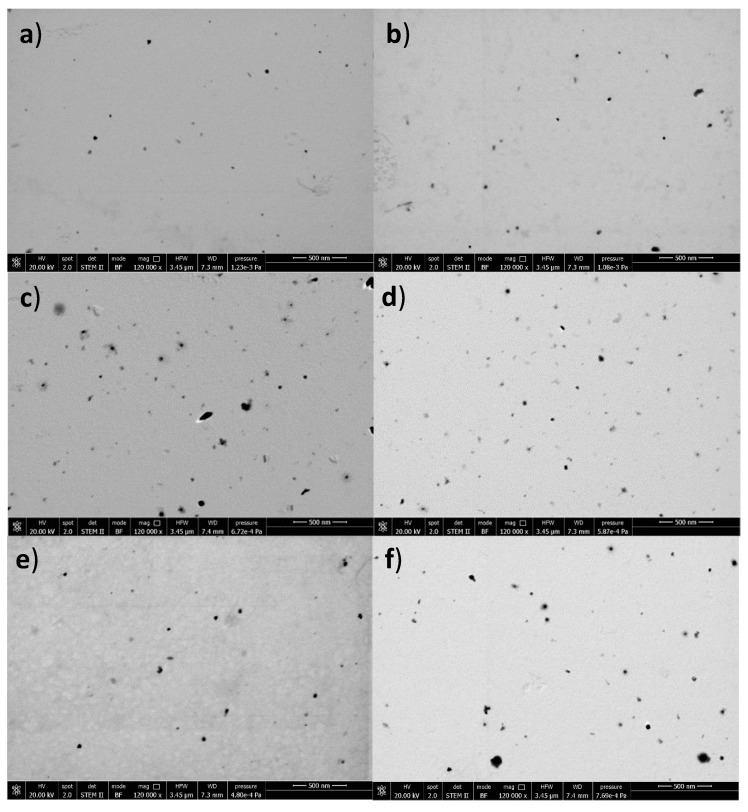
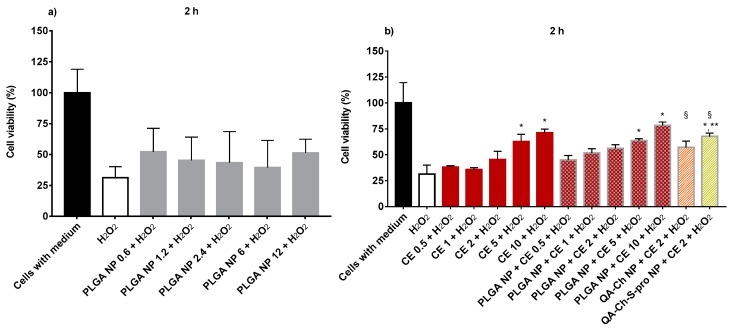
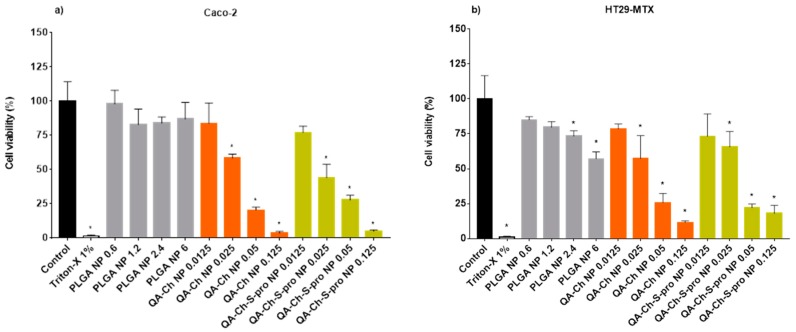
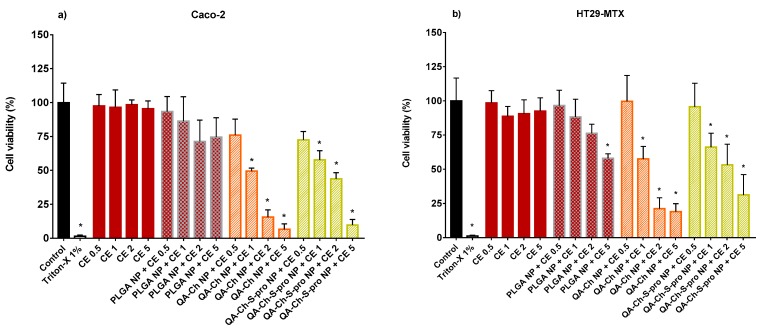
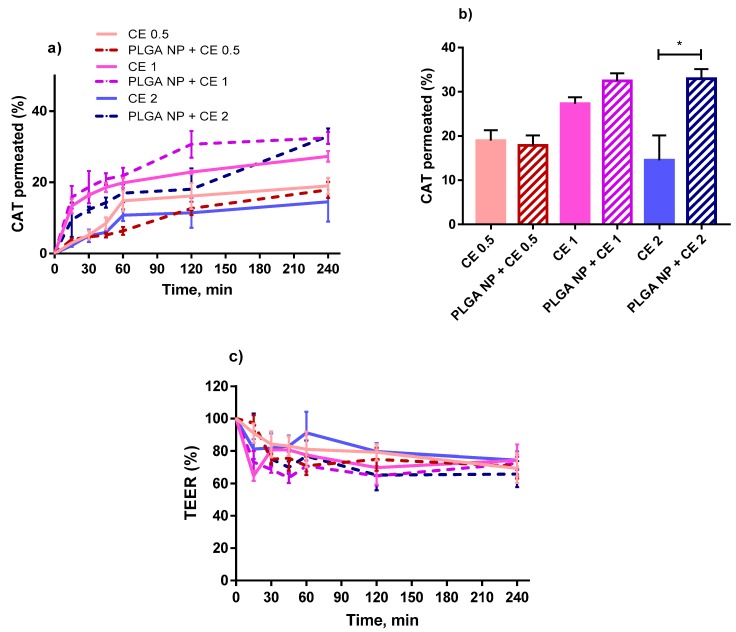
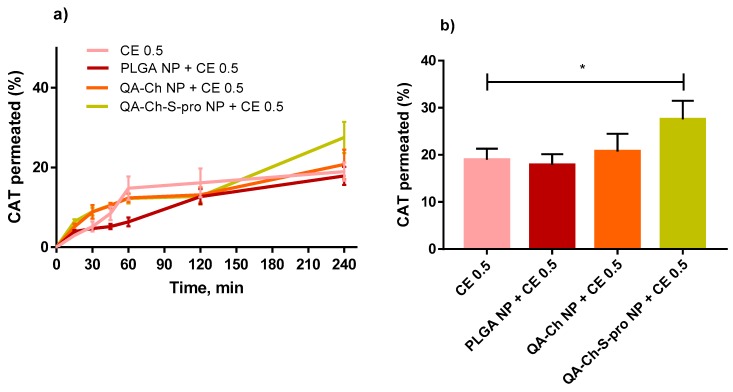
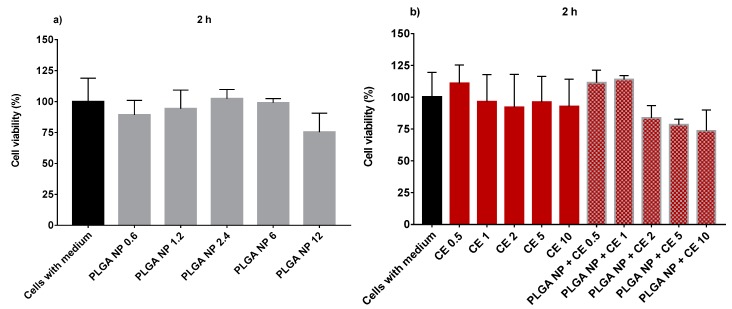
Polyphenolic compounds contained in cherry extract (CE) are well known for their antioxidant and anti-inflammatory properties. Unfortunately, most of these natural compounds have low oral bioavailability, reducing their widespread use. Here, different concentrations of polyphenol-rich CE from Tuscany (Italy), encapsulated in poly(lactic--glycolic acid) (PLGA) nanoparticles (NPs), were compared with those encapsulated in two NP types, different from each other in terms of mucoadhesivity, obtained with chitosan derivatives (Ch-der), regarding CE gastrointestinal (GI) permeability and protective effect on oxidative stress. Different NP systems were physico-chemically characterized, and the antioxidant GI permeability was evaluated in a triple-cell co-culture model (Caco-2/HT29-MTX/Raji B), resembling the intestine. PLGA NPs efficiently entrapped CE (up to 840 µg gallic acid equivalent (GAE)/mL) without altering size (210 nm), polydispersity index (0.05), or zeta potential (-10.7 mV). Such NPs promoted permeation of encapsulated CE at a CE polyphenolic concentration of at least 2 µg GAE/mL. More mucoadhesive NPs from Ch-der, coded quaternary ammonium S-protected thiolated chitosan (QA-Ch-S-pro) NP, promoted CE GI permeation of 0.5 µg GAE/mL. At higher concentrations of Ch-der polymers, the resulting NPs containing CE were toxic toward Caco-2 and HT29-MTX cells. CE protected human umbilical vein endothelial cells (HUVECs) from oxidative stress and maintained its activity when entrapped in PLGA NPs. CE encapsulated in QA-Ch-S-pro NP protected HUVECs from oxidative stress, even more effectively than non-encapsulated CE. Furthermore, mucoadhesive NPs from Ch-der were more effective antioxidant protectors than PLGA NPs, but less cytotoxic PLGA NPs could be more useful when comparatively high therapeutic antioxidant doses are needed.
樱桃提取物 (CE) 中含有的多酚化合物以其抗氧化和抗炎特性而闻名。不幸的是,这些天然化合物中的大多数口服生物利用度都较低,这限制了它们的广泛应用。在这里,我们比较了来自意大利托斯卡纳的富含多酚的 CE 用不同浓度的聚乳酸-羟基乙酸共聚物 (PLGA) 纳米粒 (NPs) 包封,以及用两种 NP 类型包封的 CE,这两种 NP 类型在粘弹性方面彼此不同,用壳聚糖衍生物 (Ch-der) 获得,研究 CE 胃肠道 (GI) 通透性和对氧化应激的保护作用。不同的 NP 系统进行了物理化学特性表征,并在三重细胞共培养模型 (Caco-2/HT29-MTX/Raji B) 中评估了抗氧化 GI 通透性,该模型类似于肠道。PLGA NPs 有效地包封了 CE(高达 840 µg 没食子酸当量 (GAE)/mL),而不会改变尺寸(210 nm)、多分散指数 (0.05) 或 zeta 电位 (-10.7 mV)。这些 NPs 以至少 2 µg GAE/mL 的 CE 多酚浓度促进了包封 CE 的渗透。更具粘弹性的 Ch-der NPs,编码季铵 S-保护巯基化壳聚糖 (QA-Ch-S-pro) NP,促进了 0.5 µg GAE/mL 的 CE GI 渗透。当 Ch-der 聚合物的浓度更高时,包含 CE 的所得 NPs 对 Caco-2 和 HT29-MTX 细胞有毒。CE 保护人脐静脉内皮细胞 (HUVECs) 免受氧化应激,并且当其包封在 PLGA NPs 中时保持其活性。CE 包封在 QA-Ch-S-pro NP 中可保护 HUVECs 免受氧化应激,比非包封的 CE 更有效。此外,Ch-der 的粘弹性 NPs 比 PLGA NPs 更有效作为抗氧化保护剂,但细胞毒性较低的 PLGA NPs 在需要比较高的治疗抗氧化剂量时可能更有用。