Veys Charles, Chatziavgerinos Fokion, AlSuwaidi Ali, Hibbert James, Hansen Mark, Bernotas Gytis, Smith Melvyn, Yin Hujun, Rolfe Stephen, Grieve Bruce
1e-Agri Sensors Centre, School of Electrical and Electronic Engineering, University of Manchester, Sackville Street, Manchester, M1 3BU UK.
2Department of Animal and Plant Sciences, University of Sheffield, Western Bank, Sheffield, S10 2TN UK.
Plant Methods. 2019 Jan 24;15:4. doi: 10.1186/s13007-019-0389-9. eCollection 2019.
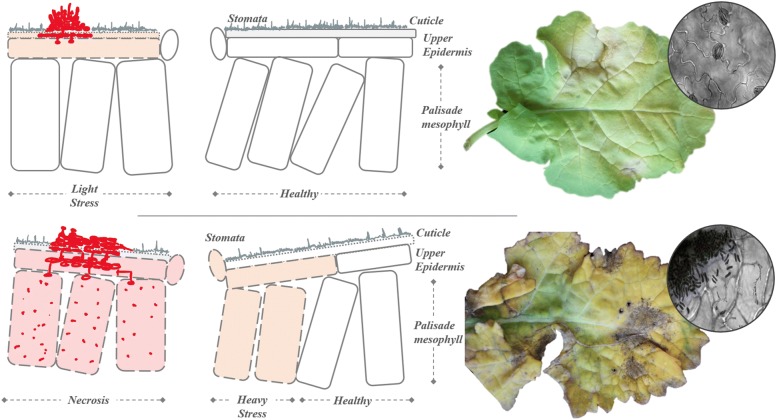
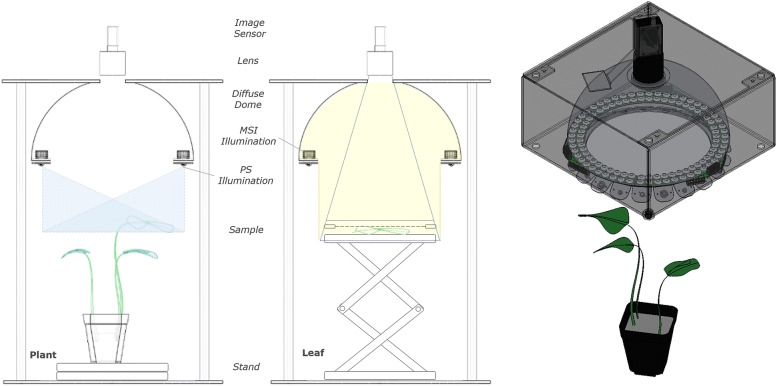
The use of spectral imaging within the plant phenotyping and breeding community has been increasing due its utility as a non-invasive diagnostic tool. However, there is a lack of imaging systems targeted specifically at plant science duties, resulting in low precision for canopy-scale measurements. This study trials a prototype multispectral system designed specifically for plant studies and looks at its use as an early detection system for visually asymptomatic disease phases, in this case in . The analysis takes advantage of machine learning in the form of feature selection and novelty detection to facilitate the classification. An initial study into recording the morphology of the samples is also included to allow for further improvement to the system performance.
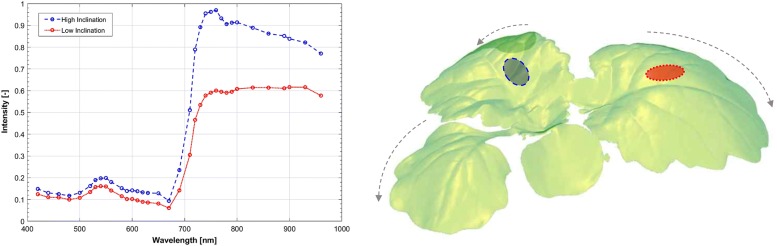
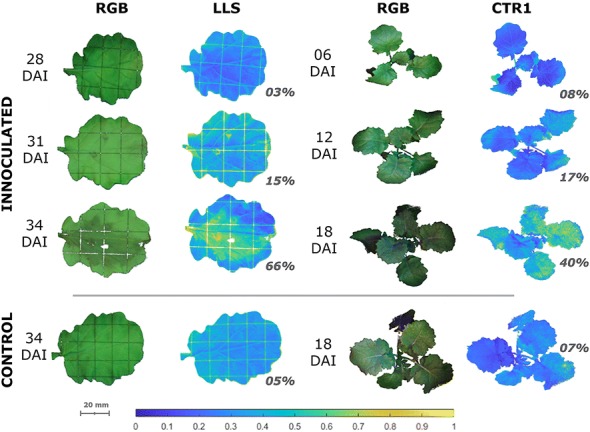
The proposed method was able to detect light leaf spot infection with 92% accuracy when imaging entire oilseed rape plants from above, 12 days after inoculation and 13 days before the appearance of visible symptoms. False colour mapping of spectral vegetation indices was used to quantify disease severity and its distribution within the plant canopy. In addition, the structure of the plant was recorded using photometric stereo, with the output influencing regions used for diagnosis. The shape of the plants was also recorded using photometric stereo, which allowed for reconstruction of the leaf angle and surface texture, although further work is needed to improve the fidelity due to uneven lighting distributions, to allow for reflectance compensation.
The ability of active multispectral imaging has been demonstrated along with the improvement in time taken to detect light leaf spot at a high accuracy. The importance of capturing structural information is outlined, with its effect on reflectance and thus classification illustrated. The system could be used in plant breeding to enhance the selection of resistant cultivars, with its early and quantitative capability.
由于光谱成像作为一种非侵入性诊断工具具有实用性,其在植物表型分析和育种领域的应用正在增加。然而,缺乏专门针对植物科学任务的成像系统,导致冠层尺度测量的精度较低。本研究对专门为植物研究设计的原型多光谱系统进行了试验,并研究了其作为视觉上无症状疾病阶段早期检测系统的用途,在本案例中是针对油菜。该分析利用特征选择和新奇性检测形式的机器学习来促进分类。还包括对记录样本形态的初步研究,以便进一步提高系统性能。
当从上方对整个油菜植株进行成像时,所提出的方法能够在接种后12天且在可见症状出现前13天以92%的准确率检测到轻叶斑病感染。光谱植被指数假彩色映射用于量化疾病严重程度及其在植物冠层内的分布。此外,使用光度立体法记录植物结构,其输出影响用于诊断的区域。还使用光度立体法记录植物形状,这允许重建叶角和表面纹理,尽管由于光照分布不均匀需要进一步开展工作来提高保真度,以实现反射率补偿。
已证明主动多光谱成像的能力以及高精度检测轻叶斑病所需时间的改善。概述了捕获结构信息的重要性,并说明了其对反射率进而对分类的影响。该系统因其早期和定量能力,可用于植物育种以加强抗性品种的选择。