El Sahly Hana M, Gorchakov Rodion, Lai Lilin, Natrajan Muktha S, Patel Shital M, Atmar Robert L, Keitel Wendy A, Hoft Daniel F, Barrett Jill, Bailey Jason, Edupuganti Srilatha, Raabe Vanessa, Wu Henry M, Fairley Jessica, Rouphael Nadine, Murray Kristy O, Mulligan Mark J
Department of Molecular Virology and Microbiology, Baylor College of Medicine, Houston, Texas.
Section of Pediatric Tropical Medicine, Center for Human Immunobiology, Department of Pediatrics, Baylor College of Medicine, Houston, Texas.
Open Forum Infect Dis. 2018 Dec 19;6(1):ofy352. doi: 10.1093/ofid/ofy352. eCollection 2019 Jan.
Clinical, virologic, and immunologic characteristics of Zika virus (ZIKV) infections in US patients are poorly defined.
US subjects with suspected ZIKV infection were enrolled. Clinical data and specimens were prospectively collected for ZIKV RNA detection and serologic and cellular assays. Confirmed ZIKV infection (cases) and ZIKV-negative (controls) subjects were compared. Dengue-experienced and dengue-naïve cases were also compared.
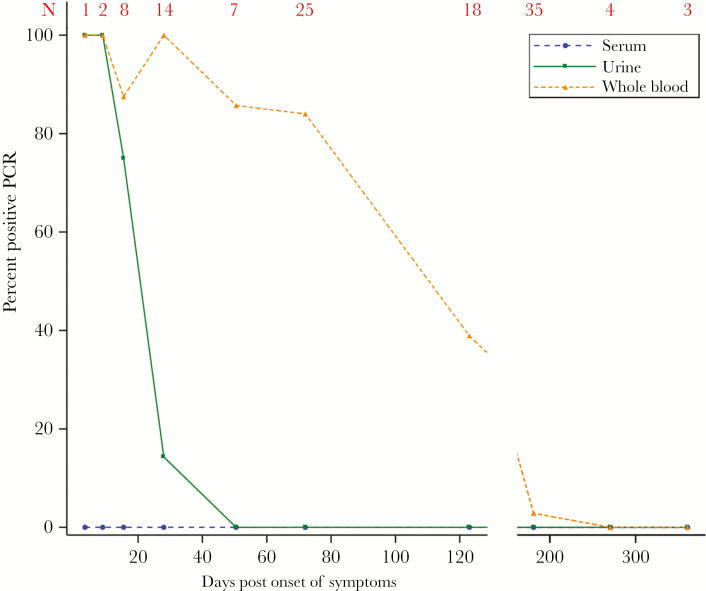
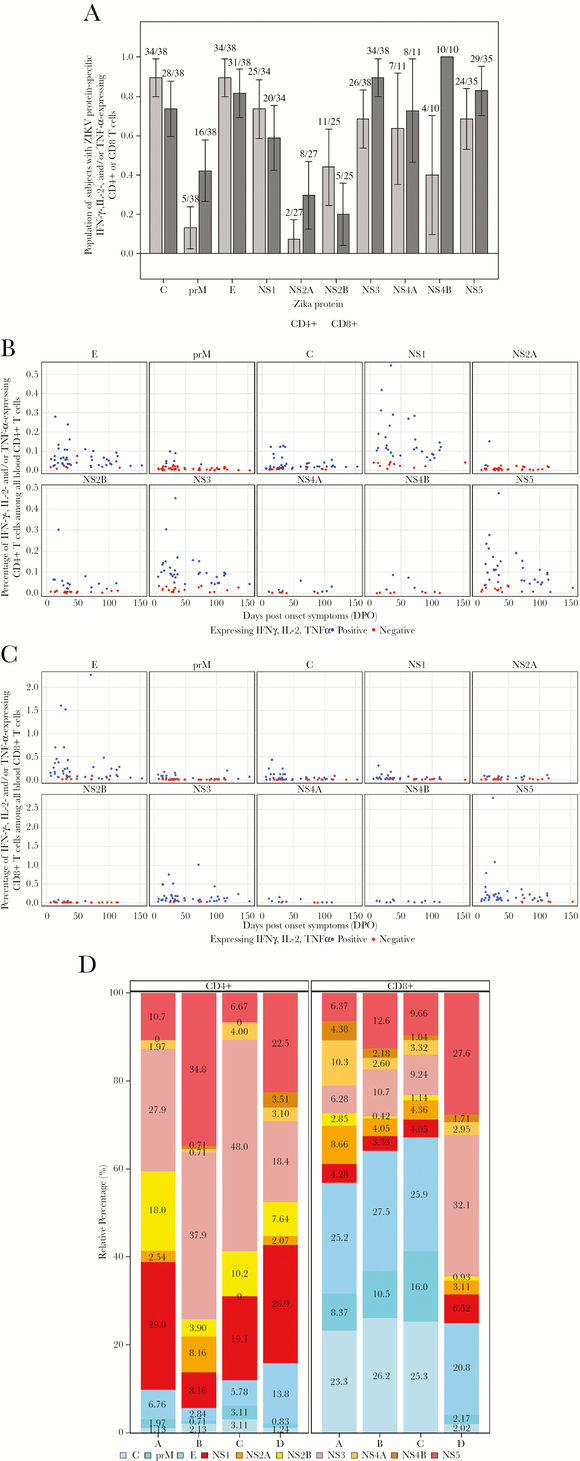
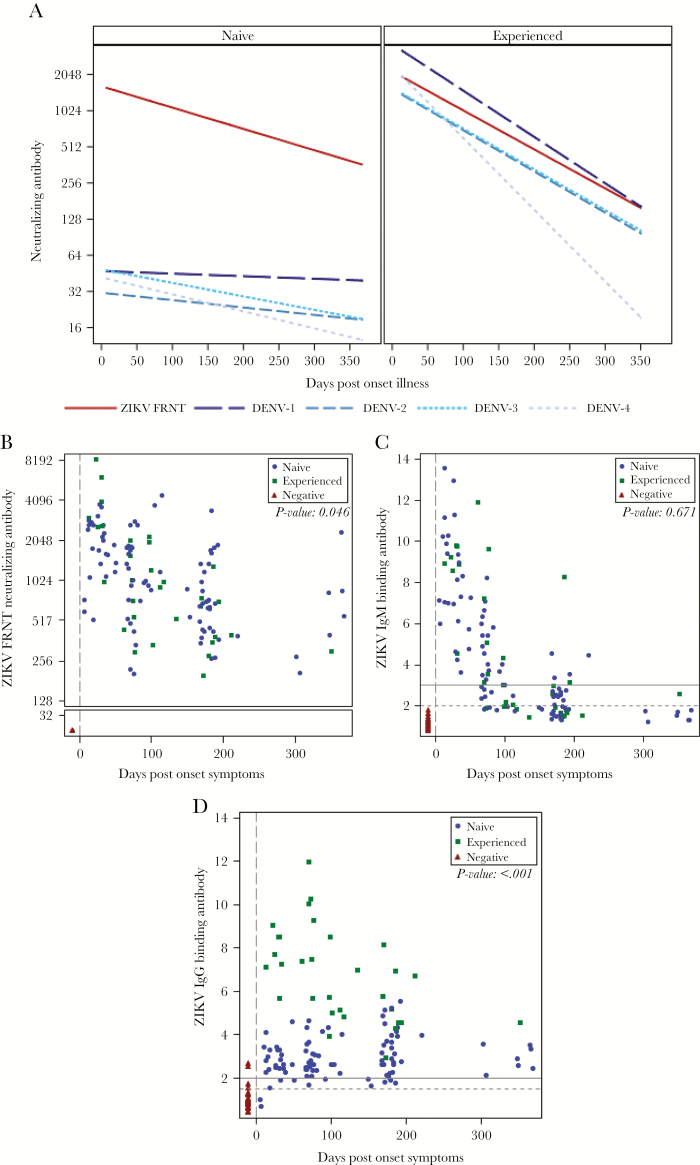
We enrolled 45 cases and 14 controls. Commonly reported symptoms among cases and controls were maculopapular rash (97.8% and 81.8%), fatigue (86.7% and 81.8%), and arthralgia (82.2% and 54.5%), respectively. The sensitivity (94%) and duration of infection detection (80% positivity at 65-79 days after disease onset) by polymerase chain reaction were highest in whole-blood specimens. ZIKV-neutralizing antibodies had a half-life of 105 days and were significantly higher in dengue virus-experienced cases than naïve ones ( = .046). In intracellular cytokine staining assays, the ZIKV proteins targeted most often by peripheral blood mononuclear cells from cases were structural proteins C and E for CD4+ T cells and nonstructural proteins NS3, NS5, and NS4B for CD8+ T cells.
ZIKV RNA detection was more frequent and prolonged in whole-blood specimens. Immunoglobulin G (IgG) and neutralizing antibodies, but not IgM, were influenced by prior dengue infection. Robust cellular responses to E and nonstructural proteins have potential vaccine development implications.
美国患者寨卡病毒(ZIKV)感染的临床、病毒学和免疫学特征尚不明确。
纳入疑似ZIKV感染的美国受试者。前瞻性收集临床数据和标本以进行ZIKV RNA检测以及血清学和细胞检测。对确诊的ZIKV感染(病例)和ZIKV阴性(对照)受试者进行比较。还对有登革热病史和无登革热病史的病例进行了比较。
我们纳入了45例病例和14例对照。病例组和对照组中常见的报告症状分别为斑丘疹(97.8%和81.8%)、疲劳(86.7%和81.8%)和关节痛(82.2%和54.5%)。聚合酶链反应检测感染的灵敏度(94%)和感染检测持续时间(疾病发作后65 - 79天80%呈阳性)在全血标本中最高。ZIKV中和抗体的半衰期为105天,有登革热病毒感染史的病例中的中和抗体显著高于无感染史的病例(P = 0.046)。在细胞内细胞因子染色检测中,病例组外周血单个核细胞最常靶向的ZIKV蛋白,对于CD4 + T细胞是结构蛋白C和E,对于CD8 + T细胞是非结构蛋白NS3、NS5和NS4B。
全血标本中ZIKV RNA检测更频繁且持续时间更长。免疫球蛋白G(IgG)和中和抗体,但不是IgM,受既往登革热感染影响。对E蛋白和非结构蛋白的强烈细胞反应对疫苗开发具有潜在意义。