Institute of Infection and Global Health (J.K.-T., Z.A.-B., J.F., M.G., T.S., L.B.), University of Liverpool; Malawi-Liverpool-Wellcome Trust Clinical Research Programme (J.K.-T., H.M.), University of Malawi College of Medicine, Blantyre; Department of Clinical Sciences (H.M.), Liverpool School of Tropical Medicine, United Kingdom.
Neurol Neuroimmunol Neuroinflamm. 2018 Dec 21;6(2):e531. doi: 10.1212/NXI.0000000000000531. eCollection 2019 Mar.
To study the relationship between endothelial dysfunction, HIV infection, and stroke in Malawians.
Using a cross-sectional design, we measured plasma levels of intercellular adhesion molecule-1 (ICAM-1), plasminogen activator inhibitor-1 (PAI-1), vascular endothelial growth factor (VEGF), and soluble thrombomodulin (sTM) in stroke patients and controls, stratified by HIV status. These biomarkers were measured using ELISA. After dichotomization, each biomarker was used as the dependent variable in a multivariable logistic regression model. Primary independent variables included HIV and stroke status. Adjustment variables were age, sex, hypertension, diabetes mellitus, tobacco and alcohol consumption, personal/family history of stroke, antiretroviral therapy status, and hypercholesterolemia.
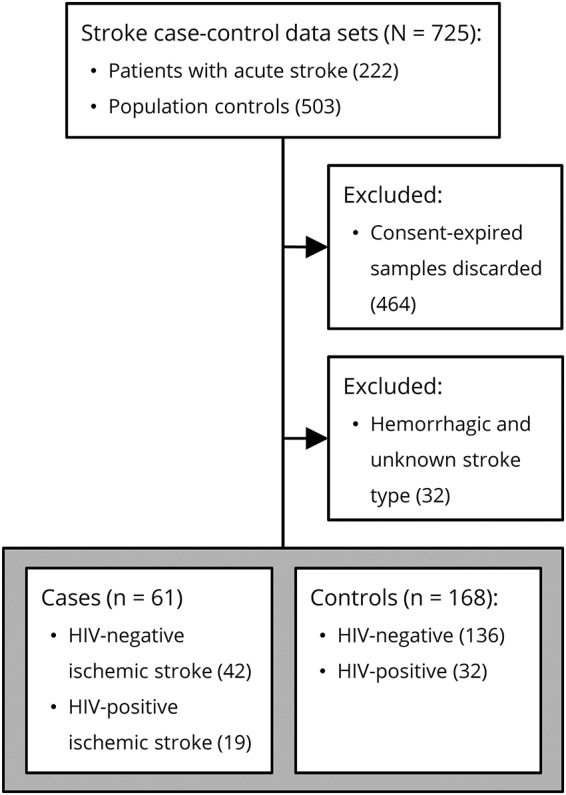
Sixty-one stroke cases (19 HIV+) and 168 controls (32 HIV+) were enrolled. The median age was 55 years (38.5-65.0) for controls and 52 years (38.0-73.0) for cases ( = 0.38). The median CD4 T-cell count was 260.1 cells/mm (156.3-363.9) and 452 cells/mm (378.1-527.4) in HIV-infected cases and controls, respectively. HIV infection was independently associated with high levels of ICAM-1 (OR = 3.6, 95% CI: 1.3-10.6, = 0.018) in controls but not in stroke cases even after excluding patients with a viral load >1,000 RNA copies/mL (OR = 4.1, 95% CI: 1.3-13.1, = 0.017). There was no association between the clinical profiles of HIV-positive controls or HIV-positive stroke and high levels of PAI-1, VEGF, and sTM.
HIV infection is associated with endothelial activation despite antiretroviral treatment. Our findings underscore the need for larger clinical cohorts to better understand the contribution of this perturbation of the endothelial function to the increasing burden of cardiovascular diseases in sub-Saharan Africa.
研究马拉维人群内皮功能障碍、人类免疫缺陷病毒(HIV)感染和中风之间的关系。
采用横断面设计,我们测量了中风患者和对照组(按 HIV 状态分层)的血浆细胞间黏附分子-1(ICAM-1)、纤溶酶原激活物抑制剂-1(PAI-1)、血管内皮生长因子(VEGF)和可溶性血栓调节蛋白(sTM)水平。采用酶联免疫吸附法(ELISA)进行检测。二分类后,每个生物标志物都作为多变量逻辑回归模型的因变量。主要的独立变量包括 HIV 和中风状态。调整变量包括年龄、性别、高血压、糖尿病、烟酒使用、个人/家族中风史、抗逆转录病毒治疗状况和高胆固醇血症。
共纳入 61 例中风病例(19 例 HIV 阳性)和 168 例对照组(32 例 HIV 阳性)。对照组的中位年龄为 55 岁(38.5-65.0),病例组为 52 岁(38.0-73.0)( = 0.38)。HIV 感染者的 CD4 T 细胞计数中位数为 260.1 个细胞/mm(156.3-363.9),对照组为 452 个细胞/mm(378.1-527.4)。HIV 感染与对照组中 ICAM-1 水平升高独立相关(比值比[OR] = 3.6,95%置信区间[CI]:1.3-10.6, = 0.018),但在中风病例中无此相关性,即使排除病毒载量>1000 拷贝/mL 的患者(OR = 4.1,95%CI:1.3-13.1, = 0.017)。HIV 阳性对照组和 HIV 阳性中风患者的临床特征与 PAI-1、VEGF 和 sTM 水平升高无关。
尽管接受了抗逆转录病毒治疗,HIV 感染仍与内皮细胞激活有关。我们的研究结果强调了需要更大的临床队列来更好地理解这种内皮功能障碍对撒哈拉以南非洲地区心血管疾病负担增加的贡献。