Department of Plant Biochemistry, Albrecht-von-Haller-Institute for Plant Sciences, University of Goettingen, Justus-von-Liebig-Weg 11, Goettingen, Germany.
Department of Plant Biochemistry, Goettingen Center for Molecular Biosciences (GZMB), University of Goettingen, Goettingen, Germany.
Plant Cell Physiol. 2019 Jun 1;60(6):1166-1175. doi: 10.1093/pcp/pcz006.
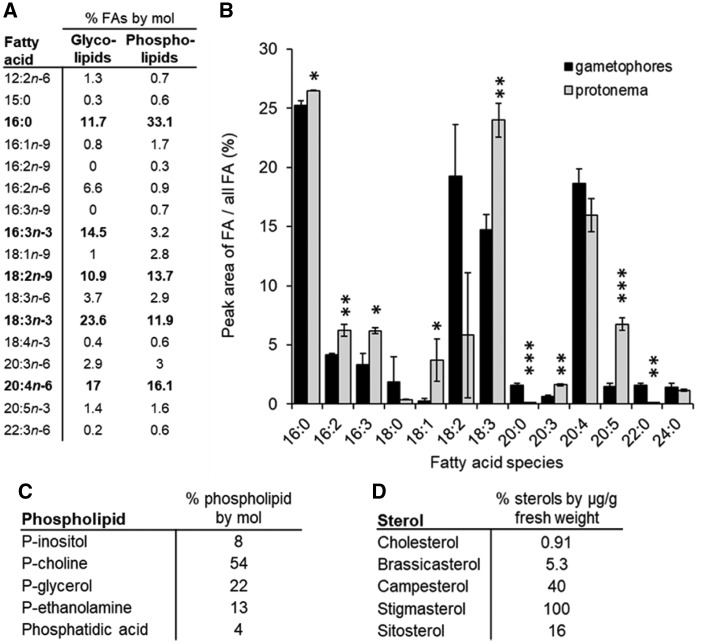
The moss Physcomitrella patens receives increased scientific interest since its genome was sequenced a decade ago. As a bryophyte, it represents the first group of plants that evolved in a terrestrial habitat still without a vascular system that developed later in tracheophytes. It is easily transformable via homologous recombination, which enables the formation of targeted loss-of-function mutants. Even though genetics, development and life cycle in Physcomitrella are well studied nowadays, research on lipids in Physcomitrella is still underdeveloped. This review aims on presenting an overview on the state of the art of lipid research with a focus on membrane lipids, surface lipids and oxylipins. We discuss in this review that Physcomitrella possesses very interesting features regarding its membrane lipids. Here, the presence of very-long-chain polyunsaturated fatty acids (VLC-PUFA) still shows a closer similarity to marine microalgae than to vascular plants. Unlike algae, Physcomitrella has a cuticle comparable to vascular plants composed of cutin and waxes. The presence of VLC-PUFA in Physcomitrella also leads to a greater variability of signaling lipids even though the phytohormone jasmonic acid is not present in this organism, which is different to vascular plants. In summary, the research on lipids in Physcomitrella is still in its infancy, especially considering membrane lipids. We hope that this review will help to promote the further advancement of lipid research in this important model organism in the future, so we can better understand how lipids are involved in the evolution of land plants.
藓类植物拟南芥自十年前基因组测序以来,受到了越来越多的科学关注。作为一种苔藓植物,它代表了第一批在陆地环境中进化的植物,而陆地植物的维管系统是在后来的维管束植物中进化而来的。它很容易通过同源重组转化,这使得形成靶向功能丧失突变体成为可能。尽管拟南芥的遗传学、发育和生命周期现在已经得到了很好的研究,但对拟南芥脂质的研究仍处于起步阶段。本文旨在综述脂质研究的最新进展,重点介绍膜脂、表面脂和氧化脂。我们在本文中讨论了拟南芥在其膜脂方面具有非常有趣的特征。在这里,超长链多不饱和脂肪酸(VLC-PUFA)的存在与海洋微藻的相似性仍然大于与维管植物的相似性。与藻类不同,拟南芥的角质层与维管植物相似,由角质和蜡组成。拟南芥中 VLC-PUFA 的存在也导致了信号脂质的更大变异性,尽管这种植物中不存在植物激素茉莉酸,这与维管植物不同。总之,拟南芥脂质的研究仍处于起步阶段,特别是考虑到膜脂。我们希望本文的综述将有助于促进未来这个重要模式生物在脂质研究方面的进一步发展,从而更好地理解脂质在陆地植物进化中的作用。