Bonn University Hospital, HIV Outpatient Clinic, Bonn, Germany.
University of California Davis Medical Center, Division of Infectious Diseases, Sacramento, California, United States of America.
PLoS One. 2019 Jan 30;14(1):e0210965. doi: 10.1371/journal.pone.0210965. eCollection 2019.
Vacc-4x, a therapeutic HIV vaccine candidate has previously induced a significant reduction in viral load (VL) set-point compared to placebo upon interruption of combination anti-retroviral therapy (ART) (2007/1 study). This study, (2012/1), explored the potential to maintain Vacc-4x effect by re-boosting eligible 2007/1 study participants.
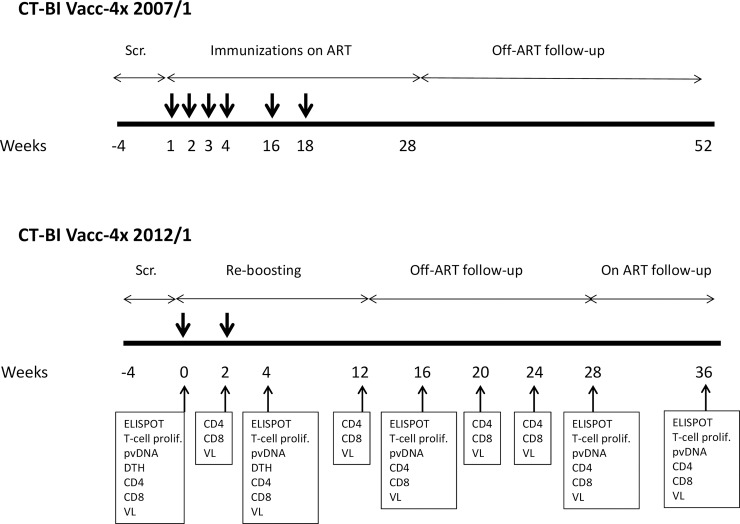
Participant inclusion required 2007/1 participants to have completed all Vacc-4x immunizations and interrupted ART for up to 26 weeks. At weeks (wk)0 and 2, participants received intradermal (i.d.) Vacc-4x booster immunizations (1.2mg) on ART with GM-CSF (60μg) i.d. as a local adjuvant. ART was interrupted for up to 16 weeks (wk12-wk28). Participants were then followed on ART until wk36. VL set-point, total proviral DNA (pvDNA) and immunogenicity assessed by IFN-γ ELISPOT, T-cell proliferation and delayed type hypersensitivity (DTH) reactions were compared to participants' values in the 2007/1 study where available.
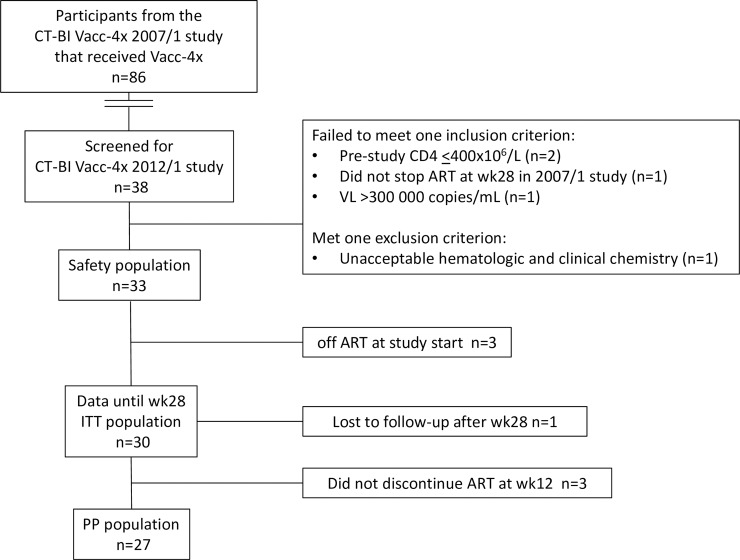
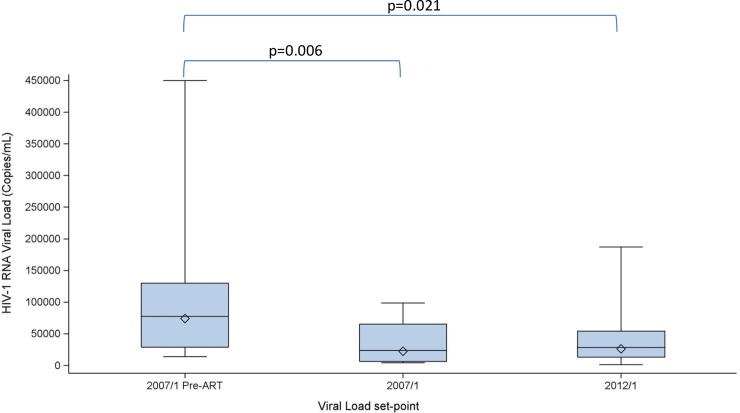
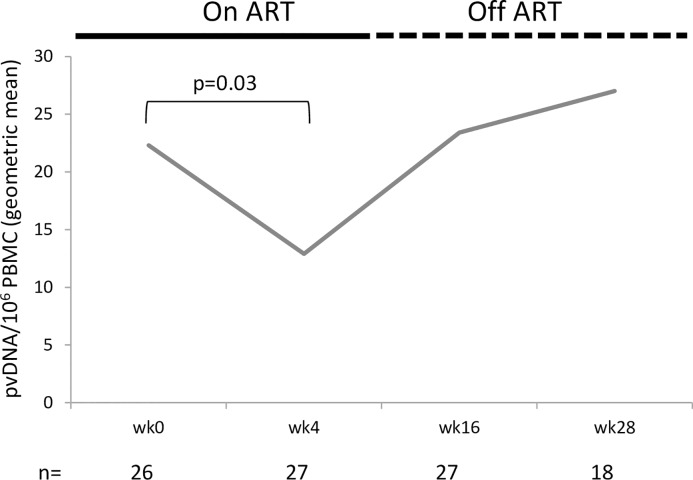
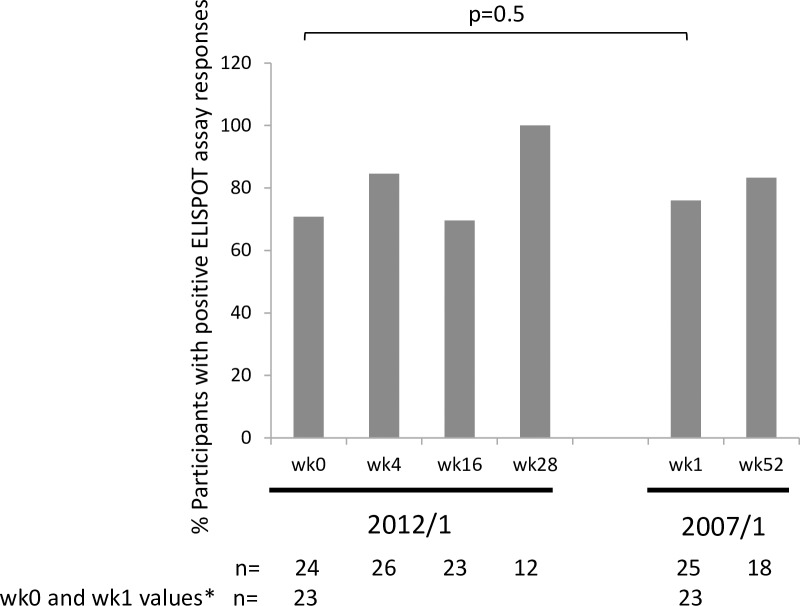
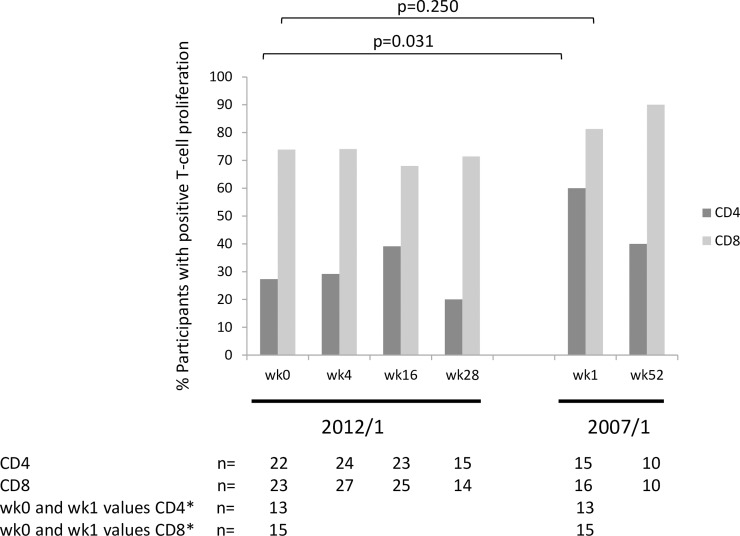
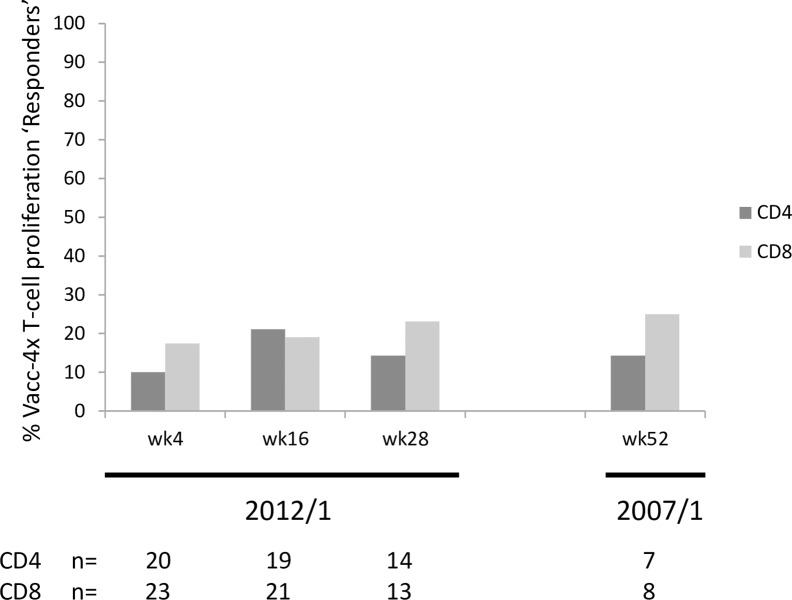
This open, multicenter, clinical study enrolled 33 participants from 9 clinical trial sites in the US and Europe. In the per-protocol (PP) population, the VL set-point geometric mean (GM) 18162 copies/mL was not significantly changed compared to the 2007/1 study (GM VL 22035 copies/mL), (p = 0.453, n = 18). For participants with available preART VL values, the VL set-point (GM 26279 copies/mL) remained significantly lower than the preART VL set-point (GM 74048 copies/mL, p = 0.021, n = 13). A statistically significant reduction in pvDNA (49%) from baseline to wk4 was observed (p = 0.03, n = 26). DTH responses (wk4) increased significantly from baseline (p = 0.006, n = 30) and compared to the 2007/1 study (p = 0.022, n = 29) whilst the proportion of participants with ELISPOT and T-cell proliferation responses was similar between the two studies.
Vacc-4x booster immunizations safely maintained the mean VL set-point at that established following primary Vacc-4x therapeutic immunization. The reduction in pvDNA during ART supports the potential for Vacc-4x immunization to reduce HIV reservoirs and thereby contribute to combination HIV cure strategies.
Vacc-4x 是一种治疗性 HIV 疫苗候选物,与安慰剂相比,在中断联合抗逆转录病毒治疗(ART)后,它以前曾显著降低病毒载量(VL)设定点(2007/1 研究)。这项研究(2012/1)探索了通过重新增强合格的 2007/1 研究参与者来维持 Vacc-4x 效果的潜力。
参与者的纳入要求 2007/1 名参与者完成所有 Vacc-4x 免疫接种,并中断 ART 长达 26 周。在第 0 周(wk)和第 2 周,参与者在接受 ART 治疗时接受皮内(i.d.)Vacc-4x 增强免疫接种(1.2mg),并用 GM-CSF(60μg)皮内作为局部佐剂。ART 中断长达 16 周(wk12-wk28)。然后,参与者在 ART 上进行随访,直到 wk36。VL 设定点、总前病毒 DNA(pvDNA)和 IFN-γ ELISPOT、T 细胞增殖和迟发型超敏反应(DTH)反应的免疫原性评估与参与者在可用时的 2007/1 研究中的值进行了比较。
这项开放、多中心的临床研究在美国和欧洲的 9 个临床试验地点招募了 33 名参与者。在符合方案(PP)人群中,VL 设定点几何平均值(GM)为 18162 拷贝/ml,与 2007/1 研究相比没有显著变化(GM VL 为 22035 拷贝/ml)(p = 0.453,n = 18)。对于有可用预 ART VL 值的参与者,VL 设定点(GM 为 26279 拷贝/ml)仍显著低于预 ART VL 设定点(GM 为 74048 拷贝/ml,p = 0.021,n = 13)。从基线到第 4 周观察到 pvDNA (49%)显著降低(p = 0.03,n = 26)。DTH 反应(第 4 周)从基线显著增加(p = 0.006,n = 30),并与 2007/1 研究相比(p = 0.022,n = 29),而两项研究中具有 ELISPOT 和 T 细胞增殖反应的参与者比例相似。
Vacc-4x 增强免疫接种安全地维持了初次 Vacc-4x 治疗性免疫接种后建立的平均 VL 设定点。ART 期间 pvDNA 的减少支持 Vacc-4x 免疫接种减少 HIV 储存库的潜力,从而有助于联合 HIV 治愈策略。