Sugashima Marine Biological Laboratory, Graduate School of Science, Nagoya University, 429-63 Sugashima, Toba, 517-0004, Mie, Japan.
Hitachi, Ltd., Research & Development Group, Akanuma, Hatoyama, Hiki, Saitama, Japan.
Sci Rep. 2019 Jan 30;9(1):1009. doi: 10.1038/s41598-018-37721-1.
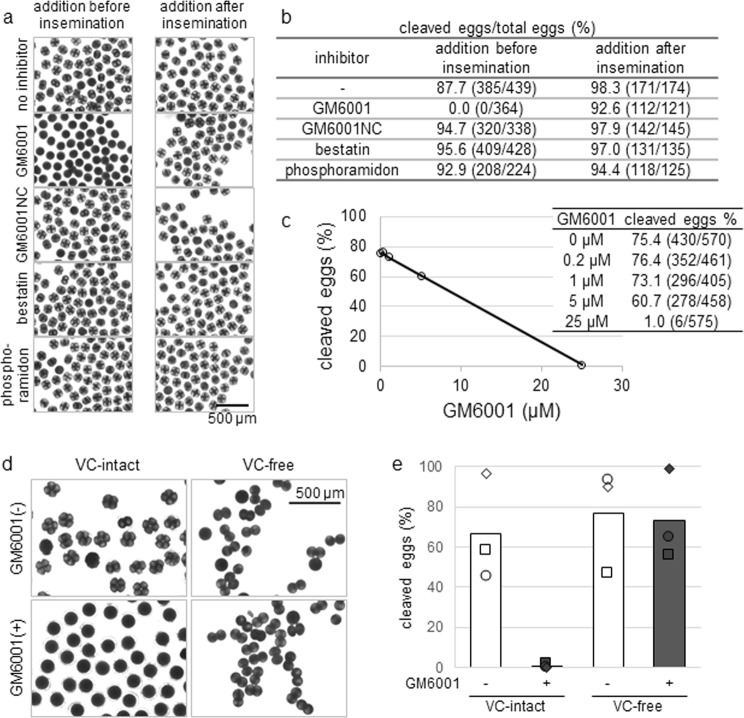
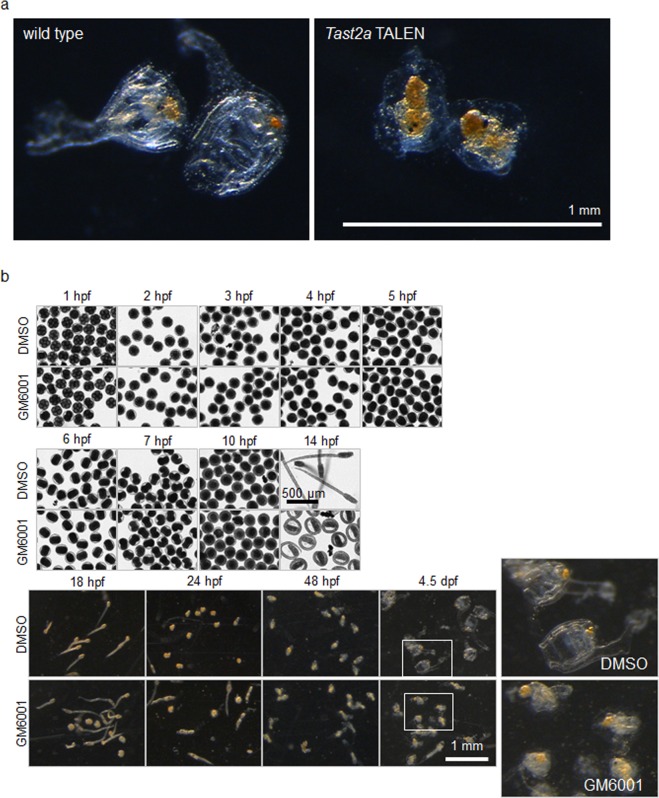
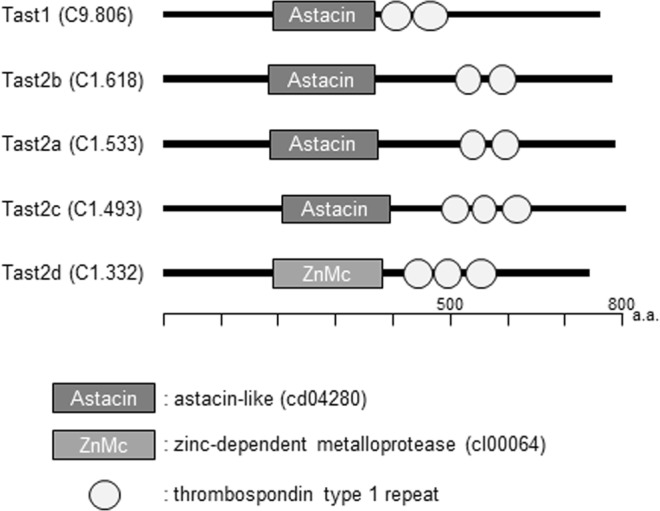
In the ascidian Ciona robusta (formerly C. intestinalis type A), the mechanism underlying sperm penetration through the egg investment remains unknown. We previously reported that proteins containing both an astacin metalloprotease domain and thrombospondin type 1 repeats are abundant in the sperm surface protein-enriched fraction of C. robusta. Here we investigated the involvement of those proteins in fertilisation. We refined the sequences of astacin metalloproteases, confirmed that five of them are present in the sperm, and labelled them as tunicate astacin and thrombospondin type 1 repeat-containing (Tast) proteins. Fertilisation of C. robusta eggs was potently inhibited by a metalloprotease inhibitor GM6001. The eggs cleaved normally when they were vitelline coat-free or the inhibitor was added after insemination. Furthermore, vitelline coat proteins were degraded after incubation with intact sperm. These results suggest that sperm metalloproteases are indispensable for fertilisation, probably owing to direct or indirect mediation of vitelline-coat digestion during sperm penetration. TALEN-mediated knockout of Tast genes and the presence of GM6001 impaired larval development at the metamorphic stage, suggesting that Tast gene products play a key role in late development.
在海鞘 Ciona robusta(以前称为 C. intestinalis type A)中,精子穿透卵投资的机制尚不清楚。我们之前报道过,富含精子表面蛋白的部分中富含含有星孢菌素金属蛋白酶结构域和血栓素类型 1 重复的蛋白质。在这里,我们研究了这些蛋白质在受精中的作用。我们改进了星孢菌素金属蛋白酶的序列,确认其中有 5 种存在于精子中,并将它们标记为被囊动物星孢菌素和血栓素类型 1 重复包含(Tast)蛋白。海鞘 C. robusta 卵子的受精被金属蛋白酶抑制剂 GM6001 强烈抑制。当卵无卵黄层或抑制剂在授精后添加时,卵正常分裂。此外,完整精子孵育后卵黄层蛋白被降解。这些结果表明,精子金属蛋白酶对于受精是必不可少的,可能是由于在精子穿透过程中直接或间接介导卵黄层的消化。TALEN 介导的 Tast 基因敲除和 GM6001 的存在损害了变态阶段的幼虫发育,表明 Tast 基因产物在后期发育中发挥关键作用。