Saito Takako, Sawada Hitoshi
Faculty of Agriculture Department of Applied Life Sciences, Shizuoka University, Shizuoka, Japan.
Depatment of Food and Nutritional Environment, College of Human Life and Environment, Kinjo Gakuin University, Nagoya, Japan.
Front Cell Dev Biol. 2022 Jan 21;9:827214. doi: 10.3389/fcell.2021.827214. eCollection 2021.
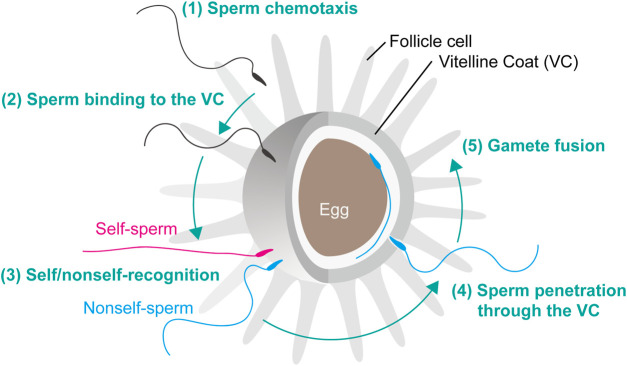
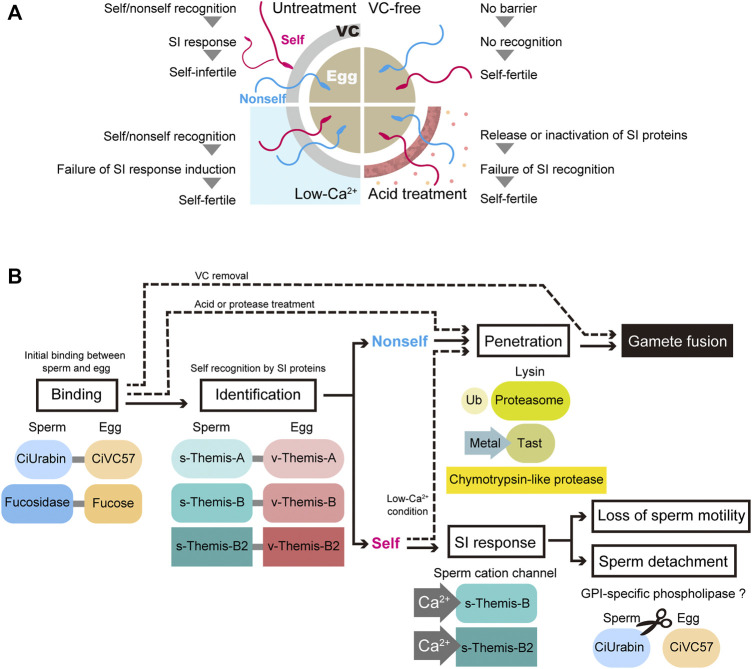
Fertilization is one of the most important events in living organisms to generate a new life with a mixed genetic background. To achieve successful fertilization, sperm and eggs must undergo complex processes in a sequential order. Fertilization of marine invertebrate type has been studied for more than a hundred years. Ascidian sperm are attracted by chemoattractants from eggs and bind to the vitelline coat. Subsequently, sperm penetrate through the vitelline coat proteolytically and finally fuse with the egg plasma membrane. Here, we summarize the fertilization mechanisms of ascidians, particularly from sperm-egg interactions to sperm penetration of the egg coat. Since ascidians are hermaphrodites, inbreeding depression is a serious problem. To avoid self-fertilization, ascidians possess a self-incompatibility system. In this review, we also describe the molecular mechanisms of the self-incompatibility system in type A governed by three allelic gene pairs of and .
受精是生物体内最重要的事件之一,它能产生具有混合遗传背景的新生命。为了实现成功受精,精子和卵子必须按顺序经历复杂的过程。对海洋无脊椎动物类型的受精研究已经有一百多年了。海鞘精子被来自卵子的化学引诱剂吸引并与卵黄膜结合。随后,精子通过蛋白水解作用穿透卵黄膜,最终与卵质膜融合。在这里,我们总结海鞘的受精机制,特别是从精卵相互作用到精子穿透卵膜的过程。由于海鞘是雌雄同体,近亲繁殖衰退是一个严重问题。为了避免自体受精,海鞘拥有一个自我不亲和系统。在这篇综述中,我们还描述了由 和 的三个等位基因对控制的A型自我不亲和系统的分子机制。