School of Forensic Medicine, China Medical University, No. 77 Puhe Road, Shenyang, 110,122, Shenbei New District, China.
BMC Med Genet. 2019 Jan 31;20(1):26. doi: 10.1186/s12881-019-0757-3.
Schizophrenia is a severe neurodevelopmental disorder with a complex genetic and environmental etiology. Abnormal glutamate ionotropic N-methyl-D-aspartate receptor (NMDA) type subunit 1 (NR1) may be a potential cause of schizophrenia.
We conducted a case-control study to investigate the association between the GRIN1 gene, which encodes the NR1 subunit, and the risk of schizophrenia in a northern Chinese Han population using Sanger DNA sequencing. The dual luciferase reporter assay was used to detect the influence of two different haplotypes on GRIN1 gene expression.
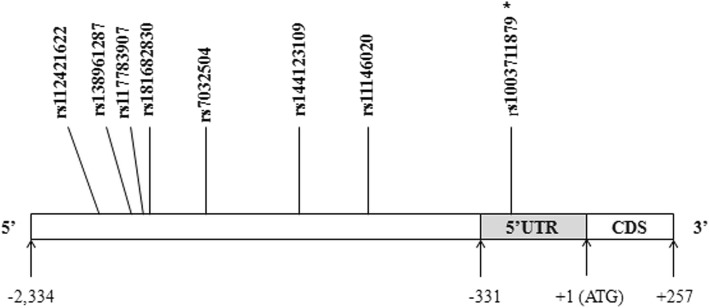
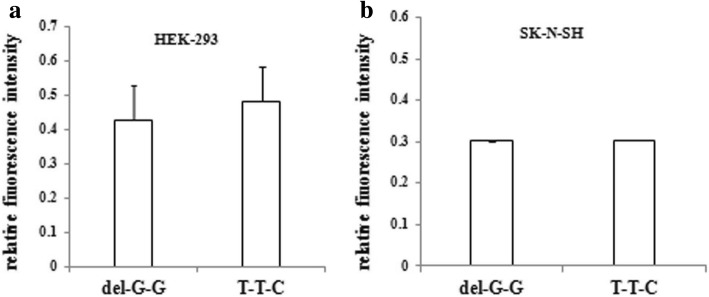
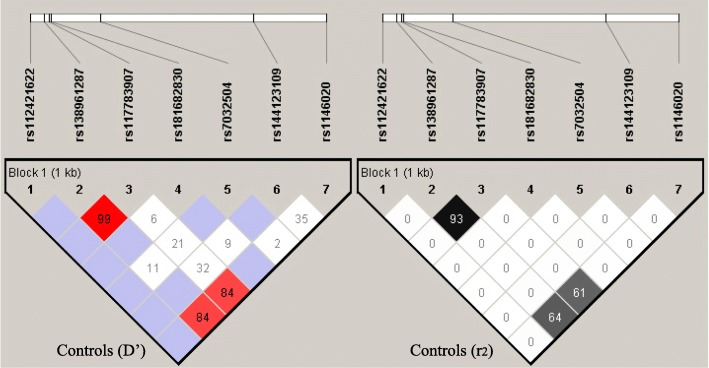
Seven SNPs (single nucleotide polymorphisms), including rs112421622 (- 2019 T/C), rs138961287 (- 1962--1961insT), rs117783907 (-1945G/T), rs181682830 (-1934G/A), rs7032504 (-1742C/T), rs144123109 (-1140G/A), and rs11146020 (-855G/C) were detected in the study population. Rs117783907 (-1945G/T) was associated with the occurrence of schizophrenia as a protective factor. The genotype frequencies of rs138961287 (- 1962--1961insT) and rs11146020 (-855G/C) were statistically different between cases and controls (p < 0.0083). The other four variations were not shown to be associated with the disease. Two haplotypes were composed of the seven SNPs, and distribution of T-del-G-G-C-G-G was significantly different between the case and control groups. However, the dual luciferase reporter assay showed that neither of the haplotypes affected luciferase expression in HEK-293 and SK-N-SH cell lines.
The GRIN1 gene may be related to the occurrence of schizophrenia. Additional research will be needed to fully ascertain the role of GRIN1 in the etiology of schizophrenia.
精神分裂症是一种严重的神经发育障碍,具有复杂的遗传和环境病因。异常的谷氨酸离子型 N-甲基-D-天冬氨酸受体(NMDA)型亚基 1(NR1)可能是精神分裂症的潜在原因。
我们进行了一项病例对照研究,使用 Sanger DNA 测序技术,在中国北方汉族人群中,研究编码 NR1 亚基的 GRIN1 基因与精神分裂症风险之间的关系。双荧光素酶报告基因检测两种不同单倍型对 GRIN1 基因表达的影响。
在研究人群中检测到 7 个单核苷酸多态性(SNPs),包括 rs112421622(-2019T/C)、rs138961287(-1962--1961insT)、rs117783907(-1945G/T)、rs181682830(-1934G/A)、rs7032504(-1742C/T)、rs144123109(-1140G/A)和 rs11146020(-855G/C)。rs117783907(-1945G/T)作为保护因素与精神分裂症的发生有关。rs138961287(-1962--1961insT)和 rs11146020(-855G/C)的基因型频率在病例组和对照组之间存在统计学差异(p<0.0083)。其他四个变异与疾病无关。由这 7 个 SNPs 组成的两种单倍型,T-del-G-G-C-G-G 在病例组和对照组之间的分布有显著差异。然而,双荧光素酶报告基因检测显示,这两种单倍型均不影响 HEK-293 和 SK-N-SH 细胞系中的荧光素酶表达。
GRIN1 基因可能与精神分裂症的发生有关。需要进一步的研究来充分确定 GRIN1 在精神分裂症发病机制中的作用。