
CSF1R 拮抗作用限制了病毒性脑炎期间抗病毒 CD8 T 细胞的局部再刺激。
CSF1R antagonism limits local restimulation of antiviral CD8 T cells during viral encephalitis.
机构信息
Department of Internal Medicine, Division of Infectious Diseases, Washington University School of Medicine, Saint Louis, MO, 63110, USA.
Department of Pathology and Immunology, Washington University School of Medicine, Saint Louis, MO, 63110, USA.
出版信息
J Neuroinflammation. 2019 Jan 31;16(1):22. doi: 10.1186/s12974-019-1397-4.
BACKGROUND
Microglia are resident macrophages of the central nervous system (CNS) locally maintained through colony-stimulating factor 1 receptor (CSF1R) signaling. Microglial depletion via CSF1R inactivation improves cognition in mouse models of neuroinflammation, but limits virologic control in the CNS of mouse models of neurotropic infections by unknown mechanisms. We hypothesize that CSF1R plays a critical role in myeloid cell responses that restrict viral replication and locally restimulate recruited antiviral T cells within the CNS.
METHODS
The impact of CSF1R signaling during West Nile virus infection was assessed in vivo using a mouse model of neurotropic infection. Pharmacological inactivation of CSF1R was achieved using PLX5622 prior to infection with virulent or attenuated strains of West Nile virus (WNV), an emerging neuropathogen. The subsequent effect of CSF1R antagonism on virologic control was assessed by measuring mortality and viral titers in the CNS and peripheral organs. Immune responses were assessed by flow cytometric-based phenotypic analyses of both peripheral and CNS immune cells.
RESULTS
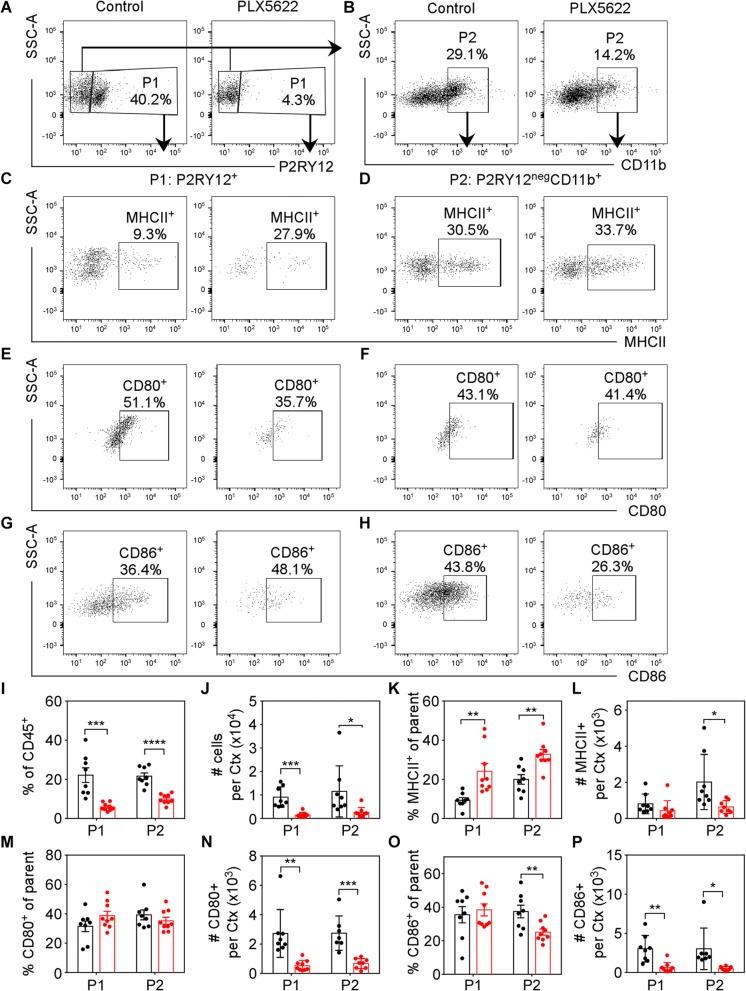
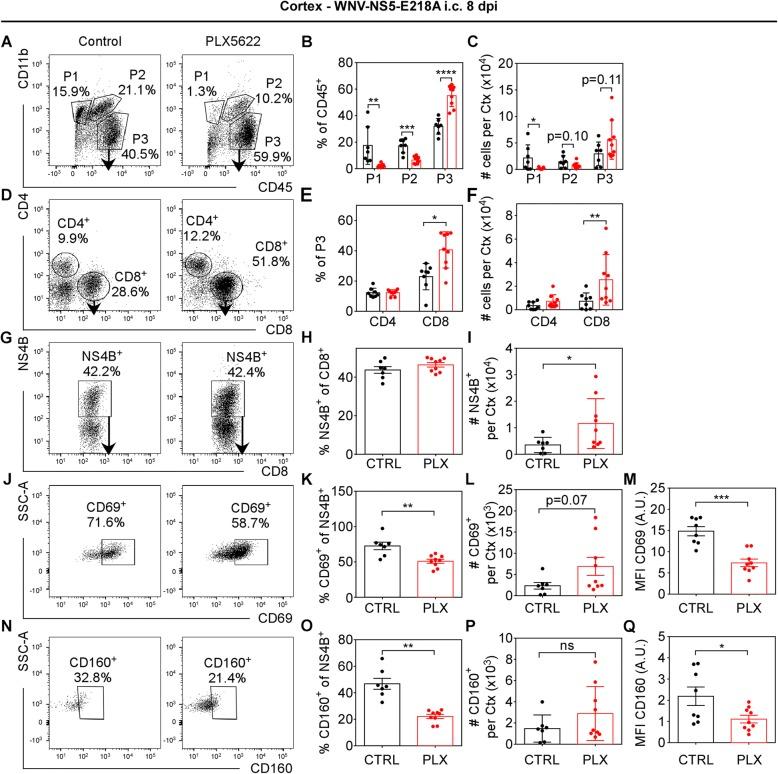
Mice treated with CSF1R antagonist prior to infection exhibited higher susceptibility to lethal WNV infection and lack of virologic control in both the CNS and periphery. CSFR1 antagonism reduced B7 co-stimulatory signals on peripheral and CNS antigen-presenting cells (APCs) by depleting CNS cellular sources, which limited local reactivation of CNS-infiltrating virus-specific T cells and reduced viral clearance.
CONCLUSIONS
Our results demonstrate the impact of CSF1R antagonism on APC activation in the CNS and periphery and the importance of microglia in orchestrating the CNS immune response following neurotropic viral infection. These data will be an important consideration when assessing the benefit of CSF1R antagonism, which has been investigated as a therapeutic for neurodegenerative conditions, in which neuroinflammation is a contributing factor.
背景
小胶质细胞是中枢神经系统(CNS)的常驻巨噬细胞,通过集落刺激因子 1 受体(CSF1R)信号维持局部状态。通过 CSF1R 失活耗竭小胶质细胞可改善神经炎症模型小鼠的认知功能,但通过未知机制限制了 CNS 中神经嗜性感染模型的病毒控制。我们假设 CSF1R 在髓样细胞反应中发挥关键作用,这些反应限制了病毒复制,并在 CNS 内重新刺激募集的抗病毒 T 细胞。
方法
在神经嗜性感染的小鼠模型中,体内评估 CSF1R 信号在西尼罗河病毒(WNV)感染中的作用。在感染强毒或减毒 WNV 之前,使用 PLX5622 实现 CSF1R 的药理学失活,WNV 是一种新兴的神经病原体。通过测量 CNS 和外周器官中的死亡率和病毒滴度来评估 CSF1R 拮抗作用对病毒控制的后续影响。通过流式细胞术分析外周和 CNS 免疫细胞的表型来评估免疫反应。
结果
感染前用 CSF1R 拮抗剂处理的小鼠对致死性 WNV 感染的易感性增加,并且在 CNS 和外周均无法控制病毒。CSF1R 拮抗作用通过耗竭 CNS 细胞来源,降低了外周和 CNS 抗原呈递细胞(APC)上的 B7 共刺激信号,从而限制了 CNS 浸润的病毒特异性 T 细胞的局部再激活,并减少了病毒清除。
结论
我们的结果表明,CSF1R 拮抗作用对 CNS 和外周 APC 激活的影响,以及小胶质细胞在神经嗜性病毒感染后协调 CNS 免疫反应的重要性。这些数据在评估 CSF1R 拮抗作用的益处时将是一个重要的考虑因素,CSF1R 拮抗作用已被研究作为神经退行性疾病的治疗方法,其中神经炎症是一个促成因素。


 Zotero 插件