Brooker Paige G, Gomersall Sjaan R, King Neil A, Leveritt Michael D
School of Human Movement and Nutrition Sciences, The University of Queensland, St. Lucia, Queensland, Australia.
School of Health & Rehabilitation Sciences, The University of Queensland, St. Lucia, Queensland, Australia.
Contemp Clin Trials Commun. 2019 Jan 11;14:100320. doi: 10.1016/j.conctc.2019.100320. eCollection 2019 Jun.
The time of day that people exercise could have an influence on the efficacy of exercise for weight loss, via differences in adherence and/or physiological adaptations. However, there is currently no evidence to support an optimal time of day for exercise to maximise efficacy.
To examine the feasibility and acceptability of prescribed morning and evening exercise.
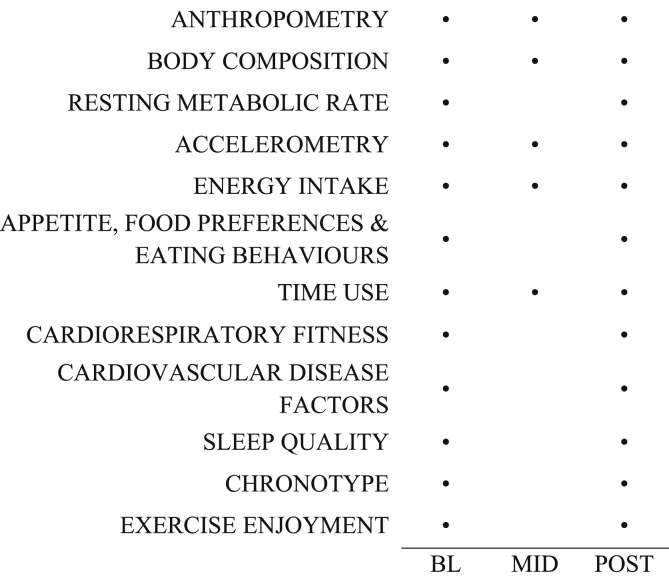
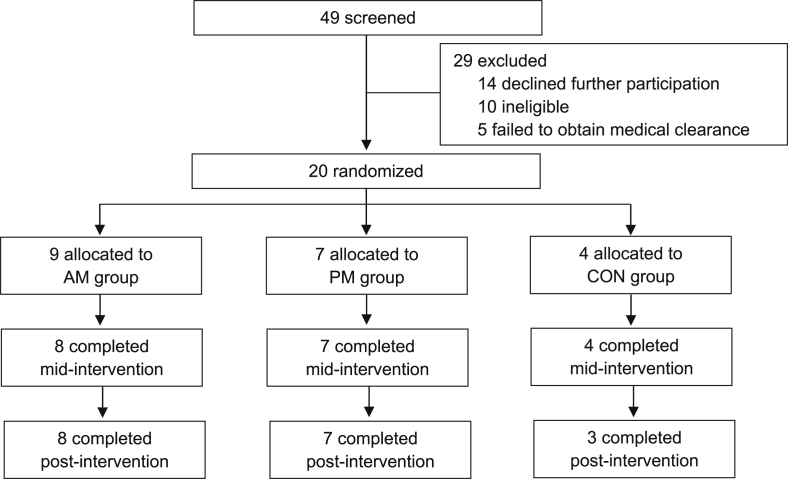
Twenty inactive, overweight adults aged 18-60 years were recruited for a 12-week intervention and randomized to one of three groups using a 2:2:1 random allocation ratio: i) morning exercise (AM; n = 9); ii) evening exercise (PM; n = 7); or iii) waitlist control (CON; n = 4). Exercise groups were prescribed self-paced walking or running on a treadmill to achieve a weekly total of 250 min. Feasibility and acceptability data were collected, and physiological and behavioural outcomes associated with energy balance were measured at baseline, mid- and post-intervention.
Attrition was low (n = 2 dropped out), with high measurement completion rates (>80%). The intervention groups had high adherence rates to exercise sessions (94% and 87% for the AM and PM groups, respectively). No adverse events resulting from the intervention were reported. Both intervention groups displayed improvements to their cardiometabolic risk profile; cardiorespiratory fitness improved by 5.2 ± 4.7, and 4.6 ± 4.5 mL kg.min and body fat percentage reduced by 1.2 ± 1.4, and -0.6 ± 1.2% for AM and PM groups, respectively.
This feasibility study provides evidence that morning and evening exercise interventions are feasible, and also provides justification for a large-scale randomized controlled trial.
This trial is registered with the Australian New Zealand Clinical Trials Registry (ACTRN12616000457448p, 7/4/2016).
人们锻炼的时间可能会通过依从性和/或生理适应性的差异,对锻炼减肥的效果产生影响。然而,目前尚无证据支持一天中进行锻炼以实现最大效果的最佳时间。
研究规定的早晨和晚上锻炼的可行性和可接受性。
招募了20名年龄在18 - 60岁之间、不运动的超重成年人,进行为期12周的干预,并采用2:2:1的随机分配比例将他们随机分为三组:i)早晨锻炼组(AM;n = 9);ii)晚上锻炼组(PM;n = 7);或iii)候补对照组(CON;n = 4)。锻炼组被规定在跑步机上进行自定步速的步行或跑步,每周总计250分钟。收集了可行性和可接受性数据,并在基线、干预中期和后期测量了与能量平衡相关的生理和行为结果。
损耗率较低(n = 2人退出),测量完成率较高(>80%)。干预组对锻炼课程的依从率较高(AM组和PM组分别为94%和87%)。未报告因干预导致的不良事件。两个干预组的心脏代谢风险状况均有所改善;心肺适能分别提高了5.2±4.7和4.6±4.5 mL·kg·min,AM组和PM组的体脂百分比分别降低了1.2±1.4和 -0.6±1.2%。
这项可行性研究提供了证据,证明早晨和晚上的锻炼干预是可行的,也为大规模随机对照试验提供了依据。
本试验已在澳大利亚新西兰临床试验注册中心注册(ACTRN12616000457448p,2016年4月7日)。